Cyberdecks rise as stylish, substantive revolt against big tech surveillance
▼ Summary
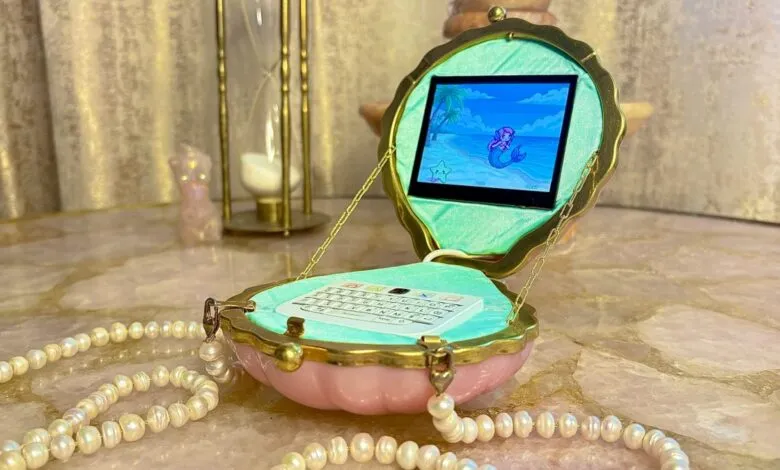
– CC, a self-taught builder, created a seashell cyberdeck that functions as a Tamagotchi, e-reader, and server-connected device, documenting her process on Bimbo Tech to help other women learn hardware building.
– The cyberdeck trend, originating from William Gibson’s “Neuromancer,” has grown on social media as women build artistic, hyper-feminine computers, rejecting tech’s standard black or silver designs.
– Builders like CC and Sarahbelle Kim see these cyberdecks as a way to take control from big tech, offering customizable, non-surveilled devices made from thrifted parts.
– Maro Vardanyan incorporates fiber art into cyberdecks, such as weaving Raspberry Pis into purses and corsets, highlighting the historical role of women textile workers in early computing.
– The movement faces criticism from men online, but builders view the impractical, pink designs as a radical rejection of Silicon Valley’s optimization culture, fostering community and education among women.
The self-described “open source baddie” known as CC responds to interview requests from what she calls a pink mermaid purse. “I’m just having so much fun,” she says of her seashell cyberdeck. “It’s a Tamagotchi. It’s also an e-reader. It’s networked to my vault and my servers, so it has access to all of my server data, which has all my PDFs, and books, and notes, and everything… It’s also connected to my local AI setup at home.”
Despite having no formal background in software engineering or computer science, CC has become adept at building unconventional DIY computers known as cyberdecks. She documents her process on her blog, Bimbo Tech, specifically to help other women follow along, even if they don’t yet understand what RAM is. The concept of the cyberdeck first appeared in William Gibson’s 1984 sci-fi novel “Neuromancer,” and gained traction in the 2010s when credit card-sized computers like the Raspberry Pi became available, allowing hardware enthusiasts to build and share their creations in niche online communities. However, in recent months, these communities have seen a surge in popularity, driven largely by women on social media who teach each other to build artistic, hyper-feminine computers.
“I have a running joke that there’s this underlying misogyny in tech , because whenever they release a pro model, or an elite model… I’m always like, let me guess, it’s black or silver,” CC said. “It’s never going to come in pink.” The act of customizing and designing a cyberdeck has evolved into an art form. On Instagram and TikTok, you can find a cyberdeck made of wood and moss that runs Game Boy Color games, a desert-inspired MP3 player inside a 3D-printed fossil, a Barbie dollhouse that opens to reveal a functional mini-computer, or a duck figurine used to record voice notes.
“I don’t want Meta AI glasses. I want to pirate books in a tiny embellished shell,” said creator Sarahbelle Kim on TikTok. “No one can surveil you there. You can get some basic parts at the thrift store or eBay and just customize it.” While there is an obvious aesthetic appeal to these girly cyberdecks, the women building them are driven by more than just glitter. This trend is peaking at a time when many feel powerless against the homogeneity of big tech and its surveillance practices.
“I think that’s such a refreshing thing for people who were sold these devices that are like Apple’s… If you try to jailbreak it, if you try to do anything to this phone that you paid $1,000 for, that you own, it’s out of warranty,” CC said. “So I just love seeing people taking the power back into their hands, taking the control back into their hands, which obviously always means creativity when people are given the means to go outside of the black box.”
Maro Vardanyan, a blockchain developer who doesn’t typically work with hardware, has always enjoyed collecting and tinkering with old computer parts. “A few months ago, I just started as a hobby making art and jewelry pieces and purses with recycled or upcycled old computers I had,” she said. “When I saw everyone doing cyberdecks, I was like, wait, why am I just doing recycled and upcycled ones when I can actually preserve the pieces on something that’s wearable, that’s movable?”
Vardanyan takes a distinct approach by emphasizing the historic relationship between fiber art and technology. She calls her work “crocheting with computers” or “macrame motherboards,” nodding to the role of weaving in early computing. Before silicon processors, some early computers ran on magnetic-core memory, made of copper wiring threaded to encode binary code. For NASA’s Apollo Guidance Computer, expert women textile workers meticulously wove wires in complex patterns to power the spacecraft that landed on the moon.
“The original processor was handwoven by seamstresses, not by engineers or anybody else,” she said. “I feel like the hand weaving, and even the fashion-meets-technology… It’s so full circle.” Vardanyan began weaving pink Raspberry Pis into purses and corsets, posting photos of her work-in-progress on X. “Of course, when the macrame went viral, all of the men are like, ‘This is such a waste of the Raspberry Pi,’ … or, ‘what about the rain?’” she said. “And then I have to be like, ‘Actually, it’s preserved in an acrylic shell.’ And then they’re like, ‘This is so performative, and the GPIO is gonna lose energy!’ And I’m like, ‘Actually, I’m using a conductive thread, so it actually will move and be fully functioning.’”
CC has also faced condescending comments online, including from a man on Reddit who dismissed her work during a RAM shortage. “This guy on Reddit was like, ‘You built your first computer a month ago, calm the f, down.’ Mind you, I’ve been building PCs for years,” CC said. “So, long story short, he ends up apologizing and buying me the circuit board for my next cyberdeck.”
From CC’s mermaid purse computer to Vardanyan’s Raspberry Pi corset, these cyberdecks are a direct rejection of Silicon Valley culture. They are intentionally impractical and inefficient, standing in stark contrast to a culture obsessed with optimization. Opting for hacky, DIY tech experiences is a radical act, allowing users to forge a closer relationship with devices that often feel abstract despite their ubiquity.
“Ten years ago, I would walk into a conference, there would be three girls, and people would literally just be like, ‘Were you hired for the marketing team?’” Vardanyan said. “I can’t even tell you how amazing it is seeing so many girls all over my social media and Instagram being into hardware, being into software, and then educating [each other], and that’s definitely the energy that we’re missing on every level in society.”
(Source: TechCrunch)