Samsung, LG Uplus to trial 6G sensing as radar alternative
▼ Summary
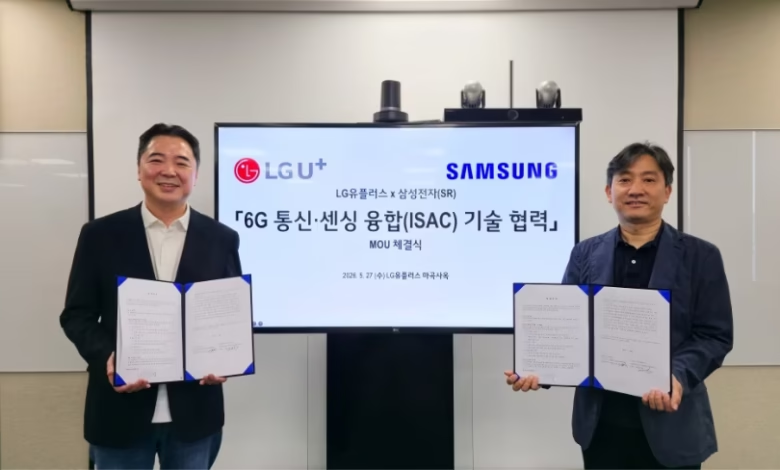
– Samsung Electronics and LG Uplus signed an MOU on 27 May to jointly develop ISAC, a technology enabling mobile base stations to act as environmental sensors by analyzing wireless signal reflections.
– ISAC extracts object speed, distance, and direction from existing communication signals, eliminating the need for dedicated sensing hardware like LiDAR or radar.
– The International Telecommunication Union has designated ISAC as one of six usage scenarios for IMT-2030 (6G), integrating physical world sensing into network design from the outset.
– The collaboration will test ISAC on LG Uplus’s 5G networks and later in the 7 GHz band, combining wireless data with camera imagery using multimodal AI models developed by Samsung Research.
– Commercial 6G deployment is expected in the early 2030s, with ISAC needing to overcome technical and regulatory hurdles, while South Korea prioritizes securing early 6G spectrum in the 7.125 to 8.4 GHz range.
Samsung Electronics and LG Uplus have signed a memorandum of understanding to jointly develop Integrated Sensing and Communication (ISAC), a technology that enables mobile base stations to function as environmental sensors. The agreement was formalized on May 27 at LG Science Park in Magok, Seoul, with Samsung Research leading the development effort under Samsung’s Device eXperience division.
ISAC works by analyzing wireless signals as they bounce off nearby objects, extracting data on speed, distance, and movement direction. In practice, this means a cell tower could detect a drone, track a vehicle, or monitor foot traffic without needing dedicated sensing hardware. The technology repurposes existing communication signals, transforming cellular infrastructure into a dual-purpose sensing platform.
Environmental sensing currently relies on separate equipment. LiDAR systems use lasers to measure distance, while radar depends on radio waves,both requiring independent installation, power, and maintenance. ISAC eliminates this by leveraging the wireless networks operators have already deployed.
The International Telecommunication Union’s Radiocommunication Sector (ITU-R) has designated ISAC as one of six key usage scenarios for IMT-2030, the formal name for 6G. This classification places ISAC alongside immersive communication, hyper-reliable low-latency communication, massive communication, ubiquitous connectivity, and AI-integrated communication. The inclusion signals that 6G networks are being architected from the ground up to sense the physical world, not just transmit data.
The collaboration will initially focus on human detection for safety applications and improving network operational efficiency. The two companies plan to validate ISAC performance on LG Uplus’s existing 5G networks before moving to the 7 GHz band, a candidate frequency for 6G that balances wide coverage with high bandwidth.
Over time, the partnership will combine ISAC-generated data,including location, speed, and density information,with camera imagery to boost detection accuracy. This involves developing multimodal AI models that integrate diverse sensing inputs. Samsung Research will handle core ISAC and AI technology development, while LG Uplus will provide data and field-testing infrastructure from its commercial network.
The 7 GHz band is increasingly viewed as the “golden band” for 6G, offering sufficient bandwidth for high-speed data while maintaining practical coverage distances. South Korea is actively exploring the 7.125 to 8.4 GHz range as a primary 6G candidate. The World Radiocommunication Conference in 2023 identified portions of the 6.425 to 7.125 GHz band for mobile use in several regions, and the 7.125 to 8.4 GHz range is on the agenda for WRC-27.
In the United States, the National Telecommunications and Information Administration (NTIA) must complete its study of the 7.125 to 7.4 GHz band by the end of 2026 before it can be opened for commercial wireless. Europe is pursuing the upper 6 GHz range. The allocation decisions at WRC-27 will largely determine which countries have the spectrum to deploy 6G at scale. For South Korea, with its economy tied to global tech supply chains, securing early 6G spectrum and standards influence is a strategic priority.
Samsung has been methodically building its 6G credentials. The company published a 6G white paper outlining its vision for AI-native and sustainable communications, demonstrated 6G technologies at the Silicon Valley Future Wireless Summit in November 2025, and showcased AI-RAN capabilities at Mobile World Congress in March 2026. The ISAC collaboration with LG Uplus moves these efforts from lab demonstrations to field validation on a live commercial network.
This partnership pairs Samsung’s research strengths with LG Uplus’s operational infrastructure,a critical combination because ISAC performance in controlled environments may differ significantly from real-world networks with interference, building reflections, and variable traffic loads. Samsung’s broader ambitions in AI and semiconductor manufacturing give it a vertically integrated stake in 6G infrastructure that few competitors can match.
Commercial 6G deployment is not expected until the early 2030s, and ISAC must clear both technical and regulatory hurdles before it can replace dedicated sensing equipment at scale. But the technology represents a genuine shift in what a wireless network can do. Samsung and LG Uplus are now testing whether the physics holds up outside the lab.
(Source: The Next Web)