BYD launches China’s first 4nm driving chip, expands God’s Eye
▼ Summary
– BYD unveiled the Xuanji A3, China’s first automotive-grade 4nm self-driving chip, delivering 700 TOPS per chip and enabling Level 3 and Level 4 autonomous driving.
– The God’s Eye driver-assistance system is expanding to mass-market models like the $10,300 Seagull, with city navigation and automated parking as a $1,770 add-on.
– BYD is offering insurance covering accidents during God’s Eye use, following user complaints about dangerous malfunctions like unintended acceleration and erratic lane changes.
– Sales have fallen for eight consecutive months, with a 55% profit decline in Q1 2026, as price wars and a stronger yuan squeeze margins despite rising exports.
– The technology push aims to shift competition from price to intelligence, as BYD integrates chip, software, and sensors while awaiting Level 3 legislation expected by 2027.
BYD has officially launched the Xuanji A3, what it describes as China’s first automotive-grade 4-nanometer chip designed for self-driving cars. CEO Wang Chuanfu made the announcement during an event at BYD’s Shenzhen headquarters on May 28, highlighting that the chip offers the lowest power consumption per unit of compute in its category, using roughly 20% less energy than comparable semiconductors. According to BYD, the chip has already entered mass production.
A single Xuanji A3 delivers 700 TOPS of computing power, while a cluster of three chips reaches 2,100 TOPS , enough to support Level 3 and Level 4 autonomous driving capabilities. The chip serves as the core of a new, laptop-sized central computing platform that consolidates three previously separate vehicle domains: the smart cockpit, the driver-assistance system, and the electric propulsion system.
This semiconductor approaches the capabilities of Huawei Technologies, which currently produces automotive chips at a 7nm geometry but has committed to introducing 1.4nm chips by 2031. The most advanced chip globally remains TSMC’s 2nm N2 node. BYD’s ability to design and mass-produce its own 4nm driving chip deepens a vertical integration strategy that already encompasses batteries, motors, and vehicle manufacturing.
God’s Eye goes mass market
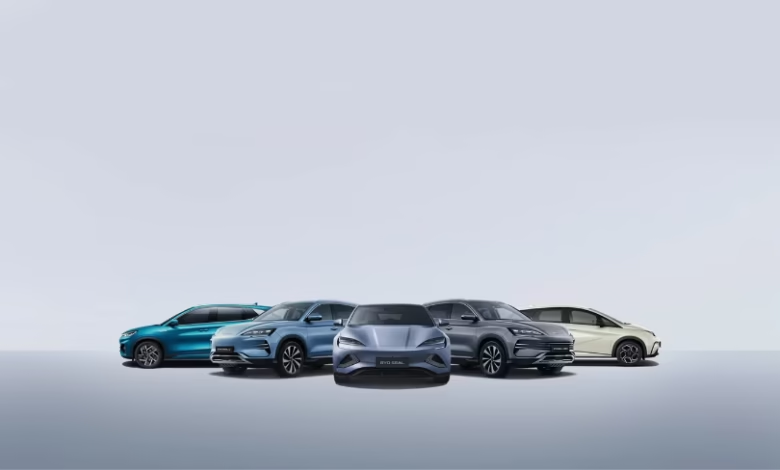
Alongside the chip, BYD announced it will expand its God’s Eye driver-assistance system across all models sold in China, including mass-market vehicles like the Seagull compact hatchback, which starts at 69,800 yuan ($10,300). The Seagull became the first car in its class to receive LiDAR when the 2026 model launched on May 11, a technology previously limited to premium vehicles.
The upgraded God’s Eye system includes city and highway navigation, traffic light recognition, and automated parking, and will be available as an add-on for 12,000 yuan ($1,770). Wang described the pricing as cost-only. BYD is also offering one year of insurance that fully covers damages from accidents that occur while the latest version of God’s Eye is engaged, a direct bet that the system is reliable enough to underwrite.
A system with a troubled track record
The insurance pledge comes after months of complaints about God’s Eye’s performance. BYD made the system a standard feature on most of its vehicles last year, but the initial rollout used a tiered structure that limited advanced urban navigation to more expensive models while giving affordable cars only basic highway cruise control. Users reported dangerous malfunctions including unintended acceleration, erratic lane changes, and steering inputs that nearly sent vehicles into oncoming traffic.
Unlike Tesla’s optional Full Self-Driving package, BYD deployed God’s Eye across millions of vehicles, meaning every flaw appeared at scale. The company says it has more than 3.15 million vehicles equipped with advanced driver-assistance hardware on the road, generating roughly 200 million kilometres of driving data every day. BYD is using that data to train its algorithms through cloud-based world models and reinforcement learning, with iteration cycles running every three days.
Eight months of falling sales
The technology push arrives at a difficult moment for BYD’s business. Sales have declined year on year for eight consecutive months, with April 2026 volumes down roughly 16% compared with the same period a year earlier. First-quarter net profit fell 55% to 4.09 billion yuan ($599 million) as a fierce price war in China and a stronger yuan compressed margins.
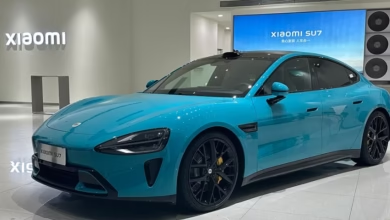
Revenue dropped 12% to 150.2 billion yuan in the quarter. Operating expenses rose as BYD invested in smart driving hardware while simultaneously cutting vehicle prices to compete with rivals including Xiaomi, which has entered the EV market with high-performance models, and Huawei-backed brands that have intensified their presence. The only bright spot has been exports, which rose more than 70% year on year to a record 135,098 units in April.
The competitive context
Tesla finally launched its Full Self-Driving system in China after years of delays, but the technology still requires active human intervention and will be marketed under a different name due to scrutiny from Chinese transportation authorities. Tesla relies on a vision-only approach using cameras and neural networks without LiDAR or radar, a fundamentally different and cheaper strategy that BYD and other Chinese automakers have criticised as less capable.
China’s Ministry of Industry and Information Technology issued its first Level 3 autonomous driving certifications in December 2025, approving cars from Changan Auto and BAIC Motor. BYD is waiting for China to formalise legislation allowing broader consumer-facing deployment of self-driving vehicles, which the company expects as soon as 2027. Chinese EV makers are also expanding aggressively overseas, with BYD targeting 1.3 to 1.6 million international deliveries in 2026.
The Xuanji A3 chip and the God’s Eye expansion represent BYD’s attempt to shift the competitive battleground from price to technology. A company that made its name on affordable electric vehicles is now trying to prove it can build the silicon, software, and sensor systems needed to compete on intelligence. Whether the strategy works depends on whether the technology can outrun the complaints, and whether drivers in a market saturated with discounted EVs are willing to pay 12,000 yuan for a feature that Huawei-backed rivals and a fragmenting global EV market are also racing to deliver.
(Source: The Next Web)