First Look at Android XR Glasses Launching This Year
▼ Summary
– Google’s Project Aura glasses, made with Xreal, now have a carrying case and a more powerful compute puck with a fingerprint scanner and lanyard.
– The glasses offer spatial computing experiences like 3D AR doodles and molecular structure identification, and can mirror a laptop display via USB-C cable.
– Adaptive transparency allows the lenses to automatically become clear when looking at a person, even if set to a darker opacity for immersive work.
– Google and Samsung’s “intelligent eyewear” features faster Gemini responses, capable of removing objects from photos and adding events to Calendar from images.
– Upcoming Android XR glasses include audio-only models from Warby Parker and Gentle Monster, with binocular displays offering 3D widgets for info like stocks and Fitbit data.
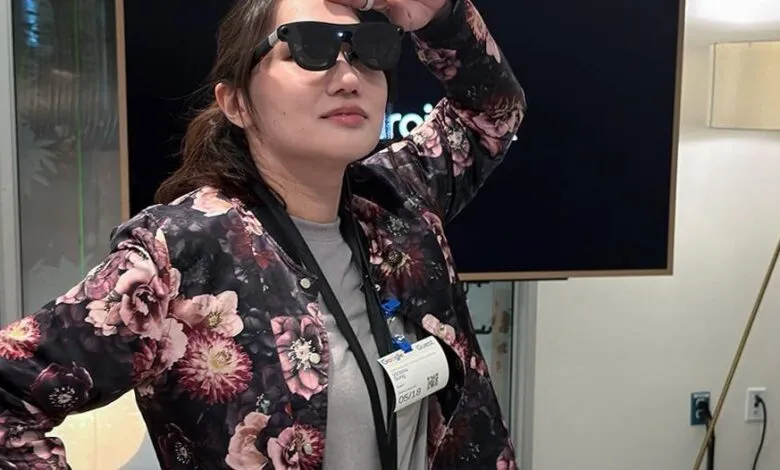
I first slipped on a pair of prototype Android XR glasses nearly 18 months ago, and while consumer-ready models are still months away, Google is finally pulling back the curtain on its progress. The centerpiece is Project Aura, a sleek pair of dark sunglasses that occupies a middle ground between bulky headsets and lightweight mixed-reality eyewear.
Since my last hands-on experience with Project Aura in October, the hardware has evolved significantly. These glasses, developed in partnership with Xreal, now come with a carrying case and a redesigned compute puck. Google declined to specify the chip inside, only noting it’s more powerful than the previous version. The puck also includes a fingerprint scanner for easier unlocking, and beyond the waist clip, there’s now a lanyard for wearing it around your neck. (Channel your inner Gadget Dad if that appeals to you.)
Let’s be clear: these glasses won’t make you look cool. But Project Aura isn’t targeting the mainstream consumer the way Meta’s Ray-Ban glasses do. Instead, it’s built for XR enthusiasts who crave a more portable, discreet alternative to a full headset. Navigating Aura’s interface feels nearly identical to the Galaxy XR, which makes sense given the shared DNA.
During my earlier demo, I explored mixed-reality tabletop games, juggled multiple app windows, and wirelessly mirrored a laptop display. This time, Google showcased vibe-coded spatial computing experiences. One let me create 3D AR doodles. Another pulled up the molecular structure of any object I “pinched.” Neither was groundbreaking, but the real takeaway is that you no longer need a bulky headset to test these spatial apps. Mirroring a display was as simple as plugging the glasses into a laptop via USB-C. My eyes widened at the thought: instead of buying a second monitor, you can carry one in your pocket. No spotty Wi-Fi required. I’ll never be the person hauling a headset onto a plane, but this? This I would actually use.
A more gimmicky yet impressive feature is adaptive transparency mode. With a button press, you can adjust the opacity of Project Aura’s lenses from light to dark. The clever part: the glasses detect whether you’re looking at content or interacting with people. Crank up the opacity for an immersive workspace, and if your spouse asks a question, the lenses automatically clear when you look at them. Look back at your digital screen, and opacity returns.
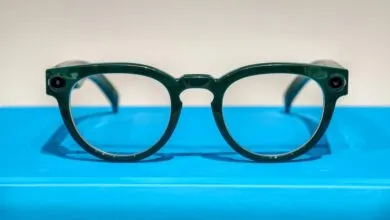
Project Aura is intriguing, but it wasn’t what I expected to demo this week. Last year, Google announced partnerships with Gentle Monster and Warby Parker to design stylish smart glasses aimed at challenging the Ray-Ban Meta. Today, Google and Samsung revealed the first designs, arriving this fall. There’s a Y2K-inspired oval pair from Gentle Monster and a “not legally Ray-Ban” style from Warby Parker.
Neither pair was available for me to see or try. Instead, Google had me test upcoming features on generic prototypes. Price and specs? Mostly unanswered. The only detail I got: these glasses will be lighter than the roughly 49-gram prototypes I tested. Samsung’s role is also being emphasized more heavily this year. These aren’t “Google smart glasses” or “Warby Parker smart glasses.” They’re Google/Samsung/Warby Parker-or-Gentle Monster smart glasses. Good luck keeping it straight.
Instead of calling them AI glasses, Google and Samsung have settled on “intelligent eyewear.” My demos included audio-only and display capabilities for future models, building on what Google has shown before. Gemini is noticeably faster and handles more complex queries. Instead of asking Nano Banana Pro to add a KPop Demon Hunters vibe to a photo, I can now ask it to mix Stranger Things and KPop Demon Hunters.
More practically, I can ask Gemini to snap a photo and remove unwanted people or background elements. For example, I requested it to remove every green plant from a room filled with them. The results were surprisingly good, though they left me pondering the classic question: What is a photo? Gemini’s smart glasses features now integrate with Google Calendar and Keep. Snap a photo of a recipe, and the ingredients get sent to a Keep list. Want to see a Mitski concert? Ask Gemini to add it to your Calendar.
Most of these Gemini features work with or without a display, so they’ll be available on the audio-only Warby Parker and Gentle Monster glasses. But I also got a look at a display-only feature for future Android XR glasses: widgets.
In single-lens displays, the widgets are simple. In binocular smart glasses with displays in both lenses, they’re multicolor and fully 3D. Swiping on the arm of a prototype let me scroll through stocks, sports scores, Fitbit step count, weather, and a translation app shortcut. The binocular displays also showed a 3D model of a cell that rotated as I moved my head. Google envisions this for educational or enterprise use cases.
Everything I saw was impressive. But as I’ve learned from real-world smart glasses testing, demos aren’t reality. In a quiet room, a translation demo from Spanish and French into English worked well. Gemini can filter out English-language cross talk, I’m told.
When I asked about real-life scenarios , like a chaotic Italian train station , the answer was less reassuring. The glasses’ mics mostly pick up sound from a 30-degree angle directly in front of you, so they can struggle. Gemini also doesn’t realize that the Mitski concert it added to my demo Calendar is in London while I live in New Jersey. In a demo, there’s no need to worry about privacy LED lights or being a “glasshole.” At Google’s headquarters, it makes sense that Gemini sends lists to Keep. In the real world, I’d prefer the ability to choose my own app.
At this I/O, I’m encouraged to see more practical use cases for smart glasses in daily life. I’m still not fully convinced that AI is the killer app for wearable tech. But that doesn’t matter much, because walking away from Google’s Mountain View campus, it’s clear that Big Tech is determined to make smart glasses happen. Heading back to my hotel, I’m struck by the fact that three separate pairs of Android XR glasses are slated for this fall. And based on everything I’ve seen, Google , despite its rocky history in this space , is shaping up to be Meta and EssilorLuxottica’s most formidable competitor.
(Source: The Verge)