Nvidia Nemotron 3 Nano Omni: 30B params, 3B active, for edge AI
▼ Summary
– Nvidia released Nemotron 3 Nano Omni, an open-weight multimodal model with 30 billion parameters but only 3 billion active per inference via a mixture-of-experts design, enabling it to run on a single GPU.
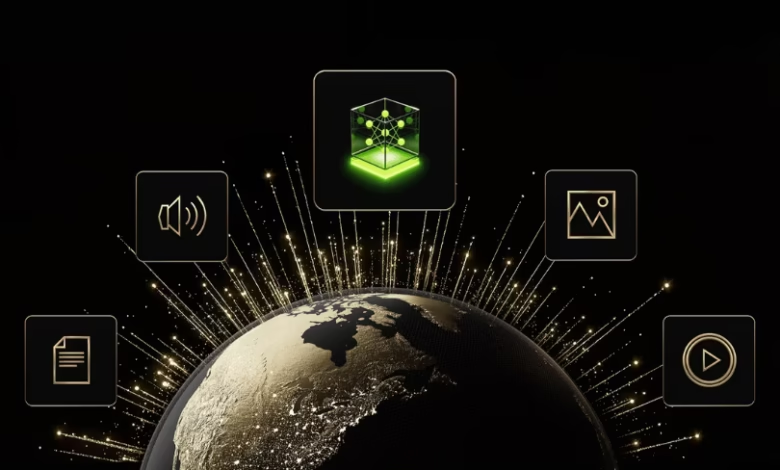
– The model processes text, images, audio, and video as inputs and outputs text, unifying vision, speech, and language tasks into one architecture to replace separate specialist models.
– It claims 9x higher throughput than comparable open multimodal models and tops six benchmarks in document intelligence, video understanding, and audio comprehension.
– Nemotron 3 Nano Omni is available under Nvidia’s Open Model Agreement for commercial use, targeting edge AI agent deployment on single GPUs in industrial settings like factory inspection and voice agents.
– The release positions Nvidia as a competitor in AI models, not just infrastructure, by creating a full-stack ecosystem optimized for its hardware, with early adoption by companies like Foxconn and Palantir.
Nvidia has officially launched Nemotron 3 Nano Omni, an open-weight multimodal AI model that consolidates vision, audio, and language processing into a single architecture. With 30 billion total parameters but only 3 billion activated per inference thanks to a mixture-of-experts design, the model is engineered for edge AI deployment on a single GPU. Nvidia claims it delivers 9x higher throughput than comparable open multimodal models and tops six industry benchmarks across document intelligence, video understanding, and audio comprehension. Available under Nvidia’s Open Model Agreement for commercial use, the release signals a strategic shift: Nvidia is no longer just the infrastructure provider for AI, but now a direct competitor in the models that run on that infrastructure.
The model processes text, images, audio, video, documents, charts, and graphical interfaces as inputs and generates text as output. This unified approach eliminates the need for separate specialist models for vision, speech, and language, which most enterprise AI stacks currently rely on. By routing each token to just six of 128 experts within a single model, Nemotron 3 Nano Omni avoids the latency that plagues pipeline architectures. Vision, audio, and text tokens all flow through the same system but activate different expertise based on modality. The result is real-time multimodal reasoning on a single GPU, a capability previously reserved for massive cloud-based clusters.
Architecturally, the model uses a hybrid Mamba-Transformer framework with 23 Mamba-2 selective state-space layers, 23 mixture-of-experts layers, and six grouped-query attention layers. The vision encoder, C-RADIOv4-H, handles variable-resolution images with up to 13,312 visual patches per image. The audio encoder, Parakeet-TDT-0.6B-v2, processes speech and environmental audio. Video processing employs 3D convolutions to capture motion between frames, rather than treating video as a sequence of still images. The base text model was pre-trained on 25 trillion tokens and supports a 256,000-token context window. The design philosophy is clear: maximize capability per active parameter, because edge deployment is constrained by compute per inference step, not total model size.
Nvidia’s strategy is circular but powerful. The company has dominated the AI boom by selling GPUs, networking, and the CUDA ecosystem. Now, with the Nemotron family downloaded over 50 million times in the past year, Nvidia is also offering the models optimized for its hardware. This creates a full-stack ecosystem that competes directly with the model-plus-cloud offerings from Google, Amazon, and Microsoft. For enterprises, the appeal is local control: rather than calling a massive cloud model for every vision or audio task, they can run a compact model locally that handles the entire perceptual stack. Early adopters include Foxconn, Palantir, Aible, and Eka Care, with Dell, DocuSign, Infosys, Oracle, and Zefr evaluating the model for production. Use cases span factory-floor visual inspection, document processing, voice agent applications, and screen understanding for computer-use agents.
The competitive landscape is crowded. DeepSeek’s V4-Pro and V4-Flash, released last week, target long-horizon agentic tasks. Meta’s Llama models dominate open-weight text, while Google’s Gemini and OpenAI’s GPT models lead in cloud-scale multimodal processing. What sets Nemotron 3 Nano Omni apart is the combination of multimodal perception across vision, audio, and text in a single model, mixture-of-experts efficiency enabling edge deployment, and open-weight commercial licensing. No other model currently offers all four properties together. Google’s Gemini Nano is not open-weight, and Meta’s Llama lacks unified audio processing.
The broader implication is strategic. If Nvidia’s open models become the default for edge AI agent deployment, the company captures value at every layer: the GPU running inference, the software framework optimizing it, and the model itself. Competitors who build on Nvidia’s models deepen their dependency on Nvidia’s hardware. Those who build their own models still need Nvidia’s GPUs to train them. Nemotron 3 Nano Omni is not Nvidia’s answer to GPT-4o. It is Nvidia’s argument that the future of AI agents will be built on small, efficient, open models running on Nvidia hardware at the edge, rather than large, proprietary models running on someone else’s cloud. Whether that argument holds depends on whether enterprises prefer local control over cloud convenience, and whether a model with three billion active parameters can do the work that currently requires hundreds of billions. The benchmarks say it can. The market will decide.
(Source: The Next Web)