20th Anniversary iPhone Gets Unique Micro-Curved OLED Screen
▼ Summary
– Apple is reportedly using Samsung to produce a custom micro-curved OLED display for its 20th-anniversary iPhone, which is brighter and thinner than existing panels.
– The redesign may feature a completely bezel-less display with shallow “micro-curves” on all four edges, avoiding the aggressively curved “waterfall” design of some Samsung panels.
– Apple aims for a “pol-less” display using Samsung’s COE (Color Filter on Encapsulation) technology, which removes the polarizer layer to improve brightness and reduce thickness and power draw.
– The display is expected to include a crater-shaped light diffusion layer to ensure uniform brightness across the screen.
– For the 2027 iPhone, Apple reportedly wants a high-end all-glass model with no display cutouts, but under-display Face ID and camera technologies are still being tested and may not be ready.
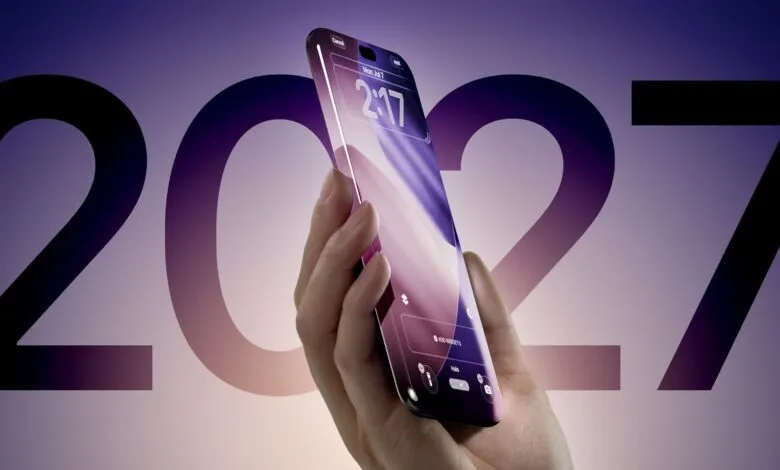
For its 20th-anniversary iPhone, Apple has reportedly turned to Samsung to manufacture a custom micro-curved OLED display that promises to be both brighter and thinner than current panels. This development comes from fresh supply chain reports originating in China.
Apple is believed to be exploring a dramatic redesign for this milestone device, one that could feature a completely bezel-less display curving smoothly around all four edges of the phone. To achieve this, the company is said to be requesting an equal-depth quad-curved panel from Samsung, employing “micro-curves” that keep the curvature very subtle. This approach contrasts sharply with the aggressively curved “waterfall” edges seen on some existing Samsung panels.
The preference for gently rounded edges may ensure the device feels softer in the hand and that swipes from the edge of the display feel more natural. It could also help prevent distortion of on-screen content around the edges.
The latest supply chain details come from Weibo-based leaker Digital Chat Station, who also indicates that Apple wants a “pol-less” display from Samsung. This means a panel design that removes the polarizer layer typically found on top of most current OLED screens.
That claim aligns with a September 2025 report out of Korea, which stated that Apple will adopt a Samsung-made OLED technology called COE (Color Filter on Encapsulation) to make the 20th-anniversary iPhone’s display brighter and thinner. COE displays remove the polarizing film from an OLED panel, applying the color filter directly onto the encapsulation layer.
This technique reduces the overall thickness of the display stack and allows more light through, improving brightness while lowering power consumption. Reflections become more challenging without a polarizing film, but Apple has already added a new anti-reflective coating to its latest iPhones, which is expected to be further improved for future models.
Apple is also reportedly incorporating a crater-shaped light diffusion layer into the display to even out brightness, ensuring the screen looks uniformly lit across all areas.
The year 2027 will mark the 20th anniversary of the iPhone, and Apple is said to be aiming for a high-end, all-glass model without any cutouts in the display. Display analyst Ross Young has stated that Apple will not have under-display Face ID ready for a 2027 iPhone, though other leakers believe it is possible. If Apple cannot integrate everything under the display, we may see under-display Face ID alongside a small hole-punch cutout for the front-facing camera.
The most recent rumors suggest that Apple is still testing an under-display iPhone camera for 2027, so this remains a viable possibility.
(Source: MacRumors)