Anker develops custom chip to embed AI across product lineup
▼ Summary
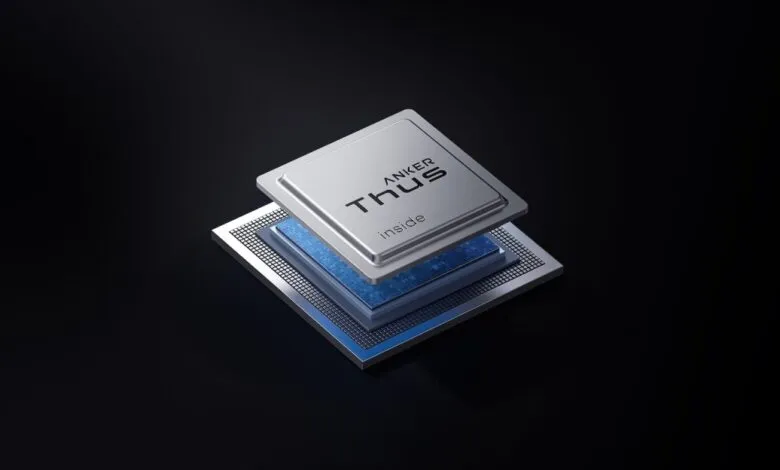
– Anker announced the Thus processor, the world’s first neural-net compute-in-memory AI audio chip, which is smaller and more power-efficient than traditional chips.
– The Thus chip integrates computation where the model is stored, eliminating the need to move data between memory and processor for each inference.
– The first Thus chip will be used in Soundcore’s flagship earbuds, enabling a neural network capable of handling several million parameters for tasks like complex noise cancellation.
– Anker claims the chip, combined with eight MEMS microphones and two bone conduction sensors, will deliver significantly cleaner call audio in noisy environments.
– The first earbuds likely to include the Thus chip are the Liberty 5 Pro Max and Liberty 5 Pro, with full details expected at Anker Day on May 21.
Anker has officially unveiled its own custom silicon, a move designed to embed local AI directly into its audio devices, mobile accessories, and IoT products. The new processor, named Thus, is being hailed as the world’s first neural-net compute-in-memory AI audio chip. It is smaller than conventional chips and consumes significantly less power while handling complex computations, making it an ideal fit for compact gadgets.
Explaining the breakthrough, Anker CEO Steven Yang compared Thus to existing technology. “Every AI chip built until now stores the model on one side and does the computation on the other. To think, the device has to carry all those parameters across, many times per second, every single inference. Thus puts the computation where the model already lives. The model never has to move again.”
The inaugural Thus chip will debut inside Soundcore’s upcoming flagship earbuds. According to the company, earbuds were chosen as the starting point because they represent the toughest challenge for integrating AI chips, given their severe size constraints. The limited space restricts available power, and because the chip remains active whenever the earbuds are worn, earlier designs had to rely on small neural networks capable of managing only a few hundred thousand parameters. Anker claims that with its more energy-efficient compute-in-memory architecture, the Thus chip can handle several million parameters. This dramatically boosts computing power for tasks like processing complex environmental noise.
Traditional call noise cancellation relies on those smaller onboard neural networks, which often struggle to isolate a user’s voice in extremely noisy settings. The result is either ambient noise bleeding through or voices becoming heavily compressed and hard to hear. Anker says the larger neural network on the Thus chip, combined with eight MEMS microphones and two bone conduction sensors to lock onto the user’s voice, will deliver significantly cleaner call audio in its upcoming earbuds, regardless of the surrounding environment.
The concept is promising, but real-world performance against rivals like the Apple AirPods Pro 3 and Sony WF-1000XM6 remains to be seen. Based on a leak from March, the first earbuds to feature the Thus chip are likely the Liberty 5 Pro Max and Liberty 5 Pro, expected to retail for $229.99 and $169.99, respectively. Anker plans to release full product details and additional AI-powered features at Anker Day on May 21.
(Source: The Verge)