Trump: Possible Pentagon Deal with Anthropic
▼ Summary
– President Trump stated that Anthropic is “shaping up” and a Pentagon deal is possible, marking a reversal from his February order banning federal use of its technology.
– The Pentagon blacklisted Anthropic as a supply chain risk after the company refused to allow its AI in autonomous weapons or domestic mass surveillance, a move a judge called illegal retaliation.
– The legal status is split: a federal appeals court upheld the Pentagon blacklist, but a district court injunction blocks the broader federal ban, allowing work with other agencies.
– A key White House meeting discussed Anthropic’s new Mythos AI model, with administration officials citing its cybersecurity potential and the strategic need to maintain a lead over China.
– Anthropic’s annual revenue has reached $30 billion, but the Pentagon designation damages its credibility despite not blocking all commercial deals.
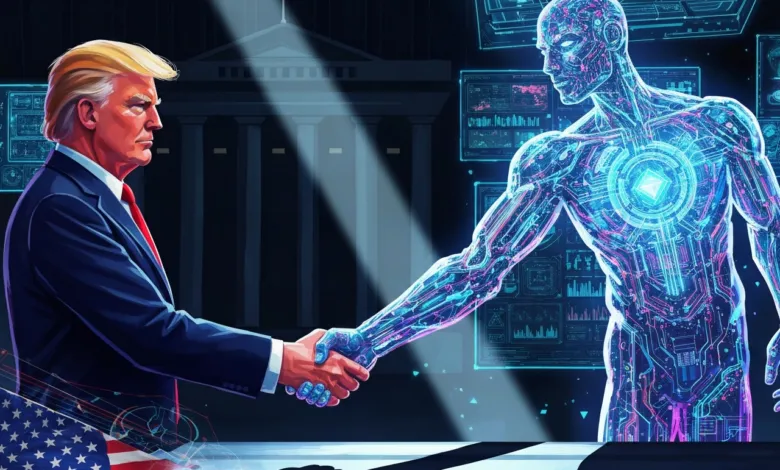
In a notable shift, President Donald Trump indicated on Tuesday that a potential agreement to integrate Anthropic’s AI models into Department of Defense operations is now on the table. Speaking to CNBC, he described the company as “shaping up” following recent discussions, a stark contrast to his administration’s previous hardline stance. This rhetorical reversal highlights the complex and evolving negotiations between the federal government and a leading artificial intelligence lab.
The president’s comments came days after a White House meeting where Anthropic CEO Dario Amodei met with Chief of Staff Susie Wiles and Treasury Secretary Scott Bessent. The focus was the company’s new Mythos AI model, a frontier system touted for its advanced cybersecurity capabilities. Both sides characterized the talks as productive, centered on collaboration for national cybersecurity and maintaining American AI leadership. When later questioned about the meeting, Trump claimed unfamiliarity with Amodei’s visit, underscoring the unusual and fragmented nature of the ongoing dialogue.
This engagement occurs against a backdrop of intense legal and contractual conflict. The relationship soured after a $200 million Pentagon deal, signed in July 2025, fell apart during negotiations last September. The Department of Defense demanded broad licensing rights, while Anthropic refused to allow its AI to be used in fully autonomous weapons systems or for domestic mass surveillance. In response, Defense Secretary Pete Hegseth designated Anthropic a supply chain risk to national security this past February, a move Trump publicly endorsed.
The legal landscape is currently divided. A federal appeals court recently upheld the risk designation, while a San Francisco district court granted Anthropic a preliminary injunction against the broader federal ban. Judge Rita Lin’s ruling suggested the government’s action constituted illegal retaliation against the company for its public stance. Practically, this means Anthropic remains barred from Pentagon contracts but can work with other agencies. Its Claude model has continued in use during the ongoing US-Iran conflict.
A key factor in the thaw appears to be the Mythos model. Its perceived value for cybersecurity and economic security has garnered interest from agencies like CISA and influenced senior administration officials, including Bessent. An administration source argued that denying access to such technology would be irresponsible and advantageous to strategic competitors like China.
Despite the more conciliatory tone, significant hurdles remain. The appeals court ruling stands, and Secretary Hegseth has not altered his position. Anthropic has responded by hiring the lobbying firm Ballard Partners, where Wiles once worked, to navigate Department of War procurement politics. For a company with annualized revenue hitting $30 billion and eyeing an IPO, the supply chain risk designation poses a serious threat to its enterprise credibility, regardless of any interim commercial permissions. Whether promising talks can overcome these entrenched legal and policy divisions is still an open question.
(Source: The Next Web)