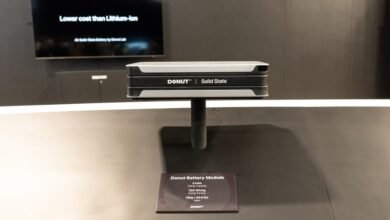
Damaged Donut Lab Solid-State Battery Loses Charge Capacity

▼ Summary
– Donut Lab tested its solid-state battery under damage conditions, and while its charge capacity was severely reduced, it did not catch fire.
– The test followed a previous incident where the battery’s pouch lost its vacuum seal during extreme heat testing, a condition that can cause fires in conventional lithium-ion batteries.
– After high-stress cycling tests, the damaged battery showed a 55% loss in energy capacity and became swollen, but operated without dangerous temperature spikes.
– The company has not yet demonstrated its battery’s long-term performance through standard accelerated aging cycle tests, despite claiming a 100,000-cycle lifespan.
– Donut Lab has also not independently verified its claimed energy density of 400 watt-hours per kilogram, a key metric for battery performance.
A startup aiming to validate its solid-state battery technology through rigorous public testing has released new results. Donut Lab recently subjected a damaged cell to a series of charge cycles to evaluate its safety and performance. While the battery’s capacity fell sharply, it did not catch fire or experience thermal runaway, an outcome the company highlights as a critical safety win.
This latest examination follows a previous high-temperature test where the battery’s pouch lost its vacuum seal, a form of damage known to cause dangerous failures in traditional lithium-ion cells. Researchers at Finland’s VTT Technical Research Centre, conducting the independent analysis, performed three procedures: a baseline five-cycle test, a high-stress 50-cycle test, and a final five-cycle baseline to measure degradation.
The data showed significant capacity degradation. The cell’s energy capacity dropped from 24.7 amp-hours to 11.2 Ah, a loss of about 55 percent. Efficiency also declined from 89.6 percent to 83 percent, and the pack swelled, increasing in thickness by 17 percent. Donut Lab attributes this decline directly to the compromised seal, which exposed the cell to air and accelerated its deterioration. The core finding, however, was the absence of fire or extreme heat.
“No temperature spikes, no fire risk,” the company stated. “In this scenario the Donut Battery fails gracefully when damaged, continuing to operate safely at reduced capacity rather than posing danger to the user.”
These tests, however, also underscore unanswered questions about the technology’s long-term durability. The recent cycling was performed on an already-damaged cell. Donut Lab has not yet publicly demonstrated an accelerated aging procedure on a pristine battery to validate its extraordinary claim of a 100,000-cycle lifespan, which equates to roughly 270 years of use. This claimed cycle life vastly exceeds the 1,000 to 2,000 full cycles typical of current electric vehicle batteries.
Furthermore, the startup has not sought independent verification for its stated energy density of 400 watt-hours per kilogram. This is a fundamental metric for evaluating a battery’s potential for electric vehicles, and confirming it through a simple weight-and-output measurement remains a notable omission from its public testing regimen. As Donut Lab continues its campaign of transparency, validation of these core performance claims will be essential for assessing its technology’s real-world potential.
(Source: The Verge)