Einstein’s Theory Gets Its Most Precise Test From Orbiting Sphere
▼ Summary
– Einstein’s general theory of relativity predicts frame dragging, where a rotating mass like Earth twists spacetime, a phenomenon modeled by Lense and Thirring in 1918.
– Measuring Earth’s frame dragging is challenging because the planet is much lighter and rotates slower than massive black holes.
– A team led by Ignazio Ciufolini has achieved the most accurate measurement of Earth’s Lense-Thirring effect, reducing uncertainty to just 0.2 percent.
– The measurement used the LARES-2 satellite, a dense sphere covered in retroreflectors with no electronics, designed for minimal external force interference.
– LARES-2’s small size and large mass give it the lowest area-to-mass ratio of any satellite in medium-Earth orbit, crucial for accurate measurements.
The most precise measurement yet of a key prediction from Albert Einstein’s general theory of relativity has been achieved using a satellite that looks like a cross between a golf ball and a disco globe. The phenomenon in question is known as frame dragging, or the Lense-Thirring effect, which describes how a rotating mass such as the Earth drags the fabric of space and time along with it in a continuous swirl.
First modeled by physicists Josef Lense and Hans Thirring in 1918, frame dragging is most pronounced around massive, fast-spinning objects. For decades, astronomers have observed it most clearly near enormous black holes. Measuring the same effect around our own planet has proven far more difficult. Earth, after all, is millions of times lighter than a typical black hole and rotates at a relatively leisurely pace.
Now, a research team led by Ignazio Ciufolini, a physicist at the Wuhan Institute of Physics and Mathematics in China, has reported the most accurate measurement of the terrestrial Lense-Thirring effect ever recorded. The new work reduces the uncertainty from a few percentage points down to just 0.2 percent. That leap in precision came courtesy of a satellite called LARES-2 (Laser Relativity Satellite 2), developed by the Italian Space Agency.
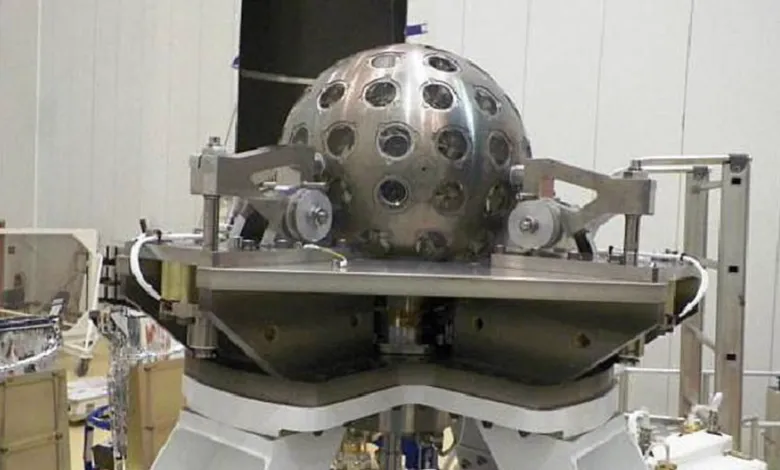
LARES-2 is a solid sphere made of Inconel 718, a dense nickel-chromium alloy. It measures just over 40 centimeters across and is covered with 303 corner-cube retroreflectors. The satellite has no thrusters, no solar panels, and no electronics of any kind. It weighs 294.8 kilograms. That combination of small size and heavy mass gives it the lowest area-to-mass ratio of any satellite currently in medium-Earth orbit.
That design was no accident. The scientists needed to minimize the influence of non-gravitational forces such as atmospheric drag and solar radiation pressure. By keeping the satellite dense and compact, they ensured that the only significant force acting on it was gravity itself. This allowed them to isolate the tiny twist imparted by Earth’s rotation on the surrounding spacetime, yielding a measurement that brings us closer than ever to confirming a subtle but profound prediction of relativity.
(Source: Ars Technica)