Hyundai’s In-Hub Motors Dominate on Ice
▼ Summary
– In-wheel motor technology has existed since 1900 but has not achieved mainstream adoption in cars despite early use in lunar rovers and e-bikes.
– Elaphe, a Slovenian company, supplied in-wheel motors for the failed Lordstown Endurance truck and continues to develop the technology for various projects.
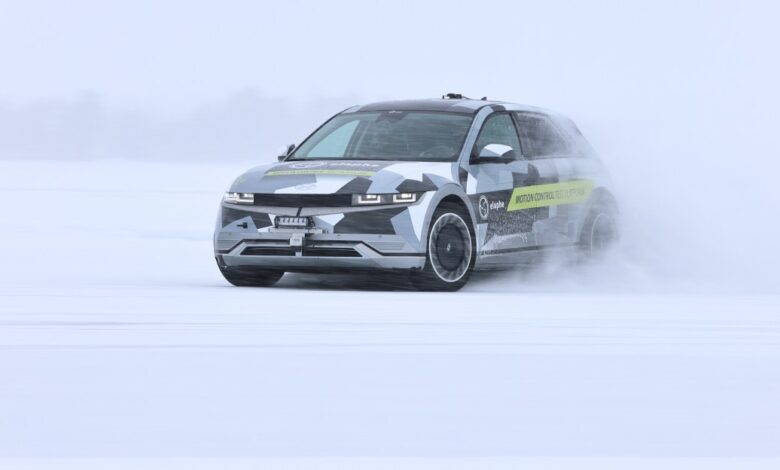
– Testing an Elaphe-modified Hyundai Ioniq 5 with four in-wheel motors demonstrated precise, software-controlled handling and torque management on ice.
– A prototype hybrid muscle car with a V8 and front in-wheel motors showed significantly improved traction and control on slippery surfaces.
– Elaphe claims future EVs designed around in-wheel motors could be lighter and cheaper, with the technology potentially mitigating unsprung weight drawbacks, and plans market entry within a few years.
The concept of placing electric motors directly inside a wheel hub is not new, tracing its origins to Ferdinand Porsche’s 1900 design and later to NASA’s lunar rovers. Despite this long history and significant potential, in-wheel motor technology has struggled to reach mainstream automotive production, with ventures like the ill-fated Lordstown Endurance truck highlighting the commercial challenges. However, the Slovenian engineering firm Elaphe, which supplied motors for that project, continues to advance the system. After extensive testing on ice, the tangible benefits of precise torque vectoring and instantaneous traction control are moving this technology from theoretical promise to a compelling reality.
Elaphe’s CEO, Gorazd Gotovac, acknowledges the setback from Lordstown’s collapse was significant, as his company had built substantial infrastructure to support the partnership. Yet, he views the experience positively. The rigorous and costly homologation process completed for those motors provided a certified foundation. “Now we are building all of our future products on top of that,” Gotovac states, expressing gratitude for the project’s role in their development.
Testing began with a standard Hyundai Ioniq 5 on a frozen lake. With its stability systems engaged, the vehicle felt secure but unengaging, as the electronics harshly cut power to prevent slides. Deactivating those aids made the car unpredictable and difficult to control, often pushing straight ahead or spinning without warning. This baseline experience sharply contrasted with the modified version.
Elaphe’s engineering team transformed the Ioniq 5 by removing its factory motors, differentials, and related components. In their place, they installed four in-hub motors, one at each wheel, each producing 188 horsepower and 1,254 lb-ft of torque. While a custom KW suspension was needed to manage the added unsprung mass, the car’s total weight increased by only about 30 pounds. The driving character, however, was utterly different. In its standard mode, the vehicle managed wheelspin with smooth, gradual power reduction rather than abrupt cuts. Entering a corner too quickly, the system would intelligently apply regenerative braking to the inside wheels to help rotate the car, then seamlessly reintroduce power on exit.
This refined behavior stems from having a motor directly at each wheel, eliminating mechanical delays from driveshafts and differentials. The software-controlled torque vectoring can sample and react to grip levels almost instantly. After demonstrating competence on the handling course, the author was permitted to engage drift mode. Here, the system provided subtle steering assistance while granting full access to the immense torque, making the car exceptionally playful and controllable while sliding.
To demonstrate the hybrid potential, Elaphe presented a prototype based on a 5.0-liter V8 American muscle car. The rear seats were replaced with a 9.0-kWh battery pack and control electronics for a pair of Elaphe motors on the front axle. With the motors disabled, the rear-wheel-drive coupe was nearly undriveable on ice, spinning its tires helplessly. Activating the front motors transformed its demeanor, enabling confident acceleration and controlled cornering as the system balanced power and regeneration between the front wheels.
Looking ahead, Gotovac notes that while this hybrid application added weight, a purpose-built electric vehicle platform could be lighter and cheaper by eliminating traditional motor bays, driveshafts, and differentials. The primary trade-off is increased mass at the wheels, which typically forces the suspension to work harder and can degrade ride quality. Yet, Elaphe argues its technology offers a unique solution. “I can dampen my vibration with the in-wheel motor instead of the active damper,” Gotovac explains, suggesting the motors themselves could act to smooth the ride, potentially offsetting the need for expensive adaptive dampers.
The pressing question is one of timing for consumer availability. Gotovac confirms collaborations with several automakers, particularly those with performance-oriented brands, and predicts the first production vehicles will arrive within a few years. Initial offerings will likely be hybrids, with more ambitious, fully electric performance models slated for after 2030. Specific details remain confidential under non-disclosure agreements.
While questions about real-world durability and on-road refinement remain, the technology demonstration was persuasive. The level of grip and control exhibited by both prototypes on a low-friction surface felt transformative, suggesting in-hub motor systems could redefine vehicle dynamics in the electric era.
(Source: The Verge)