Anno 117: Pax Romana Review – Is It Worth Your Denarii?
▼ Summary
– Anno 117: Pax Romana offers a more relaxed city-building experience with smaller cities and less demanding production chains than previous entries in the series.
– Players have greater control over quests and contracts, choosing when to engage with them rather than being pressured by constant AI demands.
– The game introduces area effects for buildings, requiring strategic placement to balance bonuses like income with negatives such as decreased happiness or fire risk.
– Two distinct regions, Latium and Albion, provide unique challenges and allow players to choose their starting location, with different population paths affecting gameplay mechanics.
– While praised for its visuals, atmosphere, and soundtrack, the game is criticized for its clunky combat, short campaign, and user interface that requires excessive navigation.
Anno 117: Pax Romana offers a more measured and relaxed city building experience that stands apart from its predecessors by focusing on smaller-scale urban development and simplified production chains. This latest installment transports players to the ancient world of Latium and Albion, where they can construct thriving settlements without the constant pressure of urgent AI quests. Players now have the freedom to choose when to engage with character-driven missions or accept contracts for extra income, allowing for a more deliberate and controlled approach to empire management.
The game treats both Latium and Albion as equally important regions rather than designating one as a satellite of the other. While the campaign begins in Latium before expanding to Albion, Endless mode grants players the choice of starting location. The removal of mandatory cross-sea dependencies means you can fully master one region’s mechanics before tackling the next, creating a gentler learning curve for newcomers.
Upgrading citizens has been streamlined, requiring only a single need fulfillment per category to advance to the next population tier. This design choice provides greater flexibility and reduces the immediate pressure of securing diverse goods. Interestingly, it’s possible to reach the highest population levels without establishing cross-region trade routes, though players will likely find them beneficial due to new area effects introduced in building placement.
Buildings now exert both positive and negative influences on their surroundings, adding strategic depth to city planning. A Tannery producing leather might decrease local happiness and increase riot risk, while the Sandal Maker using that leather boosts nearby income. Similarly, Charcoal Burners pose health and fire hazards, but Horners enhance both income and happiness within their radius. This system encourages thoughtful urban design where players must balance industrial zones against residential areas.
Space management becomes particularly crucial in Albion, where marshlands cover significant portions of islands. These wetlands are essential for production if players choose the Celtic development path, creating interesting trade-offs between residential expansion and resource generation. The Romano-Celtic path offers marshland drainage capabilities, presenting players with meaningful decisions that define their regional strategy.
The game introduces religious and research systems that provide additional layers of customization. Players can select patron gods for each island, with deities like Ceres boosting basic production, Neptune enhancing naval capabilities, and Mars supporting military endeavors. The research tree unlocks building upgrades, structural modifications, and new military units, though progression can feel slow without optimization.
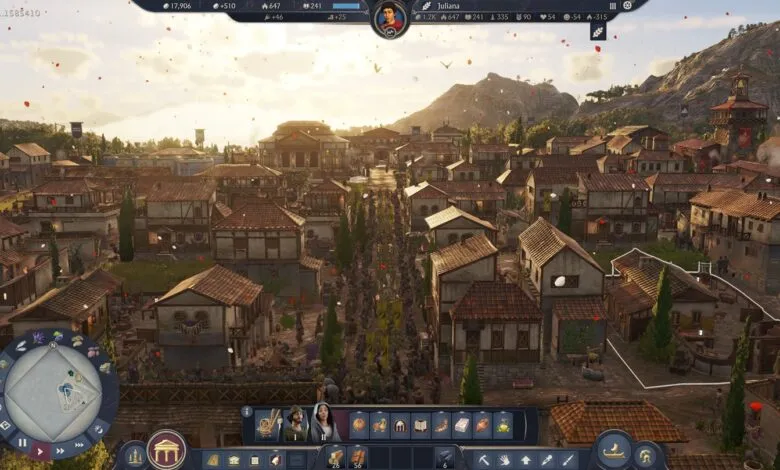
Visually, Anno 117: Pax Romana excels at creating atmospheric contrast between Latium’s sun-drenched Mediterranean landscapes and Albion’s moody, rugged terrain. Improved textures and lighting make zooming into street-level views particularly rewarding, allowing players to observe citizens going about their daily lives. The soundtrack further enhances the immersive experience, though the user interface presents some navigation challenges with its nested menus and occasionally unclear icons.
The campaign serves as an adequate tutorial but falls short narratively, featuring forgettable characters and ending abruptly just as the story gains momentum. Combat mechanics also represent a weaker aspect of the game, with both naval and land battles feeling simplistic and demanding significant resources for limited strategic payoff. Maintaining military units consumes substantial population capacity, and battlefield tactics often devolve into watching morale-based blob combat.
Performance remains generally solid on capable hardware, though higher visual settings can impact frame rates. Players may encounter occasional stuttering during camera movement and some texture pop-in, but these issues don’t significantly detract from the overall experience.
Despite its shortcomings in narrative and combat, Anno 117: Pax Romana succeeds as a thoughtful city builder that revitalizes familiar mechanics while remaining accessible to newcomers. The joy of watching your carefully planned settlements flourish against the backdrop of ancient civilization makes these missteps easier to overlook, creating a compelling foundation for future expansions and updates.
(Source: Game Watcher)