How I Almost Ruined the ‘Star Trek: Voyager’ Pilot

▼ Summary
– Star Trek Voyager: Across the Unknown is a game where players manage the Voyager starship after it is stranded 70,000 light-years away, focusing on resource management, crew morale, and critical decisions.
– The game’s demo is based on the “Caretaker” pilot episode but feels overly guided, limiting the player’s ability to make impactful narrative choices during this tutorial phase.
– Players engage in activities like scanning planets for resources, managing ship systems, and rebuilding after the catastrophic jump, with the demo emphasizing survival mechanics over cinematic storytelling.
– Despite the potential for choice-driven gameplay, the demo restricts major deviations from the original plot, such as failing away missions or altering key events, which limits player agency.
– The game shows promise in its resource management and survival systems, but it remains unclear how much freedom players will have to influence Voyager’s fate in the full release.
The moment we learned about Star Trek Voyager: Across the Unknown, its core concept instantly captured our imagination. Taking command of the USS Voyager after its sudden displacement 70,000 light-years into the Delta Quadrant presents a monumental challenge. Your decisions directly influence the ship’s integrity, from managing finite resources and navigating conflicts to monitoring crew morale and leading away teams where every choice carries life-or-death consequences. The central question remains: will you successfully guide the ship home, or forge an entirely new destiny among the stars?
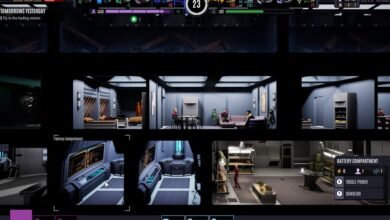
Gamexcite’s recent demo release during Steam Next Fest prompted an immediate deep dive. While the game shows immense promise, its introductory segment feels overly scripted, preventing its most compelling features from fully emerging. The demo focuses on the tutorial, built around the events of Voyager’s pilot episode, “Caretaker.” It introduces core mechanics like resource management, planetary scanning for materials, and overseeing shipboard systems including power capacity, crew morale, and technological research. A particularly interesting deviation from the series treats the ship’s massive jump as a catastrophic, disabling event, forcing you to clear debris and methodically rebuild facilities based on your available resources.
However, the narrative largely adheres to the established “Caretaker” storyline, which limits player agency. The hour-long demo follows a familiar path for Trek fans: the sudden translocation to the Delta Quadrant, an encounter with the mysterious Array and its inhabitants, missing crew members, the discovery of the Ocampa, a confrontation with the Kazon-Ogla, and the ultimate choice of destroying the Array to protect the Ocampa or using it for an immediate return to the Alpha Quadrant.
For an initial playthrough, an attempt was made to mirror the original episode faithfully. On away missions, characters from the corresponding scenes in the series were assigned, a tactic subtly encouraged by their appropriate stats and expertise for mission skill checks. These narrative moments are presented through an LCARS-style interface rather than cinematic cutscenes, and the current build lacks voiceover dialogue, reinforcing that Across the Unknown prioritizes strategic management over lavish production.
The demo concludes after the pivotal Array decision, leaving the long-term consequences of your actions and the integration of future Voyager storylines unexplored. As expected from a tutorial-heavy section, the experience felt more guided than liberating. Player impact on individual mission outcomes didn’t significantly alter the core narrative at this stage. The primary branching choice involves deciding whom to rescue on the Array, determining whether Chakotay and Tuvok or B’Elanna and Tuvok join your available “hero” roster for assignments, with Harry Kim or Tom Paris being lost instead.
The resource management and survival aspects of the game showed strong potential even in this early phase. In contrast, space combat felt underdeveloped, primarily involving targeting enemy subsystems and activating ability cooldowns. The feeling that you could truly personalize Voyager’s journey home was absent. After a “successful” first run that left Voyager stranded, a second playthrough was initiated with a new goal: embody the worst possible Captain Janeway.
This involved deliberate neglect of ship management beyond minimal power and deuterium requirements. Senior staff were left unassigned, crew morale was driven down by restricting rations, and basic facilities like rest quarters went unbuilt, all while carefully avoiding total resource depletion or morale-based failure states. Aggressive decisions were prioritized to deviate from the “Caretaker” script whenever possible.
On away missions, the least qualified personnel were dispatched and directed toward choices almost guaranteed to fail skill checks, particularly high-risk options threatening injury or death. Sending B’Elanna, Harry, and Neelix to Ocampa resulted in a cascade of failures: inability to shelter from a desert storm, aggressive contact with the Kazon, and a disorderly retreat. The expectation was to see permanent consequences, like a crew member falling to enemy fire during transport. Instead, the result was a simple “Away Mission Failed” screen and a prompt to reload a saved game.
Reluctantly complying and adopting a less overtly destructive approach allowed the story to progress. The only significant change in this run was choosing to use the Array to send Voyager home. This triggered a compelling, dark sequence where Chakotay accuses you of betrayal for abandoning the Ocampa, followed by options to arrest your Maquis allies and threaten Tom Paris with a return to his penal colony, actions fully embraced for this “worst captain” scenario. In the full game, such a decision will likely end that playthrough, requiring a fresh start.
This demo represents just a small portion of what Across the Unknown will offer upon its eventual release on PC and consoles. It left a desire to experience the game’s approach to meaningful choice beyond the heavily guided tutorial constraints. It remains difficult to gauge how much freedom players will truly have to reshape Voyager’s destiny, despite teases of future possibilities like sparing Tuvix or exploiting Borg technology.
Beneath the narrative layer, numerous intriguing systems suggest significant potential as a survival and resource management title. For Star Trek enthusiasts eager to radically reinterpret a show premise that never fully realized its own potential, a definitive verdict on this aspect must wait until more of the game becomes available.
(Source: Gizmodo)