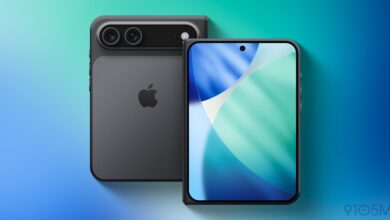
iPhone 17 Series Unveils Biggest Design Overhaul in Years

▼ Summary
– Apple introduced the iPhone Air, a new model replacing the iPhone 17 Plus, featuring a thinner design at 5.6 mm and a titanium frame for durability.
– The iPhone 17 Pro models showcase a redesigned horizontal camera layout called the Camera Plateau, replacing the previous square module and improving stability.
– Pricing details include the iPhone 17 starting at $799, iPhone Air at $999, and iPhone 17 Pro and Pro Max at $1,099 and $1,199 respectively, with preorders available on Friday.
– The iPhone Air includes compromises such as a single rear camera without an ultrawide lens and lacks millimeter wave 5G, but features advanced components like the C1X modem and N1 wireless chip.
– Both new models emphasize battery and performance enhancements, with the iPhone Air claiming 27 hours of video playback and the Pro models incorporating a vapor-chamber cooling system.
Apple’s latest iPhone 17 series introduces the most significant visual and structural updates seen in years, marking a bold departure from the design language established since the iPhone 11. While the standard iPhone 17 retains a familiar form, the Pro models showcase an entirely reimagined camera layout, and an all-new model, the iPhone Air, replaces what would have been the Plus variant, emerging as the slimmest iPhone ever produced.
The standard iPhone 17, consistently Apple’s top seller, features more subtle refinements. All new devices were unveiled during the company’s annual September event at the Steve Jobs Theater in Cupertino, alongside refreshed Apple Watches and AirPods Pro. Preorders begin Friday, with pricing set at $799 for the base iPhone 17, $999 for the iPhone Air, and rises to $1,099 and $1,199 for the iPhone 17 Pro and Pro Max, respectively.
Enter the iPhone Air, a device that enters a 2025 market increasingly focused on ultra-thin profiles, competing directly with offerings like the Samsung Galaxy S25 Edge and Honor Magic V5. At just 5.6 millimeters thick, it undercuts even Samsung’s slimmest and represents a substantial reduction from the iPhone 16 Pro. To visualize, that’s roughly the thickness of seven credit cards stacked together. Along with its featherlight build, 24 grams lighter than the standard iPhone 16, the Air incorporates a large 6.5-inch display and becomes the only model this year using a titanium frame for enhanced durability. The front glass utilizes the new Ceramic Shield 2, promising three times better scratch resistance and four times improved drop protection, while the back retains the original Ceramic Shield blend.
A horizontal camera bump houses a single rear lens, capable of simulating 2X optical zoom like many current iPhones, though it omits an ultrawide sensor, potentially limiting versatility for photography enthusiasts. Under the hood, the iPhone Air debuts Apple’s C1X modem, supporting sub-6 5G without millimeter wave capabilities, and introduces the Apple N1 wireless chip with Wi-Fi 7, Bluetooth 6, and Thread support for smarter home device integration.
Familiar features like the Dynamic Island, Action Button, and Camera Control remain, while the front camera receives a boost to 24 megapixels with support for Center Stage. A square sensor allows landscape or portrait selfies without rotating the device, and users can now record video simultaneously with both front and rear cameras.
Internally, a high-density battery, likely employing silicon-carbon technology, powers the A19 Pro chip, and the device supports ProMotion’s 120Hz refresh rate and Qi2 magnetic wireless charging at 25W. Despite its slender profile, Apple claims battery life matching the iPhone 16 Plus, offering up to 27 hours of video playback. Colors include black, white, light gold, and light blue.
Turning to the iPhone 17 Pro and Pro Max, the most striking update is the redesigned rear camera array, now arranged in a horizontal bar Apple dubs the Camera Plateau. This layout eliminates the traditional square module and may finally solve the infamous wobble when placed on a flat surface. A subtle color division hints at the shift from titanium to a fully recycled aluminum chassis, which improves heat dissipation, reduces weight, and lowers carbon footprint. Surprisingly, this material change doesn’t translate to a lower price.
A new vapor-chamber cooling system debuts in these models, a feature long common in Android devices, aimed at maintaining temperature stability during intensive tasks like 4K video recording or high-performance gaming. The redesigned internal structure also allows room for a larger battery, further supporting sustained usage.
(Source: Wired)