VR Retail Needs a Complete Overhaul
▼ Summary
– The author observed a neglected and poorly maintained Meta Quest display at a Best Buy, highlighting inconsistent retail support for VR.
– VR requires firsthand experience to be understood, yet there is no consistent or effective way for most consumers to try it before purchasing.
– Apple excels at in-store demos for its Vision Pro headset, offering curated and choreographed experiences that showcase its best features effectively.
– Meta’s retail efforts are inconsistent and lack a dedicated demo mode in its OS, making first-time user experiences often clunky and overwhelming.
– For VR to reach a mass market, a robust and dedicated retail infrastructure with knowledgeable staff and polished demo environments is essential.
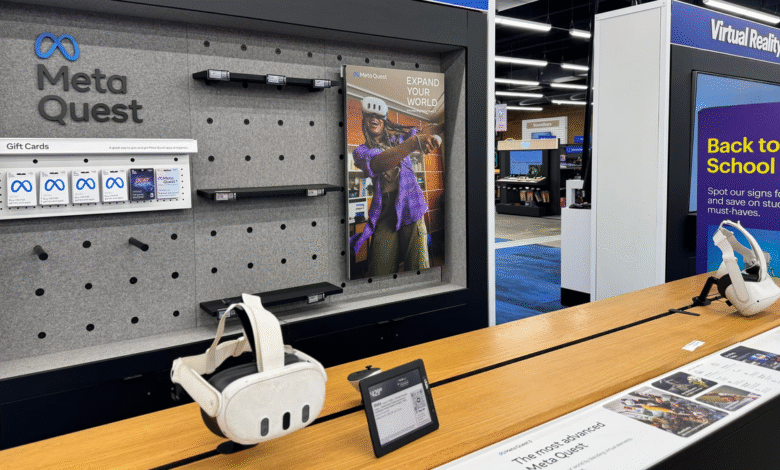
Walking into a major electronics retailer, the state of virtual reality displays often tells a story of neglect rather than innovation. VR retail desperately needs a complete overhaul if the technology hopes to capture mainstream attention. A recent visit to a Best Buy revealed a Quest 3 dummy unit barely fastened to a table, a Quest 2 facedown beside it, and no sign of the newer Quest 3S. Each headset had only one controller strapped nearby, suggesting either poor planning or long-term disinterest. No accessories, no boxed units, just an overall impression that nobody had cared for this display in months.
Virtual reality is one of those technologies you simply have to experience to understand. Describing VR to someone who has never worn a headset is like explaining color to someone who has never seen it, words fall short. Early VR required high-end gaming PCs, but standalone headsets like the Oculus Quest changed that, bringing immersive tech within reach of everyday consumers. Yet the critical hurdle remains: most people still lack a reliable, clean, and engaging way to try before they buy.
Almost everyone who has spent time in VR remembers their first moment of awe. The challenge lies in connecting that transformative experience directly to a purchase, and doing so at a scale that keeps demo units functional and inviting for the next user.
Aside from Apple, Meta is the only company putting significant effort into retail presence, but with just one permanent store of its own, it leans heavily on partners like Best Buy, Target, and Walmart. The outcome is wildly inconsistent. Some Meta Quest kiosks are tidy and fully equipped, but far too many are broken, outdated, or simply ignored, like the dismal setup spotted near New York City.
Apple, despite criticism over Vision Pro’s high price, absolutely excels at in-store demonstrations. Its retail strategy has always been a core strength. Shoppers can test products in a relaxed setting and return later for support. The experience has evolved over time, but the principle holds: to appreciate an Apple product, you have to use it. With Vision Pro, the company elevates this further. Every demo is meticulously designed to spotlight the headset’s finest capabilities, spatial videos, productivity apps, entertainment, all curated to deliver a powerful and memorable first impression.
Meta has experimented with pop-up experiences, like the Batman: Arkham Shadow tour last fall, intended to promote both the game and the Quest 3S. But these are temporary, tied to specific titles or events, and fail to build a sustained retail presence.
What’s urgently needed is a stronger, more consistent demo infrastructure. Whether through more Meta-owned stores, deeper investment in partner retail displays, or another approach altogether, one truth is undeniable: VR must be tried to be believed.
Software also presents a barrier. Meta’s Horizon OS lacks a dedicated demo mode, a smooth, guided experience tailored for newcomers. Instead, the standard setup can feel confusing and overwhelming in a store environment, especially for VR first-timers. If Meta is committed to consumer adoption, why not build a polished, pre-loaded demo directly into the OS? Skip the menus and setup; drop users straight into that jaw-dropping sense of presence. Without it, even the best hardware displays will struggle to deliver the “wow” that drives sales.
Meta’s expansion into smart glasses introduces another retail challenge. The Ray-Ban Meta glasses have been well received, with new models like the Oakley HSTN already available and more on the horizon. AR glasses represent the endgame, and for now, Meta benefits from EssilorLuxottica’s retail network. But future AR glasses won’t be part of that partnership, meaning Meta will eventually need its own dedicated retail spaces, somewhere between a tech store and an optician, where customers can try, fit, adjust, and even repair wearable tech.
That’s precisely the kind of environment Quest headsets could use right now: dedicated areas staffed by knowledgeable employees who can guide new users through that first breathtaking encounter.
It’s still unclear what Meta’s long-term retail vision entails as it scales its wearables business. Perhaps more will be revealed at Meta Connect 2025. But one thing is certain: if VR hopes to break out of its niche, we can’t leave the magic of first impressions to chance. Somebody, whether Meta or another player, must deliver that unforgettable demo to millions.
(Source: UploadVR)