LG Ultragear 45GX950A Gaming Monitor: Immersive Display & Performance
▼ Summary
– The LG Ultragear 45GX950A is a 45-inch OLED gaming monitor with a 5,120 x 2,160 resolution, offering a significant pixel density improvement over previous 45-inch ultrawide OLEDs but still lower than smaller 4K panels.
– It features a 165 Hz refresh rate at native resolution and a dual-mode option for 330 Hz at a lower 2,560 x 1,080 resolution, though the dual-mode uses interpolation instead of integer scaling.
– The monitor has a fixed 800R curvature, dual HDMI 2.1 inputs, DisplayPort 2.1, USB-C with 90W power delivery, and a USB-A hub, but its full-screen brightness is limited to 275 nits.
– Image quality is mixed, with excellent pixel response and HDR performance in dark scenes but underwhelming vibrancy and noticeable dimming in bright full-screen content due to OLED limitations.
– Priced at $1,999, it represents advanced OLED technology but feels like a near-future preview due to brightness constraints and the expectation of rapid OLED advancements surpassing it soon.
When it comes to premium gaming displays, the LG Ultragear 45GX950A stands out as a bold and ambitious offering, combining a massive 45-inch OLED screen with a striking 5K2K resolution. This monitor delivers an immersive visual experience that feels both futuristic and highly capable, though it comes with a few compromises that potential buyers should carefully consider.
At the heart of this display is an LG WOLED panel that measures a full 45 inches diagonally and features an ultra-wide 21:9 aspect ratio. Unlike many competing models, it pushes beyond the standard 3440×1440 resolution, offering a native 5120×2160 pixel grid. This upgrade significantly improves pixel density, jumping from roughly 83 DPI to about 124 DPI. While that’s still lower than what you’d get from a 27-inch or 32-inch 4K monitor, it’s a meaningful step up for a screen of this size.
The monitor supports a 165Hz refresh rate at its full 5K2K resolution, but LG also includes a dual-mode feature that allows users to switch to a lower 2560×1080 resolution with a blistering 330Hz refresh rate. This flexibility aims to cater to both competitive gamers who crave high frame rates and those who prefer maximum visual fidelity. Unfortunately, the scaling in these modes relies on interpolation rather than cleaner integer scaling, which can result in a slightly soft image.
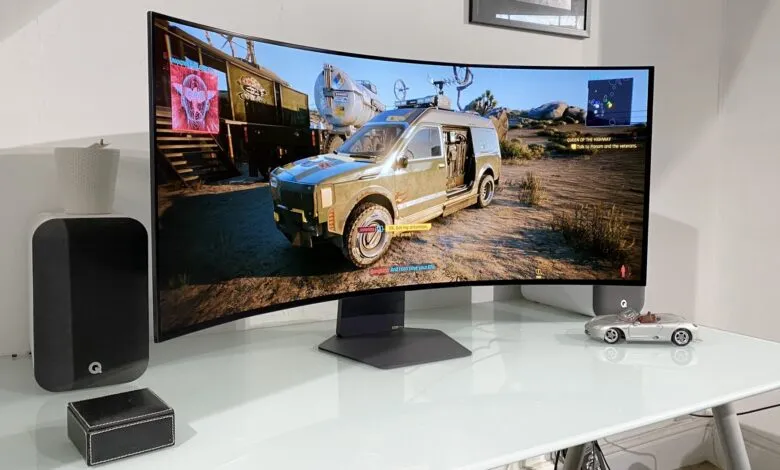
One of the most striking physical attributes is its 800R curvature, a pronounced bend that wraps the display around the viewer’s field of vision. This aggressive curve enhances immersion, especially in gaming and cinematic content, though it may not be to everyone’s taste. Connectivity is robust, with dual HDMI 2.1 ports, DisplayPort 2.1, a USB-C input offering 90W power delivery, and a built-in USB hub.
Image quality is a mixed bag. In dark or high-contrast scenes, the OLED panel shines with perfect blacks, incredible per-pixel lighting, and a 0.03ms response time that easily outperforms any LCD. HDR content, particularly in dimly lit environments, looks spectacular. However, full-screen brightness is limited to around 270 nits, which falls short of newer OLED offerings. When displaying large bright elements, like a white browser window or a sunny game environment, the screen can dim noticeably due to its automatic brightness limiter.
Color performance is another area where the LG doesn’t quite hit the highest mark. Compared to monitors using Samsung’s QD-OLED technology, this panel can exhibit a slight green tint and doesn’t deliver the same level of saturation or vibrancy. The matte anti-glare coating also slightly mutes the overall pop and brilliance of the image.
Despite these limitations, the LG Ultragear 45GX950A excels in many scenarios. Gaming in HDR with dark atmospheric titles is a genuine treat, and the combination of size, curvature, and resolution makes it excellent for both entertainment and productivity. Burn-in concerns, while not entirely gone, are less alarming than in earlier OLED generations, especially if the monitor is used primarily for gaming.
All told, this is an impressive display that offers a glimpse into the future of high-end monitors. Yet with a price tag hovering around $2,000, it’s a substantial investment, one that may feel premature given how quickly OLED technology is advancing. If you’re looking for the absolute best in brightness and pixel density, you might want to wait. But if you desire a large, immersive, and highly responsive OLED experience today, the 45GX950A is a compelling, if imperfect, choice.
(Source: PCGAMER)