Fitbit Air made me swap my Pixel Watch for good
▼ Summary
– The author initially dismissed the Fitbit Air as uninteresting but bought it with Google Store credit, and it unexpectedly changed their daily life.
– The Fitbit Air provides a break from information overload, as it lacks a smartwatch screen and constant notifications, allowing for passive health tracking.
– The device is small, lightweight, comfortable, and charges only once a week, making it easy to forget while still tracking key health metrics.
– It effectively tracks fitness activities like football and walks without needing a phone or screen interaction, promoting focus during workouts.
– The author now prefers the Fitbit Air over the Pixel Watch 4, finding the lack of a screen freeing, despite occasionally checking their wrist for the time.
I told myself the Fitbit Air would be a nice sidekick, not a replacement. A simple tracker I could toss on without worrying about battery anxiety. I also convinced myself it would never truly replace a dedicated smartwatch. I was spectacularly wrong.
I genuinely adore the Pixel Watch 4. It’s arguably Google’s finest product of 2025, even if the changes felt incremental. It looks sharp and plays nicely with every Android phone I’ve ever owned. That was true for previous versions, too.
When the first Fitbit Air leaks surfaced, I’ll be honest. I wasn’t intrigued.
Then launch day arrived, and curiosity won. I had over £100 in Google Store credit sitting in my UK account, so I figured I’d grab one for free and see what happened. I know this sounds like hyperbole, but that offhand decision has quietly reshaped my daily life in ways I never anticipated.
A wearable that doesn’t feel like one
For years, I’ve used a smartwatch as a bridge to my phone. Nothing groundbreaking there. I mention it because I keep my phone on silent permanently. Random notification sounds drive me insane. I allow only keyboard and touch haptics. That’s it.
I want the screen I carry everywhere to only make noise when I command it.
Then, in my infinite wisdom or foolishness, I offloaded those annoyances to the smartwatches strapped to my wrist. All the pings, vibrations, and buzzes migrated to my left arm. You can guess where this is headed.
Yes, I’ve come to regret that.
My various Pixel Watches became too much of a phone extension. Information overload became a real struggle. The sensible fix would be disabling those vibrations, right?
I did that. But it didn’t stop me from scrolling or waiting for things to appear on that tiny screen I stare at for 16 hours a day. My phone can be face down, out of sight. It requires active interaction to become a true distraction. My watch? It’s literally strapped to me, packed with sensors for health and fitness feedback.
Enter the Fitbit Air. When I saw the launch details and understood the downgrades from a smartwatch, I immediately saw a firebreak from information overload. Something I could wear to check key metrics on my own terms. No tinkering. No constant fiddling.
I saw it as a truly passive piece of technology.
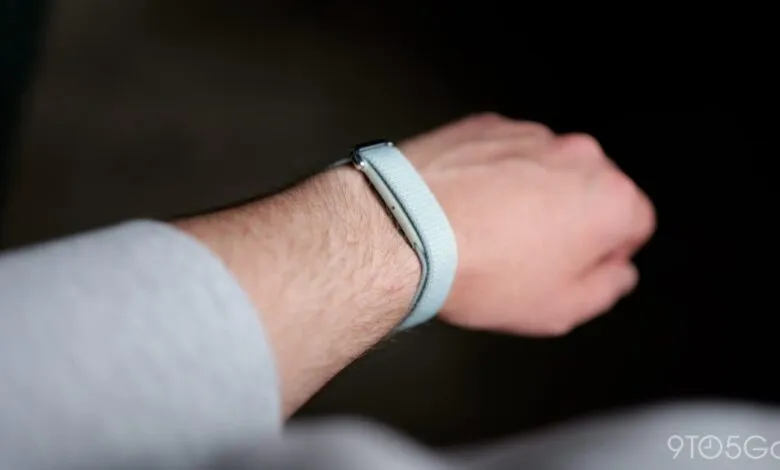
It’s small, lightweight, and comfortable. That’s the dream trio for something worn all day and all night. Charging once a week feels freeing, too. Sedentary folks might get even longer.
I’m not sure this is a compliment, but I’d compare it to those old Livestrong bands. The highest praise I can give is that I forget the Fitbit Air is there. That’s arguably its best feature. It blends seamlessly into my existence while tracking the health stats I actually care about.
This is the kind of product I want and need more of.
What’s more, it’s surprisingly decent at fitness tracking. I recently came out of an unintended brief retirement to play football with old friends. It tracked the entire 80-minute session without me touching my phone. I just tagged it in Google Health later when I grabbed my phone from pitchside.
Same for walks or evening dog strolls. I’m not setting it or forgetting it. I can’t vouch for pinpoint accuracy, but it seems fair. No GPS hardware inside, but I’m not worried about missing a few meters. Anything above a rough estimate is plenty for me.
The lack of a screen feels freeing in more ways than one.
First, I’m not fiddling with a display mid-workout. Just lift weights, run, walk the dog. Zero distractions. I’m focused. That feels incredible.
Less is genuinely more
Maybe my opinion would differ if my Pixel Watch 4 were LTE. I completely understand the appeal of going to the gym or running without a phone. But those experiences are for locking in. Putting in hard hours and focusing on one task. That’s been my approach over the past 18-24 months to improve my health and wellbeing.
Yes, Google Health could be better. But I only want the data. Give me a solid picture of what’s happening, and I’ll adjust my habits to live a healthier existence.
If you’d asked me weeks ago whether a Fitbit would be on my “must-have” EDC list, I’d have called you a liar. Yet here we are. I’m going Pixel Watch free and truly loving it.
The only downside? I often lift my left wrist to check the time. All that stares back is a light blue fabric strap and a sliver of silver. And that’s all it needs to be.
At $99, it’s hard to go wrong.
(Source: 9to5google.com)