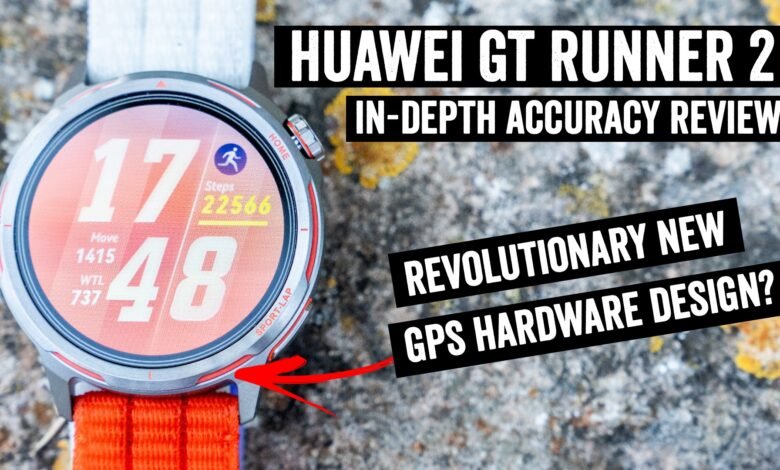
Huawei GT Runner 2: How Accurate Is Its GPS?
▼ Summary
– Huawei launched the GT Runner 2 watch, heavily promoting a new dual-antenna GPS design claimed to outperform competitors like the Garmin Forerunner 970 and Apple Watch Ultra 3.
– The watch includes numerous software features like training load metrics, running power, and dynamic recovery guidance, alongside hardware specs such as a lightweight titanium case and a long battery life.
– Independent real-world testing found the watch’s GPS accuracy to be consistently poor, with significant track errors in both open and urban environments compared to other leading devices.
– Huawei suggested the GPS algorithms were optimized for road running, but the reviewer concluded the fundamental accuracy issues are likely hardware-related and not easily fixable via software updates.
– Despite the GPS shortcomings, the watch was praised for its premium design, comfortable quick-dry strap, bright display, and accurate heart rate sensor.
Huawei’s latest GT Runner 2 smartwatch arrives with a bold promise: to deliver best-in-class GPS accuracy through a novel dual-antenna design. The company positioned this feature as a revolutionary leap, directly challenging established leaders like Garmin. However, real-world testing reveals a significant gap between the marketing claims and the device’s actual performance, raising questions about its viability for serious runners who depend on precise location tracking.
The watch itself packs an impressive list of features beyond navigation. It boasts a lightweight titanium case, a remarkably bright 3,000-nit display, and a comprehensive suite of training metrics. Runners gain access to tools like running power, dynamic recovery guidance, and specialized marathon race screens. The software includes smart training plans and an expanded training load analysis. With a claimed 32 hours of GPS battery life and a rapid-drying fabric strap, the hardware specifications are compelling, especially at its price point of 399 euros.
The core selling point is the redesigned GPS system. Huawei’s engineers moved beyond focusing solely on the chipset, targeting the antenna design, a critical factor for signal integrity. The GT Runner 2 incorporates two separate GNSS antennas: one integrated into the case and another isolated within the titanium bezel. This configuration aims to better match satellite signal polarization, theoretically improving reception in challenging environments like urban canyons or dense tree cover. The company’s presentation included sophisticated slides comparing its technology to a high-precision reference device, suggesting centimeter-level accuracy.
Extensive field testing, however, tells a different story. In side-by-side comparisons with top-tier watches from Garmin, Suunto, and Apple, the Huawei GT Runner 2 consistently underperformed. On open trails with clear skies, its recorded track showed minor but persistent deviations. The problems magnified on switchback mountain climbs, where the track drifted by 50 meters or more from the actual path, despite ideal satellite conditions.
Urban running presented another set of issues. The watch frequently exhibited a “lock to road” behavior, plotting the runner’s position on the street center instead of the adjacent sidewalk or path actually being used. This algorithmic assumption proves problematic for athletes who rarely run directly on roadways. In one clear example, while the tester followed a sidewalk and crosswalk, the watch’s track stubbornly remained on the road, inaccurately suggesting a dangerous route through traffic.
Elevation data also proved unreliable, with readings that drifted significantly over the course of a run, sometimes dipping into negative values before the activity concluded. Interestingly, heart rate monitoring was a bright spot, showing strong accuracy and consistency during workouts.
When presented with these findings, Huawei suggested its algorithms are optimized for road running, which might explain some behavior. Yet, the fundamental inaccuracies occurred across varied terrains, pointing to a deeper hardware or integration issue. Historical precedent in the wearable industry shows that early GPS inaccuracies are seldom fully resolved through software updates alone; they often stem from immutable antenna design limitations.
Ultimately, the Huawei GT Runner 2 is a well-built watch with a rich feature set, but it stumbles on its primary mission. For runners who prioritize precise route and pace data, the current GPS performance is a deal-breaking limitation. It fails to meet the standard set by its key competitors in both simple and moderately challenging environments. While the device excels in other areas, its inability to reliably deliver on its headline promise of superior GPS accuracy leaves it as a curious, yet flawed, contender in the high-performance running watch category.
(Source: DC RAINMAKER)
