5 Cars Powered by Motorcycle Engines
▼ Summary
– Motorcycle engines are designed for high revs and speed, while car engines are built for low-end torque to move heavier vehicles.
– A motorcycle engine lacks the necessary rotational inertia and low-end torque to effectively power a standard, heavy sedan from a standstill.
– Using a motorcycle engine in a car would require significant re-engineering, such as adding a reverse gear and adapting the gearbox.
– In a lightweight car under 1.5 tons, a superbike engine can deliver exceptional power density, creating a raw, high-revving performance experience.
– Several manufacturers, including Morgan, Ariel, and Honda, produce niche cars that are specifically built with motorcycle engines.
The world of high-performance driving often pits the raw, screaming power of a motorcycle engine against the muscular, low-end grunt of a traditional car powerplant. While conventional wisdom holds that these two engineering philosophies are incompatible, a select group of visionary manufacturers has proven otherwise. By placing a lightweight, high-revving motorcycle engine into an ultra-light chassis, they create vehicles that defy categorization, offering an unparalleled blend of agility and explosive acceleration. This unique formula transforms a car into something closer to a four-wheeled superbike, delivering a visceral driving sensation that heavier, torque-focused machines simply cannot replicate.
The fundamental challenge lies in the core design principles. A typical motorcycle engine is engineered for minimal weight and maximum power at extremely high revolutions, as it only has to propel a machine weighing under a thousand pounds. A car engine, in contrast, is built with substantial rotational mass to produce the low-end torque necessary to move a much heavier vehicle from a standstill. Dropping a bike engine into a standard sedan would be an exercise in frustration; it would lack the pulling power at low speeds and necessitate a completely re-engineered gearbox, often lacking a reverse function.
However, the equation changes dramatically when the vehicle’s weight is slashed. In a chassis weighing less than 1.5 tons, the power-to-weight ratio becomes the dominant factor. A lightweight car stripped to its essentials provides the perfect canvas for a high-strung motorcycle engine. The result is a performance cheat code: a vehicle that revs to stratospheric levels, benefits from lightning-fast sequential gearboxes, and offers a razor-sharp, unfiltered connection to the road. This niche is populated by a handful of dedicated brands that have mastered the art of the motorcycle-powered car.
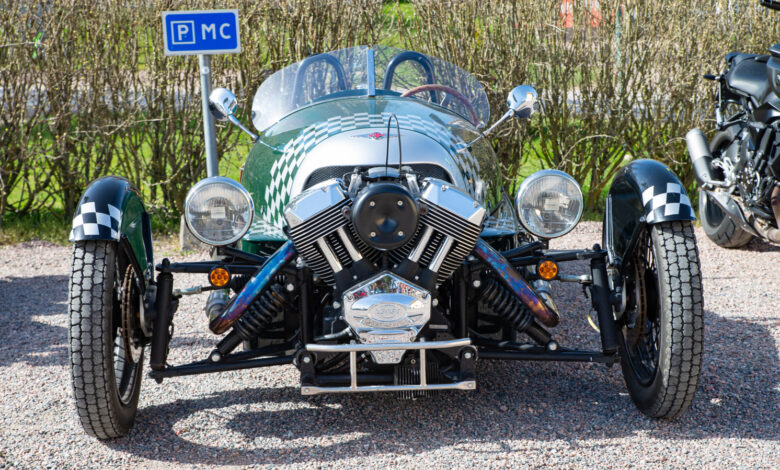
Morgan has a long history with this concept, most famously with its 3-Wheeler, which uses a potent V-twin engine from S&S to deliver a thrilling, retro-inspired experience. Ariel takes a more radical approach with its Atom, a minimalist, street-legal track car often available with a turbocharged engine from Honda’s motorcycle division, producing astonishing acceleration. The Radical sportscar company builds purpose-built race machines for the track, many of which utilize high-performance engines derived from superbikes, offering near-professional racing performance in a turn-key package.
Caterham, renowned for its lightweight Seven sports cars, has also explored this territory with models like the Seven 165, which uses a 660cc turbocharged triple from Suzuki to create a tiny, incredibly agile roadster. Even automotive giant Honda has played in this space, producing the iconic Beat kei car in the 1990s, which featured a mid-mounted, high-revving 660cc motorcycle-derived three-cylinder engine, making it a beloved enthusiast vehicle. These five examples demonstrate that when weight is minimized, the intense, frenetic energy of a motorcycle engine can create some of the most exciting and singular driving machines on the planet.
(Source: JALOPNIK)