AMD: Ryzen 7 9850X3D Sees Negligible FPS Drop With Slower RAM
▼ Summary
– The text criticizes AMD marketing for downplaying the performance difference between slow and fast RAM on their new CPUs, suggesting they should be more transparent.
– It argues that AMD’s X3D CPUs are less sensitive to RAM speed, making expensive high-speed kits less necessary for good performance, which is a valid technical point.
– The author is skeptical of the marketing claims, suspecting the presented benchmarks might be from GPU-limited scenarios, like 4K gaming, which minimizes CPU/RAM differences.
– There is a broader complaint about deceptive marketing practices across the tech industry, where companies exaggerate to sell products.
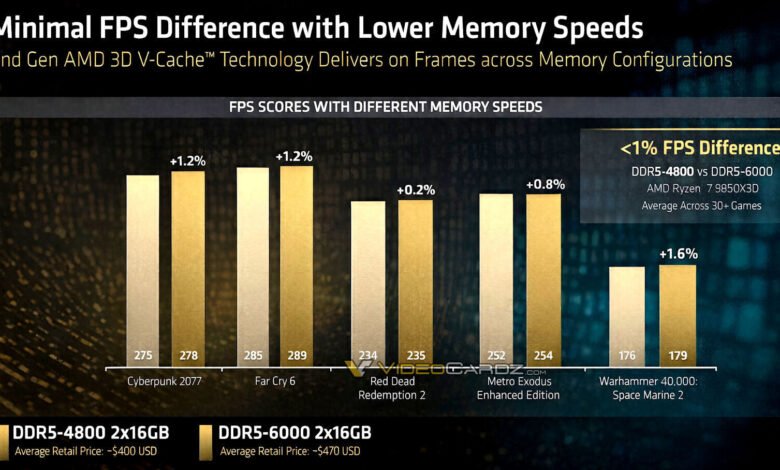
– A key financial argument is that affordable, slower RAM (like 4800 MT/s) offers minimal real-world performance loss on X3D CPUs compared to far more expensive high-speed kits.
When building a new gaming PC, one of the most common debates centers on memory speed. Conventional wisdom suggests that faster, lower-latency RAM is a critical component for unlocking peak performance, particularly for high-end processors. However, new insights regarding AMD’s Ryzen 7 9850X3D suggest this relationship may be far less significant for their 3D V-Cache models. The company’s internal data indicates that moving from a standard 6000 MT/s kit to a premium 6200 MT/s CL28 configuration resulted in a gain of less than one frame per second at 4K resolution. This negligible uplift challenges the perceived necessity of investing heavily in top-tier memory for these specific CPUs.
The conversation becomes more relevant at lower resolutions like 1080p, where the processor is more likely to be the performance bottleneck. Even in these scenarios, especially when paired with an Nvidia GPU whose drivers can be more CPU-intensive, the performance delta attributed to RAM speed appears minimal for X3D chips. This characteristic isn’t new; it has been a noted advantage of the 3D V-Cache technology since its first generation. The architecture’s massive L3 cache effectively reduces the system’s dependency on fetching data from the slower system RAM, thereby mitigating the typical penalties associated with slower memory kits.
The timing of this marketing focus is strategic, coinciding with the significant price disparity between different DDR5 tiers. A basic 4800 MT/s kit remains relatively affordable, while high-clock, low-latency 6000+ MT/s kits can cost exponentially more. For a user considering 64GB of memory, the choice might be between a 400€ budget kit and a 650€ performance kit. The gap widens dramatically for 128GB configurations, where prices can jump from 800€ to a staggering 1800€. AMD’s implied message is that pairing a 9850X3D with a modest RAM kit still delivers an exceptional gaming experience, potentially saving builders hundreds of euros with little tangible cost to frame rates.
This approach has sparked mixed reactions. Some view it as a rare instance of honest marketing, clarifying that consumers don’t need to overspend on memory to enjoy high performance. Others remain skeptical, questioning the test conditions and suggesting the demonstrations might be GPU-limited or otherwise engineered to downplay memory’s role. There is also commentary that the generational uplift from a previous X3D chip to the 9850X3D itself is the real story, offering a more substantial performance gain than any RAM upgrade could provide within the same generation.
Ultimately, while marketing hyperbole is an industry standard, the core technical point holds merit for this product segment. For gamers targeting high-value builds, the Ryzen 7 9850X3D’s insensitivity to RAM speed is a legitimate cost-saving advantage. It allows enthusiasts to allocate their budget toward other components, like a more powerful graphics card, where the performance return on investment is often much greater. The data suggests that with an X3D processor, spending extra on ultra-fast memory yields diminishing returns so minor that most users would never perceive the difference during actual gameplay.
(Source: TechPowerUp)


