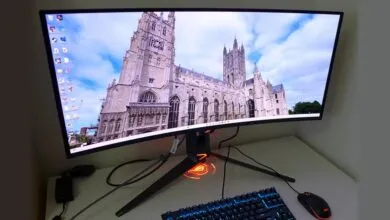
Asus ROG Strix 27-inch OLED Monitor Review: Premium 280Hz Gaming for Less

▼ Summary
– The Asus ROG Strix XG27AQWMG is a 27-inch QHD OLED gaming monitor praised for its exceptional picture quality, high brightness, and perfect motion resolution at its 280 Hz refresh rate.
– It challenges LCD’s price advantage with an estimated opening price of $599, aiming to offer premium OLED performance at a more accessible cost.
– The monitor features Asus’s Tandem OLED technology for increased brightness and lifespan, along with comprehensive gaming features like Adaptive-Sync, ELMB for motion clarity, and extensive calibration controls.
– The reviewer disputes common OLED burn-in concerns based on extensive personal testing and use, noting no such issues despite prolonged static content display.
– Build quality and design are first-rate, including a fully adjustable stand, USB ports, and RGB lighting, though the monitor lacks internal speakers.
For gamers seeking a premium visual experience without the typical premium price tag, the Asus ROG Strix XG27AQWMG delivers exceptional performance. This 27-inch QD-OLED monitor combines stunning picture quality with a high 280Hz refresh rate, creating a compelling package for serious players. While the debate between OLED and LCD often centers on cost and brightness, this model challenges the status quo by offering OLED’s superior contrast and motion clarity at a more accessible point.
Choosing between OLED and LCD technology often comes down to priorities. LCD panels generally hold two advantages: a lower price point and potentially higher peak brightness, especially with Mini-LED backlighting. Concerns about OLED burn-in persist for some, but extensive hands-on experience with over fifty OLED monitors tells a different story. Running static test patterns for hours and using an OLED as a primary display for office applications has not resulted in any permanent image retention. While individual experiences can vary, modern OLED panels include robust protective measures.
The price gap is narrowing, and the XG27AQWMG is a prime example. Its specifications are impressive: a 2560×1440 resolution, Quantum Dot enhancement for color, a 280Hz refresh rate, and support for both AMD FreeSync Premium Pro and Nvidia G-Sync. It also carries the DisplayHDR 500 True Black certification. The refresh rate, while not the absolute highest available, is more than sufficient. OLED panels exhibit virtually no motion blur at a given frame rate compared to LCDs, meaning a 280Hz OLED feels incredibly smooth without needing aggressive overdrive settings. If your system can consistently hit 280 frames per second at QHD, Adaptive-Sync becomes almost unnecessary. For lower frame rates, Asus includes ELMB (Extreme Low Motion Blur), which uses black frame insertion flawlessly without visual artifacts.
Image quality is where this display truly excels. It ranks among the brightest OLEDs available, measured at 557 nits in SDR and 653 nits in HDR for a 25% window. This is aided by what Asus terms Tandem OLED Technology, designed to boost brightness and longevity. Users can select between uniform or variable brightness modes, and crucially, the HDR luminance is adjustable, a feature rarely found on monitors. The build quality and design are premium, featuring a fully adjustable stand, RGB lighting, USB ports, and a thoughtful accessory pouch. The anticipated price point makes its performance particularly attractive.
The monitor arrives well-protected and assembles easily with a tool-free stand or a 100mm VESA mount option. The design is sleek, with a thin panel attached to a central bulge housing the connections: two HDMI 2.1 ports, one DisplayPort 1.4 with DSC, a 3.5mm audio jack, and USB 3.2 ports with one upstream and two downstream. The stand is remarkably stable, offering height, tilt, swivel, and portrait rotation. Front controls include a joystick, a programmable button, and a power toggle, along with a proximity sensor that can blank the screen when you walk away. The screen has a glossy finish that enhances clarity but requires mindful placement to avoid distracting reflections.
The on-screen display is comprehensive and user-friendly, also controllable via Asus’s DisplayWidget Center software. Gaming features are plentiful, including toggles for Adaptive-Sync and ELMB, plus GamePlus tools like crosshairs and timers. The “sRGB Cal” mode within GameVisual provides excellent color accuracy out of the box, though the default Racing mode was also very good. The Image and Color menus offer deep customization, including separate brightness memories for SDR and HDR content. A full suite of panel care options, like a pixel orbiter and logo detection, helps protect the screen. One critical setting to change immediately is the Power Setting, which defaults to a brightness-limiting “Power Saving” mode; switching to “Performance Mode” unlocks the monitor’s full potential.
Out-of-the-box performance is strong, with gamma tracking the 2.2 target perfectly. A minor adjustment to the user color temperature can refine the grayscale. For the widest color gamut, the Wide Gamut setting is recommended. For accurate sRGB, selecting it from the Color menu preserves calibration controls. In HDR, the Gaming HDR mode is accurate, but enabling “Adjustable HDR” is necessary to reach the measured peak brightness of 653 nits.
In practice, the picture quality is breathtaking. It stands out even among other excellent OLEDs, likely due to its exceptional brightness and precise HDR tuning. The perceived motion clarity at 280Hz is perfect, with no blur. Paired with a high-end graphics card, gameplay in titles like Doom Eternal was flawlessly smooth. The ELMB feature effectively cleans up motion at lower frame rates. Colors are richly saturated and textures appear three-dimensional, making everything from games to photos pop. Input lag is imperceptibly low, offering instantaneous control response.
This monitor would also excel as a productivity display. The QHD resolution provides a sharp 109 pixels per inch, and the screen’s optical clarity is outstanding. The glossy coating does demand attention to lighting, but the visual payoff is significant. The build is solid, adjustments are easy, and the minimalist front profile keeps the focus on the image. The lack of built-in speakers is a minor concession, easily addressed by the headphone jack.
The Asus ROG Strix XG27AQWMG represents a remarkable achievement. It delivers top-tier OLED image quality, superb gaming performance, and a robust feature set, all at a price that undercuts many competitors. It is a versatile display that handles work and play with equal prowess, making it an easy recommendation for anyone ready to experience the OLED difference.
(Source: Tom’s Hardware)