At Valorant: A Brain-Scanning Headset That Reads Your Mind
▼ Summary
– Neurable is collaborating with HyperX to develop gaming headsets with built-in EEG sensors that read brainwaves to improve player accuracy, reaction times, and mental resilience.
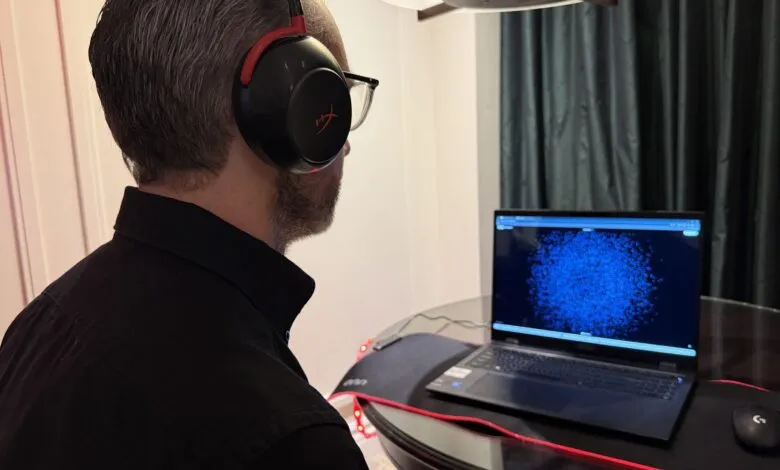
– The technology includes a ‘Prime’ biofeedback exercise, using a visual of shrinking dots, to train users to reduce cognitive load and increase focus before gaming.
– In tests, the priming process has shown measurable improvements, such as increased target-aiming accuracy by about 1.5-3% and faster average reaction times by around 40 milliseconds.
– The system monitors two key brain metrics in real-time: cognitive load (mental capacity used) and focus, with potential uses for practice optimization, tilt prevention, and even team synchrony analysis in esports.
– While still in prototype, the final consumer product is aimed for release in approximately a year, with the goal of making advanced mental state training accessible without requiring specialized skill.
Imagine a gaming headset that doesn’t just deliver sound, but reads your mind. This is the future being built by brain-reading company Neurable in collaboration with HyperX, aiming to use neuroscience to elevate player performance. The concept involves headsets with integrated EEG sensors that monitor your brainwaves during gameplay. The goal is to provide data-driven insights to sharpen your accuracy, slash reaction times, and help you maintain composure to avoid tilting or performance drops.
The partnership, unveiled at CES 2026, targets two key areas: priming your mental state before a session and monitoring cognitive activity during play to ensure you stay at your peak. I recently tested a prototype and spoke with Neurable’s CEO and co-founder, Dr. Ramses Alcaide, a neuroscientist whose background includes developing brain-computer interfaces for medical rehabilitation.
The prototype was functional but clearly early-stage, it was heavy and lacked a microphone boom, details sure to be refined for a final consumer product. Yet, the core technology worked and was instantly fascinating.
The central idea is that your mental state profoundly impacts performance, but instead of guessing if meditation helps, this tech makes the improvement measurable. Dr. Alcaide explained a common gamer’s dilemma: “You normally have to choose between reaction time or accuracy… This is the first time where you can handle one of the biggest issues gamers have, which is getting yourself mentally primed for the activity.”
The initial offering is a ‘Prime’ program designed to get you “in the zone.” It presents a spinning cloud of dots on screen. As you increase your focus, the cloud compresses, the dots moving closer together until they merge into a single point and vanish. “Your brain is highly plastic, which means it’s able to adapt very rapidly,” Alcaide noted. This biofeedback loop trains your brain to reduce cognitive load while boosting focus, creating a “locked-in” state.
Neurable’s data suggests pro eSports players improved target-aiming accuracy by about 3% using Priming, with an average reaction time improvement of 40 milliseconds, a meaningful few frames in a fast-paced game.
I tried it myself. After an initial Aimlabs target-shooting test (scoring ~34,000), I used the Prime exercise. Following tips to focus on individual dot movements, I found the cloud shrinking as I concentrated. Within about 45 seconds, faster than the typical two-to-four minutes, it disappeared, indicating a focused state. Retaking the Aimlabs test, my score jumped to around 37,000. My reaction time saw a minor dip, but my accuracy improved by over 2% after less than a minute of this guided mental preparation.
The system tracks two distinct metrics: cognitive load (how much mental capacity is in use) and focus (sustained attention on a task). “You can have a high focus and have a low cognitive load, which is the ultimate way of playing,” Alcaide said, citing work with the Singapore Air Force where expert pilots exhibited this optimal state, leaving mental bandwidth to react swiftly to new information.
Neurable uses EEG to measure alpha, beta, and theta brainwaves, employing proprietary AI to boost the signal-to-noise ratio. This allows for accurate readings from headset pads without the need for clinical-grade gels or bulky helmets.
The applications extend beyond pre-game priming. Real-time brain data could be used for eSports training, integrated into Twitch streams, or to signal optimal break times. “It tells you to take a break when you’re cognitively tired, not when you’re physically tired,” Alcaide explained, suggesting this could add hours of high-quality practice to a player’s day. The data could also be synced with gameplay replays to analyze mental states preceding mistakes or peak performances.
Future enhancements could include eye-tracking to pinpoint the object of a player’s focus, complemented by brain data revealing the depth of their attention. Alcaide also highlighted potential for team dynamics, referencing research on “team synchrony,” where aligned brainwaves among teammates correlate with better collaborative performance.
Regarding concerns about competitive bans, Alcaide views the technology as an accessible form of mental training, akin to listening to music to get pumped up. “This is just a way where it removes the skill level required to be able to get into that type of mental training. It makes it easier,” he stated, noting interest from professional athletes beyond gaming.
A consumer product is likely at least a year away, possibly targeting a 2026 or CES 2027 launch. My brief demo left a strong impression. The value wasn’t just in the marginal accuracy gain, but in the tangible, feedback-driven process of clearing one’s mind, a beneficial ritual any player might willingly adopt before jumping into a match.
(Source: NewsAPI Gaming Hardware & Accessories)