Patriot Viper PV593 4TB SSD Review: A Disappointing Performer
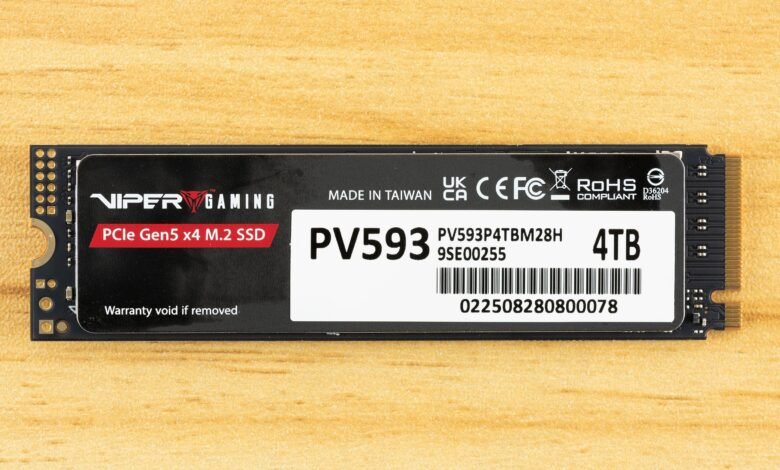
▼ Summary
– The Patriot Viper PV593 is a high-end, no-frills PCIe 5.0 SSD promising speeds up to 14 GB/s, representing a bolder move from a brand known for budget drives.
– Its market positioning aims for affordability in the high-end PCIe 5.0 segment, but its current pricing is high compared to competitors like the Adata XPG Mars 980 Blade.
– The drive uses a Silicon Motion SM2508 controller and older Micron 232-layer TLC NAND flash, a choice that likely reduces cost but is technically outdated.
– It is a double-sided M.2 drive with standard high-end specifications, including a five-year warranty and endurance ratings up to 700 TBW per terabyte.
– The article suggests the drive’s value is highly dependent on volatile market pricing, making it a potential secondary storage option rather than a primary performance leader.
Patriot Memory’s Viper PV593 enters the competitive PCIe 5.0 SSD arena with a promise of high-speed performance at a more accessible price point. This drive aims to deliver sequential read speeds up to 14,000 MB/s without the flashy extras like RGB lighting, focusing instead on core functionality. However, in a market experiencing significant price volatility and rapid technological advancement, the PV593 faces stiff competition, and its real-world value proposition requires careful scrutiny.
The concept of a budget-friendly, high-end PCIe 5.0 drive might seem contradictory, but it reflects current market dynamics. While early production of these drives coincided with forecasts of strong memory demand, the landscape has shifted. SSD component costs have risen dramatically, putting pressure on manufacturers to balance performance with affordability. The PV593 is positioned for builders who want the latest interface but must watch their budget, potentially slotting into a system as a secondary drive behind a faster primary SSD. Yet, its success hinges entirely on aggressive pricing, an area where competitors like the Adata XPG Mars 980 Blade currently have an edge.
On paper, the Viper PV593’s specifications are solid for its class. Available in 1TB, 2TB, and 4TB capacities, it utilizes a Silicon Motion SM2508 controller paired with Micron 232-layer TLC NAND flash. The advertised performance peaks at 14,000 MB/s for sequential reads and 13,000 MB/s for writes on the larger models, with random performance rated up to 2,000K IOPS. Endurance is rated at 700 TBW per terabyte, backed by a standard five-year warranty. While these figures are respectable, they are not class-leading, and the use of previous-generation flash memory can be a limiting factor compared to newer alternatives like Micron’s 276-layer TLC.
A physical inspection reveals a practical, double-sided design without an integrated heatsink. This layout, which places the controller, a single package of LPDDR4x DRAM, and four NAND packages on both sides of the PCB, helps manage costs. The majority of heat generation is concentrated on the top side, which should simplify cooling if a heatsink is added. This no-frills approach extends to the included software and accessories, which are minimal. Users are directed to free, third-party utilities like CrystalDiskInfo for drive monitoring and CrystalDiskMark for benchmarking.
When it comes to real-world performance, the Patriot Viper PV593 delivers speeds that are fast but often fall short of its maximum rated potential and the best-in-class competition. In benchmark testing, sequential write speeds can dip significantly under sustained loads, a common trait among drives using this controller and flash combination. While everyday tasks and game loading feel snappy, the drive doesn’t consistently leverage the full bandwidth of the PCIe 5.0 interface. For users whose workloads involve transferring massive files regularly, this performance inconsistency is a notable drawback.
The drive’s value is its most contentious aspect. At its launch price, the PV593 struggles to justify itself against both superior PCIe 5.0 drives and exceptionally fast PCIe 4.0 models available for less money. The higher endurance rating is a minor advantage, but not enough to offset a significant price premium. Its most logical use case is in a multi-drive setup where it serves as high-capacity, secondary Gen5 storage. For the majority of users building a new system, investing in a top-tier PCIe 4.0 SSD or spending slightly more for a faster PCIe 5.0 model like the Crucial T710 often makes more sense. The PV593’s appeal is entirely conditional on finding it at a deeply discounted price, transforming it from a disappointing performer into a competent budget option.
(Source: Tom’s Hardware)

