Saturn-Sized Planet Found in Rare “Einstein Desert”
▼ Summary
– Most exoplanets are found in tight orbits, but some are discovered via microlensing, which occurs when a planet’s gravity briefly brightens a distant star by bending its light.
– Microlensing can detect rogue planets drifting in interstellar space, as the lensing planet can be anywhere along the line of sight between Earth and the background star.
– Researchers have used microlensing and the Gaia telescope to find a Saturn-sized planet in the “Einstein desert,” a region where such detections are rare, offering clues about rogue planet origins.
– Rogue planets can form through gravitational interactions, such as collisions or stellar encounters, that eject them from their original solar systems, resulting in planets of various sizes.
– Alternatively, rogue planets may form directly from gravitational collapse in interstellar space, similar to stars, but stopping at a mass between a gas giant and a brown dwarf.
Astronomers have discovered a Saturn-sized world using a rare cosmic alignment, marking the first planet found within a region known as the “Einstein desert.” This detection, made possible by the microlensing phenomenon and the precise positioning of the Gaia space telescope, provides new clues about the mysterious population of planets that wander the galaxy alone, untethered to any star.
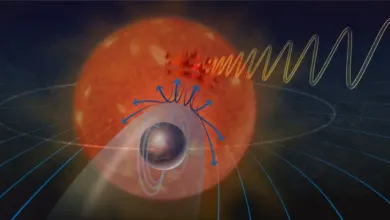
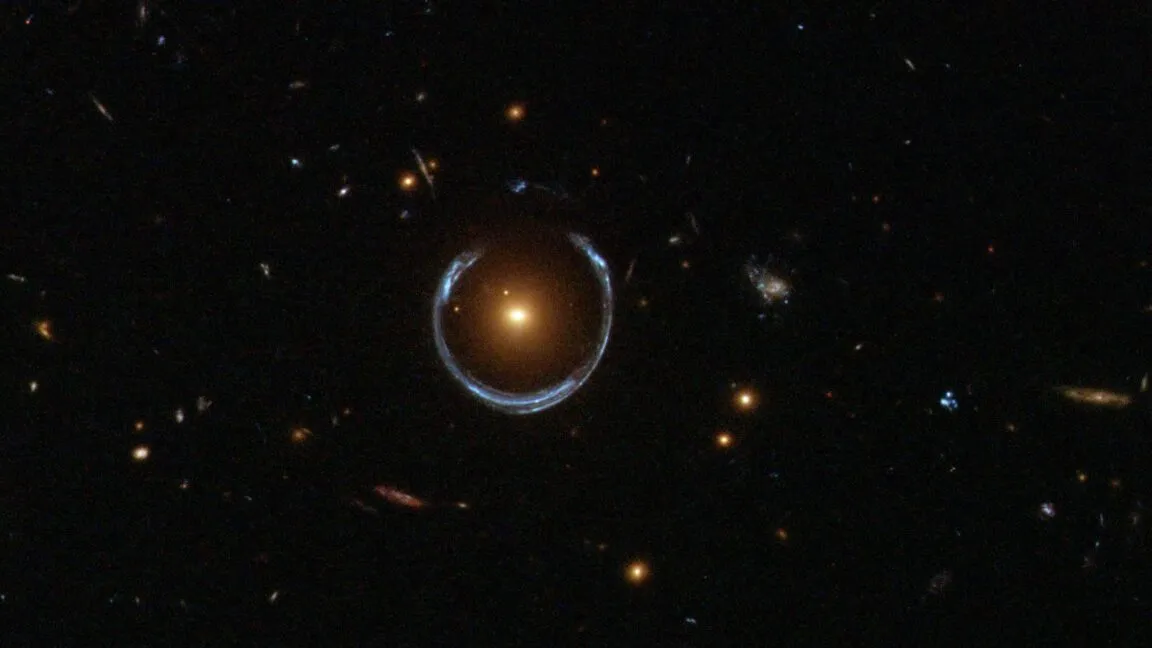
The vast majority of known exoplanets orbit their stars closely, allowing for repeated observations. Microlensing offers a different path to discovery. This method relies on a chance alignment where a foreground object, like a planet, passes directly between Earth and a distant background star. The planet’s gravity acts as a lens, bending the starlight and causing a temporary, telltale brightening. Unlike other techniques, microlensing can detect objects almost anywhere along that long line of sight, making it exceptionally good at finding isolated rogue planets drifting in the darkness between stars.
Researchers have now leveraged this method alongside data from Gaia to identify a planet roughly the mass of Saturn. Its location is particularly significant because it falls within the Einstein desert, a theoretical zone where planets of certain masses were predicted to be scarce due to the specific physics of microlensing events. Finding one there challenges some assumptions and may reveal details about how such free-floating worlds come to exist.
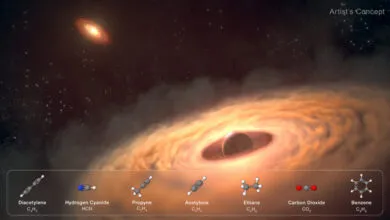
Planets typically form within swirling disks of gas and dust encircling young stars. Observations have captured these disks and even hints of infant planets taking shape inside them. This raises a fundamental question: how do planets break free from their stellar anchors? Scientists propose two primary origins for these nomadic objects.
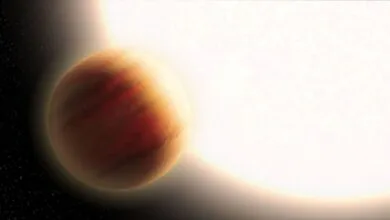
The first involves gravitational chaos within a planetary system. Intense interactions between planets, or a close encounter with a passing star, can violently eject a world from its orbit. Flung into the void, it becomes a rogue planet. These ejected worlds should resemble the planets we know, spanning a wide range of sizes from small rocky bodies to massive gas giants.
A second, more exotic formation path mirrors the birth of a star. A dense cloud of gas and dust could begin to collapse under its own gravity. If this process stalls prematurely, running out of material before a star ignites, the result could be a large gaseous object with a mass falling somewhere between a planet like Jupiter and a failed star known as a brown dwarf. This object would be a rogue planet from its very beginning, never having orbited a sun.
(Source: Ars Technica)