Hear With Your Eyes: Affordable Audio Visualization Under $200
▼ Summary
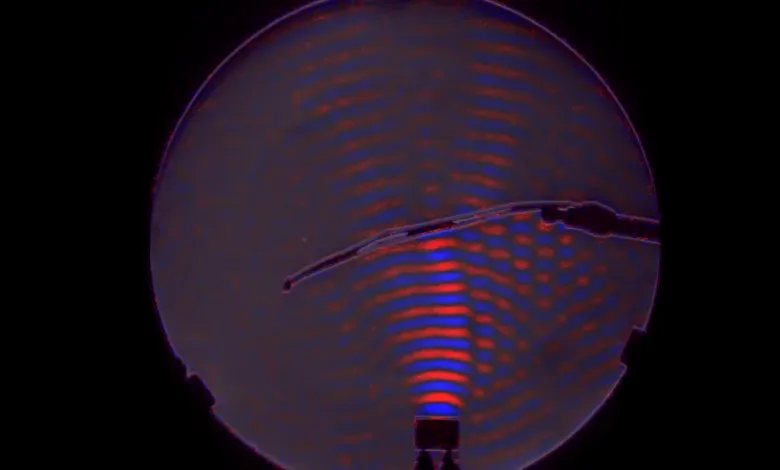
– The article describes a project by [PlasmatronX] that uses a modified Schlieren imaging technique to visually capture sound waves, including their interference patterns.
– Traditional Schlieren imaging typically visualizes air density changes from heat, but this setup captures density variations caused by sound pressure waves.
– Instead of using an extremely high-speed camera, the project employs a cleverly synchronized audio and optical capture system to achieve the effect.
– Significant technical modifications were required, such as altering audio circuits to remove filters and overvolting an LED flash for a quick strobe.
– The project’s resources are available on GitHub, and it is presented as an innovative example within a broader field of experimental imaging techniques.
Seeing sound waves is no longer a concept reserved for high-end laboratories, thanks to innovative and affordable audio visualization techniques. A recent project demonstrates how to capture the physical form of sound using a modified Schlieren imaging setup for less than two hundred dollars. This method transforms the invisible pressure waves we hear into visible patterns of light and shadow, even revealing complex phenomena like constructive and destructive interference.
Traditionally, Schlieren imaging is a technique used to visualize air density changes, often from heat sources like a candle flame or an engine exhaust. The core of the system involves a precisely aligned concave mirror and a sharp light source, such as a point LED. As light passes through air of varying densities, it refracts at slightly different angles. The mirror focuses this light onto a razor blade edge, which acts as a filter. Areas where the air density changes, like those created by sound waves, cause the light to bend just enough to miss the blade, creating a visible shadow pattern on a camera sensor.
The real challenge in adapting this for sound lies in timing. Sound waves oscillate far too quickly for a standard camera shutter to freeze. High-speed cameras capable of such feats are prohibitively expensive. The ingenious solution here bypasses this cost barrier entirely. Instead of relying on a fast shutter, the system uses a synchronized strobe light. An audio signal triggers a bright, ultra-fast LED flash at the exact moment a specific sound wave passes through the imaging area. This flash, often achieved by overvolting the LED for a split second, acts like a snapshot, illuminating the transient density variations caused by the sound.
Capturing the audio signal itself requires some electronic tinkering. Many common audio circuits incorporate high-pass filters that block low-frequency signals. Since sound visualization often benefits from seeing lower frequencies, these filters must be carefully removed or modified. This ensures the trigger signal sent to the LED strobe is a faithful representation of the original sound wave.
The result is a direct visual correlation to audio. A pure tone creates a stable, repeating pattern of light and dark bands. Music or complex sounds generate intricate, shimmering interference patterns that dance in real-time. This project proves that with some optical alignment, basic electronics knowledge, and a standard digital camera, visualizing the physics of sound is an accessible and fascinating DIY endeavor. For those inspired to try, the complete build details and code are available in the project’s repository. This approach to making the invisible audible joins a long tradition of creative imaging projects that push our perception, reminding us that there are always new ways to observe the fundamental forces around us.
(Source: Hack A Day)