Asus ROG Ally Review: Affordable Windows Handheld Gaming
▼ Summary
– The Asus ROG Xbox Ally is priced at $599, offering a more affordable option in a market where many handhelds cost $999 or more.
– It features a comfortable, Xbox-inspired design and a 7-inch 1080p 120Hz screen, but uses older RDNA 2 graphics technology.
– The device suffers from sleep/wake function issues and its Windows-based interface is less simple and smooth than SteamOS.
– Its gaming performance is similar to the Steam Deck OLED when plugged in, but the Steam Deck has a superior OLED screen and better performance on battery.
– A key practical advantage is that the Ally is regularly in stock, unlike the frequently out-of-stock Steam Deck OLED.
Finding a capable and affordable handheld gaming PC can feel like a challenge in today’s market, where premium models often command prices near or above a thousand dollars. The Asus ROG Ally enters the fray at a compelling $599, offering a Windows-based handheld that prioritizes accessibility. While it shares a comfortable, familiar design with its more powerful sibling, this model is defined by its budget-friendly AMD Ryzen Z2 A processor and a suite of compromises that potential buyers should carefully weigh.
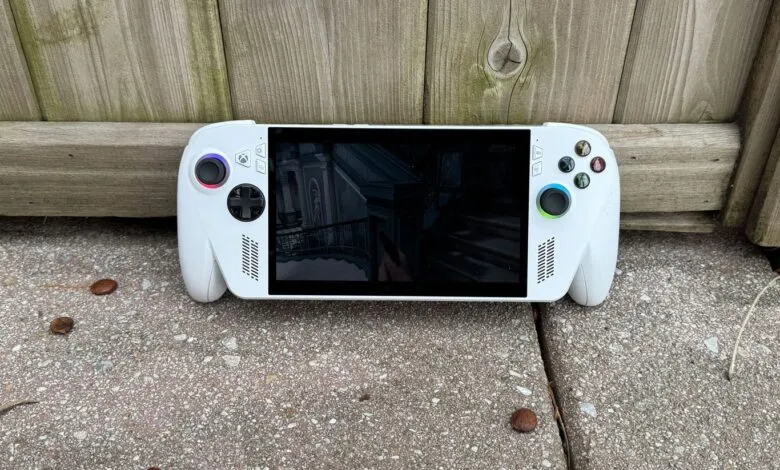
The device’s ergonomic design is a clear strength, mirroring the comfortable, controller-like grip of the pricier ROG Ally X. Its white chassis and Xbox-style colored buttons provide a distinct look, though the light color may show wear over time. Weighing 1.48 pounds, it feels slightly heavier than the Steam Deck OLED but remains manageable for extended sessions. The layout is intuitive for anyone accustomed to an Xbox controller, featuring ABXY buttons, offset joysticks with a rubberized texture, and customizable rear macro buttons. Top-side connectivity is generous, including two USB-C ports, a microSD card reader, and a headphone jack. Notably, the package lacks a carrying case, an accessory that competitors often include.
Under the hood, the system is powered by an AMD Ryzen Z2 A processor with integrated Radeon RDNA 2 graphics. This places its graphical capabilities in line with the older Steam Deck, rather than the newer RDNA 3.5 architecture found in premium models. It pairs this with 16GB of RAM and a 512GB SSD. The 60 WHr battery is larger than the Steam Deck’s but smaller than the one in the Ally X. For gaming, the hardware is clearly geared toward 720p resolution. Attempting to run modern titles at the native 1080p of the 7-inch, 120Hz screen typically results in unplayable frame rates. When plugged in and using its 20W turbo mode, performance can sometimes edge out the Steam Deck OLED, but on battery power, Valve’s device often maintains an advantage or matches it closely.
The software experience is built around the Xbox Full Screen Experience, which boots directly into a console-like interface. This is a significant improvement over navigating the standard Windows 11 desktop on a small screen, as it conserves system resources for gaming. However, it is not without friction. Third-party game launchers like Epic Games can be awkward to navigate with a controller, and games from outside the Xbox or Steam ecosystems lack integrated performance profiles. The most persistent issue involves sleep and wake functionality. During testing, putting the device to sleep with a game running frequently led to crashes, failure to wake, or controller disconnection errors. Asus suggests using hibernate mode as a more reliable workaround, acknowledging that a complete fix requires coordination across multiple companies.
Battery life will vary dramatically with game selection and settings. In a demanding title like Resident Evil Requiem at 720p with conservative settings, the device lasted approximately two and a half hours. The display is adequate, covering a wide color gamut, though it cannot match the vibrancy or peak brightness of an OLED panel. Audio from the front-facing speakers is serviceable for gameplay but lacks the vocal clarity desired for dialogue-heavy scenes. On a positive note, the device stays relatively cool during intensive use, with heat concentrated at the exhaust vent.
For tinkerers, the SSD is upgradeable, though the process involves careful prying to avoid damaging an internal ribbon cable. The joysticks are modular potentiometers, which are susceptible to drift over time, but third-party replacement options exist.
Ultimately, the Asus ROG Ally occupies a specific niche. Its primary competition is the Steam Deck OLED, which offers a superior screen, a more polished and intuitive operating system in SteamOS, and often better performance on battery power, all for a similar starting price. The Ally’s value proposition hinges entirely on its immediate availability in a market where the Steam Deck is frequently out of stock. If you need a handheld now and are willing to navigate Windows quirks and occasional technical hiccups, the ROG Ally delivers competent gaming in a well-designed form factor. For those who can wait, however, the more refined alternative may be worth the patience.
(Source: Tom’s Hardware UK)