Toshiba’s 78-Drive HDD Array Hits 17GB/s, Rivaling PCIe 5.0
▼ Summary
– In 2023, Toshiba demonstrated a 78-drive JBOD array that achieved 1.5PB of raw storage and 17GB/s throughput using 18TB SAS HDDs.
– The experiment showed that HDDs can deliver impressive aggregate performance for data centers when many drives are configured in parallel.
– Toshiba claimed that with further tuning, the system’s performance could potentially reach close to 20GB/s.
– The demonstration highlighted that large numbers of HDDs remain a cost-effective solution for scaling bulk storage capacity compared to SSDs.
– Despite newer systems offering higher specs, the test proved HDDs can play an active role in high-speed, high-capacity arrays, not just as cold archives.
Toshiba demonstrated in 2023 that hard disk drives can still deliver remarkable performance when deployed at scale, achieving throughput speeds that rival modern solid-state storage interfaces. In a specialized test, the company configured a massive array of 78 enterprise HDDs, showcasing that mechanical storage remains a highly cost-effective solution for data centers needing vast amounts of capacity without sacrificing speed.
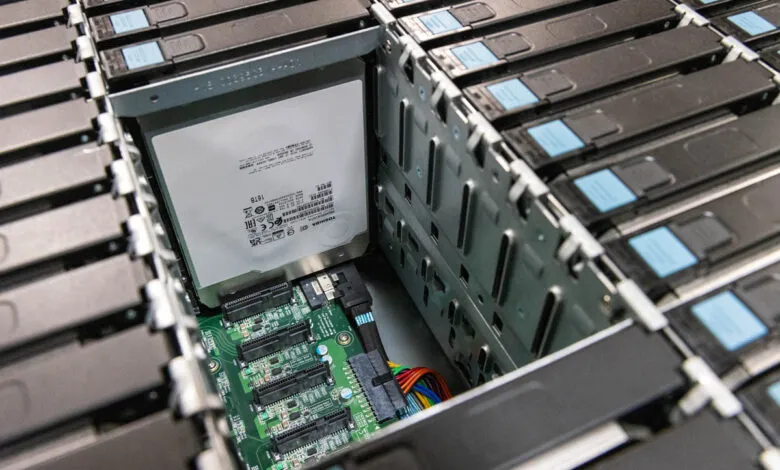
Engineers at Toshiba’s European laboratory filled a 4U top-loading JBOD chassis with 78 MG08 18TB SAS hard drives. The goal was to illustrate how parallel configurations can dramatically boost both storage space and data transfer rates. By connecting the array to a Supermicro server via SAS4 links and managing it with an Adaptec RAID controller, the system achieved a raw capacity of 1.5 petabytes. More impressively, it reached aggregate throughput speeds approaching 17 gigabytes per second, a figure that competes with PCIe 5.0 performance benchmarks.
The experiment highlighted a clear scaling effect. A single hard drive delivered approximately 300 megabytes per second, but as more drives were brought online, the total bandwidth increased almost linearly. With all 78 disks active, the system’s throughput was sufficient to surpass the limits of a 100 gigabit per second network. Toshiba engineers believed that with further firmware adjustments and hardware refinements, the same setup could potentially reach close to 20 gigabytes per second.
This demonstration underlined an important trade-off between density and performance in storage architecture. While solid-state drives continue to dominate high-performance tiers, large-scale HDD arrays provide a compelling balance of capacity and speed for bulk storage applications. Properly configured, hard drives are fully capable of supporting demanding data center workloads, not just acting as cold archives.
Since Toshiba’s 2023 test, the industry has continued to advance. Seagate’s Exos E 4U106, for example, now offers up to 2.5 petabytes and 36 gigabytes per second in a single enclosure. Even so, Toshiba’s experiment serves as a valuable reminder that traditional hard drives can play an active role in high-speed, high-capacity storage systems. The company has continued this line of research, opening a new HDD Innovation Lab in Düsseldorf in early 2025 to further explore how grouping HDDs can deliver scalable performance at a lower cost than all-flash alternatives.
(Source: techradar)