Airport Phone Confiscation: What Happens Next
▼ Summary
– Customs agents at Minneapolis-St. Paul International Airport seized the phone of labor organizer Janette Zahia Corcelius after she returned from Europe, and it has not been returned.
– The Council on American-Islamic Relations (CAIR) alleges that Customs and Border Protection (CBP) is systematically searching activists’ devices, targeting left-wing critics under the guise of counterterrorism.
– CBP can conduct basic inspections or advanced forensic searches of phones at the border, and while American citizens cannot be denied reentry for refusing a search, their phone may be seized and unlocked.
– CBP phone searches have risen 32 percent from 2023 to 2025, with 55,318 searches conducted in the 2025 fiscal year.
– Corcelius is suing to stop advanced searches, delete any data gathered, and return her phone, but legal rulings on warrantless phone searches vary by jurisdiction, creating a patchwork of regulations.
Even if you have nothing to hide, surrendering your smartphone to law enforcement is rarely a wise move. Yet for international travelers passing through American airports, refusal often isn’t an option , and this applies to U.S. citizens, too.
When Minnesota labor organizer Janette Zahia Corcelius returned from a three-week European trip in late April, customs agents at Minneapolis-St. Paul International Airport detained and questioned her. According to a federal complaint filed in Minnesota, agents searched her luggage twice, confiscated political literature she purchased abroad, and seized her phone , which still hasn’t been returned.
Does Customs and Border Protection have the constitutional authority to take your phone and keep it? The Council on American-Islamic Relations (CAIR), which sued the government on Corcelius’ behalf, argues no. The civil rights group claims she is being targeted for opposing ICE raids in Minneapolis. Her lawsuit against the Department of Homeland Security alleges the phone confiscation violates the Fourth Amendment and CBP’s own search and seizure regulations.
But this case extends beyond a single phone search. CAIR contends that CBP is conducting systematic searches of activists’ devices, employing counterterrorism language and tools to target left-wing critics. This aligns with President Donald Trump’s efforts to go after those he labels “Violent Left-Wing Extremists, including Anarchists and Anti-Fascists.”
According to the complaint, Corcelius called her attorney after being pulled aside. She handed her phone to the CBP manager on duty so they could speak with her lawyer. She was then told the phone was being confiscated. Both CBP agents and agents from Homeland Security Investigations, an ICE division focused on international crime, drug trafficking, and national security, searched her other property.
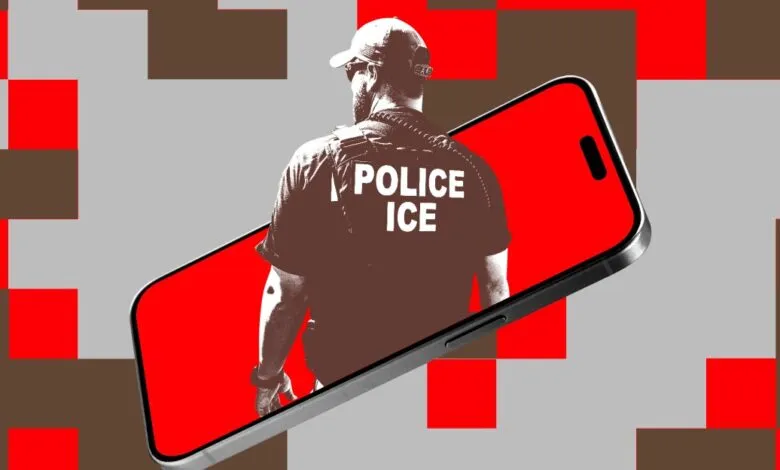
At the border, CBP can perform two types of device searches: basic inspections, where they only view content while the phone is in airplane mode, and advanced forensic searches, where they connect the phone to an external device to access and potentially copy its data. American citizens cannot be denied reentry for refusing a phone search, but their device may be seized. If agents unlock it , manually, with biometrics, or using tools from companies like Israel-based Cellebrite , its contents can be searched. CBP did not respond to The Verge’s request for comment.
Since Trump returned to office, immigrants, tourists, and other noncitizens have been deported or denied entry after phone searches, and in one case, detained and allegedly “violently interrogated” by customs agents. Activists, including members of a convoy delivering humanitarian aid to Cuba, have also had phones seized at the border.
While CBP phone searches remain relatively uncommon, they are increasing. The agency conducted 55,318 searches of phones and other electronic devices in fiscal year 2025, up from 41,767 in 2023 , a 32 percent increase.
The CAIR complaint notes that border agents can only confiscate property at a port of entry if they have “reasonable cause to believe that any law or regulation enforced by Customs or Border Protection or Immigration and Customs Enforcement has been violated.” The sole exception is a “national security concern.”
After conservative activist Charlie Kirk’s assassination last September, Trump issued an executive order designating “Antifa” as a terrorist organization, despite it lacking formal structure. He also issued a presidential memorandum calling for a “new law enforcement strategy that investigates all participants in these criminal and terroristic conspiracies.” Presidential adviser Stephen Miller described this as an “all-of-government approach to dismantle left-wing terrorism.” By linking Kirk’s killer to so-called “antifa terrorists” and smearing all opponents as such, the administration has created cover to harass critics.
In January, the administration characterized widespread resistance to ICE’s brutal raids in the Twin Cities as a coordinated plot. The FBI began investigating Signal chats where Minnesotans track and organize against ICE. Miller called Alex Pretti, one of two people DHS agents killed in Minneapolis, a “domestic terrorist” and “would-be assassin.”
Corcelius was among those opposing ICE’s presence in the Twin Cities. Beyond organizing, she shared news on social media about a Minneapolis City Council resolution encouraging European institutions to divest from corporations contracting with DHS, according to the complaint.
“These rules that attempt to bring terrorism into the domestic policy discussion are exactly what we have been afraid of happening for a long time,” John Fossum, a CAIR staff attorney representing Corcelius, told The Verge. “The use of these types of terrorist designations domestically allows the administration to plug into this national security apparatus that allows them to conduct searches, to conduct seizures, to target people in ways they otherwise certainly are not allowed to do under domestic law.”
Corcelius is asking a federal court to order CBP to stop any advanced searches of her phone, delete any gathered data, and return her phone and belongings. She also seeks to prohibit DHS from conducting non-routine searches of her property in the future and to require policy changes around non-routine phone searches.
Even if the court rules in her favor, it may not stop CBP from targeting activists elsewhere. In 2024, a federal judge in New York ruled that CBP cannot search travelers’ phones without a warrant , but that ruling only applies to the Eastern District, which includes John F. Kennedy Airport. In 2021, a U. S. appeals court ruled that CBP agents can search devices without a warrant. This creates a patchwork of regulations across the country. In some jurisdictions, CBP can conduct warrantless basic inspections but not forensic ones. In others, CBP has free rein. Similarly, any ruling in Corcelius’ case may only apply in Minnesota.
As of this writing, she still hasn’t gotten her phone back.
(Source: The Verge)