Slate Truck: Too Minimal for Practical Use?
▼ Summary
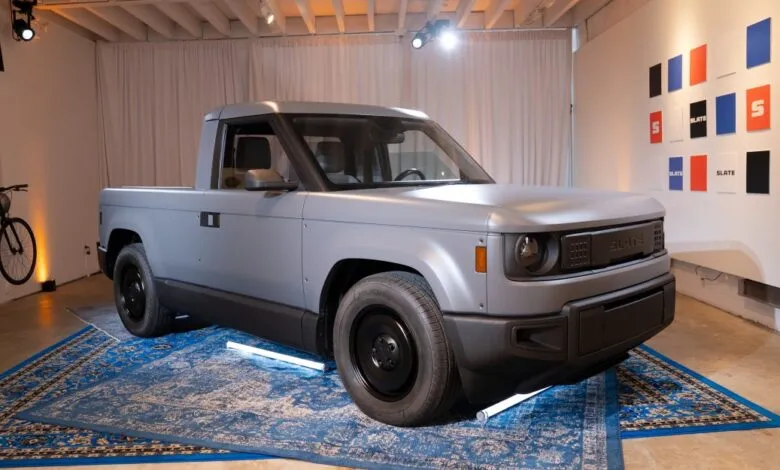
– The Slate Truck is notably small for an American pickup, with dimensions comparable to a 1985 Toyota SR5 and a curb weight of about 3,602 pounds.
– Despite its compact exterior, the truck’s interior is designed to be spacious and comfortable, specifically accommodating people over six feet tall.
– The vehicle is a minimalist, two-seater electric pickup, omitting features like paint, a radio, and power windows to prioritize affordability and customer choice.
– Slate emphasizes customization through accessories and aftermarket kits, including wraps and conversion kits to transform the truck into an SUV.
– It offers two battery options with EPA-estimated ranges of 150 and 240 miles, trade-offs made to serve as an affordable urban vehicle rather than maximize aerodynamic range.
The Slate Truck immediately stands out for its compact dimensions, a stark contrast to the oversized pickups dominating American roads. At just over 174 inches long, it shares a footprint with classic 1980s compact trucks. This intentionally small form factor is a core part of its identity, prioritizing urban maneuverability over imposing presence. Despite the exterior size, the interior feels surprisingly spacious. Even for someone over six feet tall, there is generous headroom and legroom, a deliberate design choice that challenges the cramped cabins often found in modern small vehicles.
This focus on usable space reflects the startup’s broader philosophy of practical accessibility. The company’s head of design, Tisha Johnson, explained that while many vehicles are designed for occupants around six-foot-one, Slate aimed for a more comfortable and ample interior from the outset. This emphasis on thoughtful utility extends to every aspect of the truck, which arrives as a radically minimalist electric vehicle. The base model, dubbed the Blank Slate, forgoes paint, a radio, power windows, and even a cellular connection in its quest for affordability.
Such extreme cost-cutting measures naturally raise questions. In a market where gasoline-powered vehicles in the mid-$20,000 range include standard infotainment, the Slate’s stripped-down approach walks a fine line. The initial skepticism fades, however, upon experiencing its particular brand of minimalism. Unlike some designs that bury essential controls in frustrating digital menus, Slate’s philosophy centers on utility and conscious choice. Johnson, whose background includes a decade at Volvo, described intense internal debates over every feature. The guiding principle was whether removing an item lowered cost without critically harming function, thereby passing savings directly to the customer.
Some debates were straightforward. The necessity of an HVAC system in an era of climate change was undeniable, so air conditioning stayed. Other traditional creature comforts were eliminated. There is no built-in stereo, only a small speaker for mandatory audio alerts. The rationale is to let customers decide if and how they add sound, perhaps with a portable Bluetooth speaker, rather than forcing all buyers to pay for a system they may not want.
This ethos of owner customization is central to Slate’s vision. The company plans to offer a robust catalog of accessories and kits, from decorative wraps and wheels to functional modifications like suspension lifts or even a conversion kit to transform the two-seat pickup into a five-seat compact SUV. The goal is to move beyond predetermined trim levels, allowing owners to define their vehicle over time as their needs and budgets change.
This commitment to affordability and modularity necessitates significant engineering tradeoffs. The truck’s upright, boxy design increases wind resistance, impacting aerodynamic efficiency and range. Slate currently offers two battery options: a 53kWh pack with an estimated 150 miles of range and an 84kWh pack rated for up to 240 miles. These figures are modest compared to many modern EVs, a concession Johnson attributes to a “real clarity” about the truck’s primary use as an urban commuter vehicle. The design prioritizes interior space and utility over chasing maximum range, accepting that its form requires working “in a very particular way to optimize performance.”
Whether this bold product strategy will resonate remains an open question. Launching a new EV brand is a formidable challenge, yet rising vehicle and fuel costs could make an affordable, customizable option appealing. Slate is betting that a segment of buyers will value its minimalist foundation and post-purchase personalization over a fully equipped cabin. The first trucks are scheduled to reach customers by the end of 2026, providing a concrete test for its unconventional approach.
(Source: The Verge)