HP’s PC-in-a-Keyboard: A Hot-Desking Solution for Businesses
▼ Summary
– HP has introduced the EliteBoard G1a, a full Windows computer built into a keyboard, designed for portability between workstations by plugging into monitors and mice.
– The device is a Copilot+ PC with AMD Ryzen AI processors, offering AI features like Microsoft Recall, and connects via USB-C or an included adapter for power and video.
– HP markets it as an enterprise device with security features, targeting businesses with hoteling practices, but its practicality for home use is questioned due to the need for duplicate setups.
– The article also details HP’s new EliteBook X G2 laptop lineup, offering 14-inch models with various processor options from Intel, AMD, and Qualcomm, and advanced features like human presence detection.
– HP announced AI software for enterprise printers, called HP for Microsoft 365 Copilot, enabling document redaction, smart file naming, and summaries directly from the printer’s touch screen.
The traditional model of issuing laptops to employees is being challenged by a novel concept from HP: a complete Windows computer built directly into a full-size keyboard. This innovative device, the HP EliteBoard G1a, aims to redefine workplace mobility by allowing users to carry their core computing power in a highly portable form factor, simply plugging into available monitors and peripherals at any location.
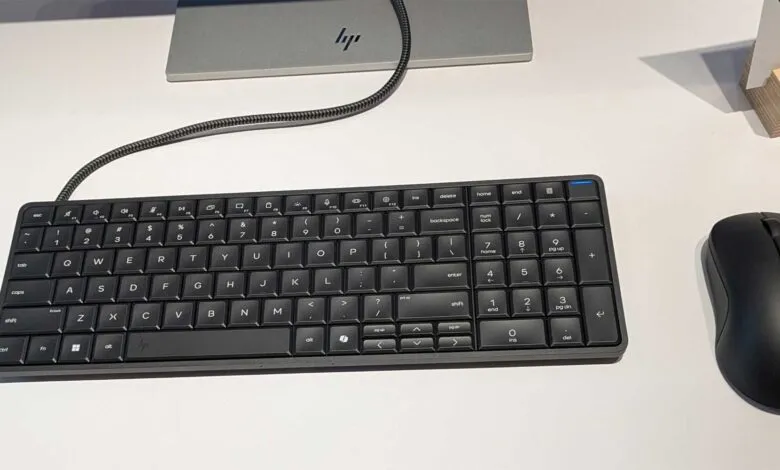
Announced at CES, the EliteBoard G1a resembles a standard desktop keyboard with 93 keys, including a numeric keypad. It offers a comfortable typing experience with 2mm of key travel, exceeding most laptops, though it stops short of being a mechanical keyboard. The true innovation is hidden on its back surface, which features a small cooling vent and either two USB-C ports or a single port with a permanently attached cable. The core idea is elegant in its simplicity: connect the keyboard to a USB-C monitor for simultaneous power, video, and data over a single cable, pair a wireless mouse, and your workstation is ready. For monitors without USB-C input, an included adapter bridges the connection to HDMI.
Weighing between 1.5 and 1.7 pounds, the G1a is more portable than most laptops, albeit longer. HP demonstrated a slim carrying envelope and noted it fits any bag designed for a 16-inch laptop. Underneath the keys, it packs modern computing power with a choice of AMD Ryzen AI 5 or 7 processors featuring integrated Radeon 800 graphics and a Neural Processing Unit (NPU) capable of 50 TOPS. This qualifies it as a Microsoft Copilot+ PC, unlocking offline AI features like Recall and Windows Studio Effects. Configurations can include up to 64GB of RAM and 2TB of SSD storage, with Wi-Fi 6E or 7 connectivity.
Set for a March release, the G1a will be available with or without the embedded cable; the latter option is likely more practical for durability and ease of transport. An optional 32 Wh battery promises up to 3.5 hours of untethered use, which is useful for transporting the device between desks without a full shutdown. HP is targeting this as an enterprise solution, equipping it with HP Wolf Security for Business for firmware-level protection. The vision is to shift from a “laptop culture” to a “keyboard culture,” particularly in hot-desking environments where employees move between workstations.
However, this model assumes employees have compatible monitor setups at home, which could introduce cost and support complexities for IT departments. The keyboard PC’s success may hinge on its price point needing to be substantially lower than a standard business laptop. A more immediate application could be in space-constrained environments like call centers, where the device could serve as a compact, shared computing terminal for rotating shifts, eliminating the need for bulkier all-in-one systems.
For those preferring a conventional laptop, HP also unveiled its updated EliteBook X G2 series. These 14-inch laptops are uniquely offered with processor choices from all three major chipmakers: Intel’s upcoming “Panther Lake,” Qualcomm’s Snapdragon X series, and AMD’s Ryzen AI chips. Weighing from approximately 2.2 pounds, they feature high-resolution display options up to a 2880 x 1800 OLED touchscreen. Specifications include up to 64GB of RAM, 2TB SSD storage, a 5MP IR webcam with human presence detection, and Wi-Fi 7 connectivity, with 5G modem options available on most models.
In a separate enterprise-focused announcement, HP is integrating Microsoft 365 Copilot directly into its compatible Workpath printers. This upcoming software, available this spring, will enable AI-powered functions from the printer’s own touchscreen. Users will be able to redact personal information from documents before printing, generate suggested file names for scans, print AI-generated summaries, and perform on-device translation, all designed to streamline document handling and enhance security directly at the point of use.
(Source: The Register)