SanDisk Rebrands WD SSDs as New ‘Optimus’ Drives
▼ Summary
– Western Digital is splitting into two separate companies: one for hard drives and a new SanDisk for solid-state storage.
– This split reverses the company’s $19 billion acquisition of SanDisk from a decade ago.
– Existing consumer WD Blue and WD Black SSDs are being discontinued and rebranded as new SanDisk Optimus drives.
– The new SanDisk Optimus line maintains the same technical tiers and model numbers as the old WD drives.
– Key technical differences between the drive tiers remain, such as flash memory type, PCIe interface generation, and cache design.
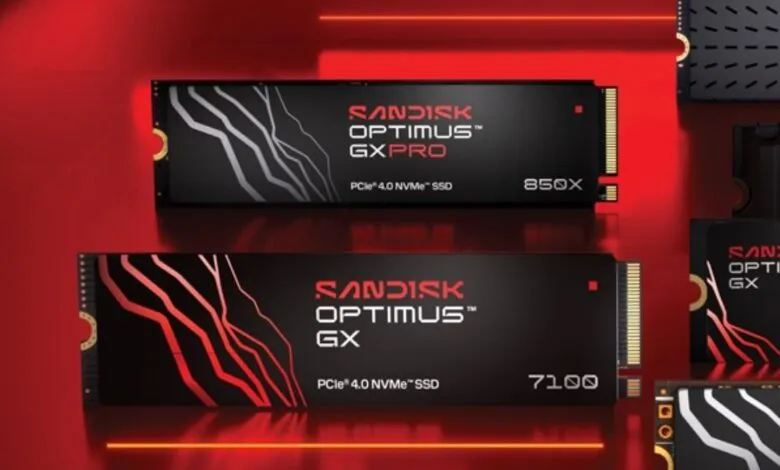
The recent corporate restructuring at Western Digital has led to a significant rebranding of its popular solid-state drives, with the SanDisk name now taking center stage for consumer storage products. Following the company’s decision to separate its hard drive and flash memory businesses, the familiar WD Blue and WD Black SSD lineups are being phased out. In their place, SanDisk is introducing a new family of Optimus-branded NVMe drives, which carry over the same underlying hardware and model numbers but with updated branding that reflects the new corporate focus.
This move effectively reverses the acquisition that brought SanDisk under the Western Digital umbrella nearly a decade ago. The transition means that mainstream WD Blue drives will now be sold as SanDisk Optimus SSDs. The first model, the Optimus 5100, is a direct rebadge of the WD Blue SN5100. For the performance-oriented segment, mid-tier WD Black drives are becoming SanDisk Optimus GX models, with the Optimus GX 7100 replacing the WD Black SN7100. The high-end enthusiast drives are receiving the SanDisk Optimus GX Pro designation. This tier includes the Optimus GX Pro 850X and the Optimus GX Pro 8100, which take the place of the WD Black SN850X and SN8100, respectively.
For most users, the performance difference between the entry-level and high-end drives in this new lineup might not be immediately noticeable, as all are fast NVMe SSDs. The fundamental technical distinctions between the models, however, remain unchanged from their WD-branded predecessors. The new SanDisk Optimus 5100 (formerly WD Blue) continues to utilize quad-level cell (QLC) NAND flash, which typically offers higher capacities at a lower cost but with somewhat reduced write speeds and endurance compared to other types. The mid-range Optimus GX 7100 employs more durable triple-level cell (TLC) memory.
The performance ceiling is pushed by the Optimus GX Pro models. The Optimus GX Pro 8100 achieves its top speeds by adopting the newer PCIe 5.0 interface and incorporating a dedicated DRAM cache. In contrast, the Optimus 5100 and GX 7100 rely on a Host Memory Buffer (HMB) feature, which uses a small portion of the system’s RAM for caching duties. The Optimus GX Pro 850X represents a slightly older design, retaining a dedicated DRAM cache but operating at the maximum speeds of the PCIe 4.0 interface. This rebranding signifies a clearer market positioning under the SanDisk name, with the Optimus family now defining the consumer SSD portfolio.
(Source: Ars Technica)