Intel Scraps Next-Gen Mainstream Xeon Server CPUs
▼ Summary
– Intel has canceled its next-generation 8-channel “Diamond Rapids” Xeon server processors, removing them from the roadmap under new Data Center Group leadership.
– The high-end server processor market is transitioning to 16-channel memory, with both Intel and AMD planning 16-channel designs for future AI cluster support by late 2026.
– 8-channel platforms like the current Xeon 6700 series remain popular due to their cost-effectiveness, allowing for cheaper motherboards and memory configurations with more DIMM slots.
– Intel is simplifying its Diamond Rapids platform by focusing solely on 16-channel processors to extend benefits across different customer use cases.
– This cancellation follows industry trends where lower-end server platforms with fewer memory channels are gradually phased out as market demands shift toward higher capacities.
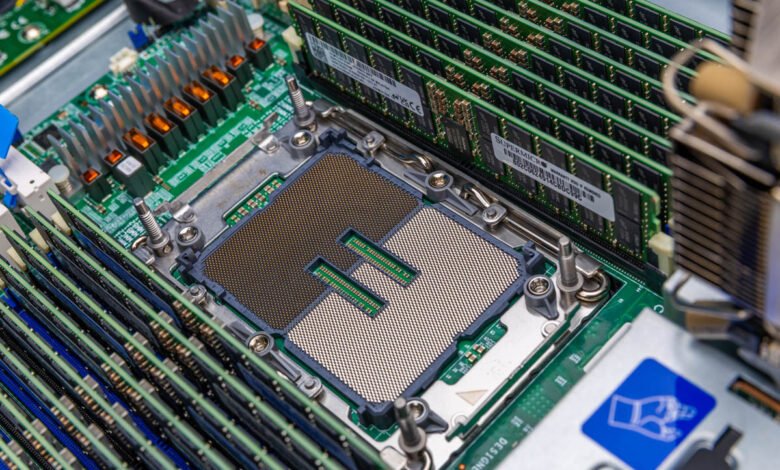
A major shift is underway in Intel’s server processor strategy, as the company has officially removed its next-generation mainstream Xeon CPUs from the product roadmap. Intel’s decision to cancel the 8-channel “Diamond Rapids” processors, which were slated to succeed the current Granite Rapids-SP and the popular Xeon 6700P/6500P series, signals a significant consolidation of its data center offerings. This move, confirmed by Intel following an internal review of its server roadmap, means the tech giant will now focus exclusively on developing higher-end 16-channel memory platforms for its future Xeon lineup.
The server processor landscape is evolving toward systems with greater memory bandwidth to power increasingly demanding workloads, particularly in artificial intelligence. Both Intel, with its 16-channel Diamond Rapids design, and AMD, with its upcoming EPYC “Venice” processors, are steering the industry in this direction. This transition to 16 memory channels, expected around the second half of 2026, is seen as essential for supporting next-generation AI cluster infrastructure.
Currently, Intel employs a dual-platform approach in the data center. Its high-performance offerings, such as the Granite Rapids-AP (Xeon 6900P series) and the specialized Sierra Forest-AP, utilize 12 memory channels. In a standard rack server, this configuration allows for a substantial number of components. This design philosophy is mirrored by AMD’s EPYC 9004 and 9005 series for platforms like Genoa and Turin, which also leverage 12-channel memory. Theoretically, a 12-channel design provides a fifty percent boost in memory bandwidth compared to an 8-channel setup, assuming all other technical factors are constant.
However, the now-canceled 8-channel platform, known as Birch Stream-SP for the Xeon 6700 series, offered distinct advantages that made it a favorite for many mainstream server applications. A key benefit was its ability to support a two DIMMs per channel (2DPC) configuration. This allows a dual-socket server to house 32 memory modules, which is a third more than what a 12-channel platform can physically accommodate. For many enterprise workloads that prioritize vast memory capacity over raw bandwidth, this was a critical feature.
The popularity of the cost-effective 8-channel Xeon 6700 series is evident in real-world deployments. Recent industry benchmark submissions for MLPerf Training showed the Xeon 6700P appearing more frequently than its higher-end Xeon 6900P counterpart. This underscores a market segment where a balanced combination of core count, memory capacity, and overall platform cost outweighs the need for maximum performance. The 8-channel platform enabled more affordable motherboards and lower DRAM costs, as system builders could use a larger number of lower-capacity, less expensive memory modules.
The original plan for the next-generation Oak Stream platform was to offer both 8-channel and 16-channel variants of the Diamond Rapids CPU. The 16-channel design was poised to deliver memory capacity comparable to an 8-channel platform running in a 2DPC mode, effectively bridging the gap. Recent executive commentary had already hinted at strategic changes, with Intel’s CEO discussing decisions to improve product competitiveness. Following this, industry chatter among original equipment manufacturers (OEMs) suggested the 8-channel Diamond Rapids was in jeopardy.
Intel has now confirmed this change. In an official statement provided to media, a company spokesperson said, “We have removed Diamond Rapids 8CH from our roadmap. We’re simplifying the Diamond Rapids platform with a focus on 16 Channel processors and extending its benefits down the stack to support a range of unique customers and their use cases.”
This type of product line consolidation is not unprecedented in the server market. Over time, entry-level platforms that maintain the same memory channel count as their predecessors often get phased out as the industry standardizes on more capable, higher-bandwidth architectures. While the Xeon 6700P/6500P series found a strong user base, the broader trend points toward the eventual disappearance of smaller socket options as server capacities continue to scale upward.
(Source: ServeTheHome.com)


