Nvidia, Deutsche Telekom Form €1B AI Data Center Partnership in Munich
▼ Summary
– Nvidia and Deutsche Telekom signed a €1 billion partnership to establish an “AI factory” in Munich, aiming to increase Germany’s AI computing power by 50%.
– The project, called the “Industrial AI Cloud,” will use over 1,000 Nvidia DGX B200 systems and up to 10,000 Blackwell GPUs for AI inferencing while complying with German data laws.
– Early partners include Agile Robots for server rack installation and Perplexity for providing in-country AI inferencing services to German users and companies.
– This initiative occurs amid European tech industry calls to reduce reliance on foreign infrastructure and criticism of EU AI regulations for hindering innovation.
– The project is separate from the EU’s AI gigafactory initiative and is expected to begin operations in early 2026, focusing on industrial applications like digital twins and simulations.
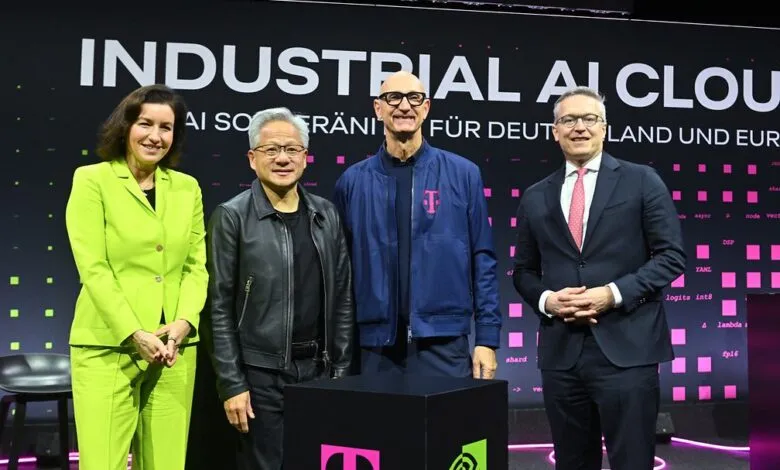
A major new partnership between Nvidia and Deutsche Telekom is set to dramatically expand Germany’s artificial intelligence capabilities. The two technology giants have announced a joint €1 billion investment to construct a powerful “AI factory” in Munich. This ambitious facility is projected to increase the nation’s total AI computing power by an impressive 50%, providing a significant boost to its technological infrastructure.
Dubbed the “Industrial AI Cloud,” the project will leverage a massive deployment of Nvidia hardware. The centerpiece will be more than 1,000 Nvidia DGX B200 systems and RTX Pro Servers, incorporating up to 10,000 Blackwell GPUs. This formidable computing power will be dedicated to providing AI inferencing services and other advanced capabilities for German businesses. A key feature of the initiative is its commitment to operating in full compliance with Germany’s stringent data sovereignty regulations, ensuring that data remains within national borders.
Deutsche Telekom has already confirmed several foundational partners for the venture. The robotics firm Agile Robots will utilize its automated systems to install server racks within the facility. Concurrently, the AI company Perplexity will leverage the data center to deliver localized, “in-country” AI inferencing to users and corporations across Germany. The telecom leader also highlighted that the facility will support sophisticated industrial applications, including the creation of digital twins and the execution of complex, physics-based simulations.
Under the partnership’s framework, Deutsche Telekom will be responsible for supplying the physical infrastructure, including the data center itself. The enterprise software powerhouse SAP will contribute its Business Technology platform and a suite of applications to the ecosystem, creating a comprehensive service offering for industrial clients.
This collaboration arrives at a pivotal moment for the European technology sector. There is a growing chorus of voices within the industry urging EU policymakers to decrease dependence on foreign infrastructure and service providers, advocating instead for the cultivation of homegrown alternatives. Simultaneously, many tech firms have expressed concerns that the bloc’s current approach to AI regulation could potentially stifle innovation rather than encourage it.
Earlier this year, the European Union committed €200 billion to establish “AI gigafactories” across the continent, with a specific focus on industrial and mission-critical applications. However, overall funding for AI initiatives within the EU continues to lag significantly behind investments in the United States, where corporations like Nvidia, Microsoft, Google, and Oracle are pouring hundreds of billions into constructing massive data centers and supporting infrastructure.
Deutsche Telekom has clarified that its Munich project, which is scheduled to begin operations in early 2026, is a separate endeavor from the EU’s broader gigafactory initiative. Tim Höttges, the CEO of Deutsche Telekom, emphasized the strategic importance of this investment, stating, “Mechanical engineering and industry have made this country strong. But here, too, we are challenged. AI is a huge opportunity. It will help to improve our products and strengthen our European strengths.”
(Source: TechCrunch)