Nvidia Soars to $5 Trillion Milestone as CEO Rejects AI Bubble Fears
▼ Summary
– Nvidia reached a $5 trillion market capitalization, becoming the first company to achieve this milestone after announcing $500 billion in AI chip orders and plans to build seven supercomputers for the US government.
– The company’s stock has surged nearly 12-fold since ChatGPT’s launch in late 2022, with shares rising 4.6% following the GTC conference announcements.
– CEO Jensen Huang dismissed concerns about an AI bubble, stating that AI models are widely used and paid for, while projecting shipments of 20 million latest chips compared to 4 million of the previous generation.
– Despite Nvidia’s success, there are persistent concerns about an AI investment bubble, with fears that market enthusiasm has exceeded the technology’s immediate economic value.
– Analysts warn that overheated valuations could be problematic, noting that AI expansion relies on dominant players financing each other and may face issues if investors shift focus to cash flow returns.
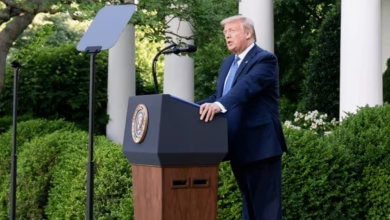
Nvidia has shattered records by becoming the first corporation ever to achieve a five trillion dollar market capitalization, a landmark valuation reached just three months after it hit the four trillion dollar threshold. This historic surge occurred following CEO Jensen Huang’s keynote at the GTC conference in Washington, DC, where he revealed the company secured five hundred billion dollars in artificial intelligence chip orders and will construct seven supercomputers for the United States government. The rapid ascent has propelled Nvidia past industry titans Apple and Microsoft, yet it simultaneously amplifies ongoing worries about a potential bubble in the AI investment sector.
Since the debut of ChatGPT in late 2022, Nvidia’s stock has skyrocketed, increasing in value by nearly twelve times. This explosive growth has been a primary force behind the S&P 500 reaching unprecedented highs. On Wednesday, the company’s shares climbed another 4.6 percent, a direct response to the announcements made at its GTC conference the previous day. In an interview with Bloomberg Television at the event, Huang directly addressed the widespread anxiety over soaring valuations. He stated his firm belief that the current market does not represent an AI bubble, pointing out that businesses are actively and willingly paying for a wide variety of AI services and models.
During his conference presentation, Huang provided staggering figures to illustrate the company’s accelerating momentum. He projected that Nvidia will ship twenty million units of its newest chips, a number that dwarfs the total lifetime shipments of just four million units for the prior Hopper generation. The colossal five hundred billion dollar order book encompasses cumulative demand for its Blackwell and Rubin processors through the end of 2026. Huang did clarify, however, that these projections deliberately exclude any potential future sales to the Chinese market.
Despite the current atmosphere of triumph, Nvidia’s extraordinary success is accompanied by a significant measure of caution. Even before the latest valuation leap, the breakneck speed of AI-related investment has stoked persistent fears that market excitement has raced far ahead of the technology’s capacity to generate immediate, tangible economic returns. A number of financial analysts are sounding the alarm, suggesting that current valuations may indeed be overheated. Matthew Tuttle, CEO of Tuttle Capital Management, expressed a particularly pointed concern to Reuters, noting that the present AI expansion is heavily reliant on a small group of dominant companies essentially funding each other’s growth. He warned that if investor focus shifts from capacity announcements to demanding actual cash flow returns, the entire ecosystem could face a sudden and severe disruption.
(Source: Ars Technica)