OpenAI’s Atlas Browser: A New Era for AI and Climate Action

▼ Summary
– A TikTok deal between the US and China may be finalized this week, with a meeting scheduled between Donald Trump and Xi Jinping.
– Covid vaccines have shown promise in prolonging the lives of cancer patients, suggesting potential for a universal cancer vaccine.
– Developing nations are benefiting economically from AI decolonization by requiring local data processing, spreading AI wealth beyond Silicon Valley.
– Rising electricity costs are driven more by expensive equipment and disaster preparation than by AI’s energy demands.
– California State University is partnering with Amazon, OpenAI, and Nvidia to become a major AI-empowered institution for student career readiness.
Navigating today’s technology landscape requires staying informed on pivotal developments, from geopolitical tech negotiations to AI’s expanding role in climate and education. Here’s a curated selection of noteworthy stories making waves across the digital sphere.
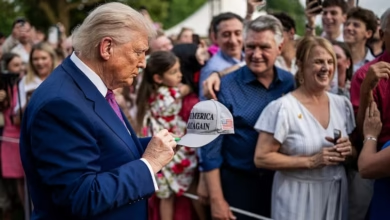
Former President Donald Trump has indicated a potential TikTok agreement could emerge this week, possibly during his scheduled meeting with Chinese leader Xi Jinping. This follows remarks from US Treasury Secretary Scott Bessent, who seemed to prematurely announce the deal was finalized, adding a layer of intrigue to ongoing diplomatic discussions.
In health tech, recent studies show Covid vaccines contributed to extended survival rates among cancer patients, fueling optimism for a future universal cancer vaccine. This breakthrough coincides with reports that US federal health agencies are shifting away from mRNA vaccine technologies, marking a significant turn in public health strategy.
The global AI revolution is unfolding unevenly, with developing nations gaining economic advantages through “AI decolonization” policies. Regulations mandating local data processing by Silicon Valley titans are helping distribute the industry’s financial benefits more broadly. Elsewhere, Saudi Arabia is aggressively positioning itself as a premier “AI exporter,” while India races to secure technological self-reliance in artificial intelligence.
Rising electricity bills are often attributed to artificial intelligence’s energy demands, but the real culprits include expensive grid infrastructure and disaster preparedness investments. Amazon reportedly explored hiding how much water its data centers consume, raising environmental concerns. Still, experts debate whether AI’s potential to optimize energy systems might ultimately benefit the power grid.
California State University is poised to become the nation’s largest “AI-empowered” academic institution through collaborations with Amazon, OpenAI, and Nvidia. This initiative aims to equip students for a workforce increasingly shaped by intelligent systems. Parallel conversations explore how emerging tools reshape skill acquisition, why affluent families favor institutions like High Point University, and how job seekers can navigate a challenging employment climate.
A controversial new startup is openly marketing AI-powered bot interactions designed to sway social media, despite clear violations of platform rules. Meanwhile, the real estate sector faces its own AI disruption, with prospective buyers encountering a flood of artificially enhanced property listings, complicating the home search process.
(Source: Technology Review)