Claude’s New Skills Boost Workplace Productivity

▼ Summary
– AI companies are increasingly focusing on developing practical AI agents for consumers and professionals after years of conceptual and experimental work.
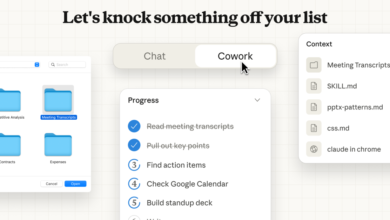
– Anthropic launched Skills for Claude, a tool that provides instructions and resources to enhance Claude’s performance on specific work tasks like Excel and brand guidelines.
– The Skills feature is available to Pro, Max, Team, and Enterprise users and aims to reduce the need for detailed prompting by tailoring Claude’s capabilities to organizational contexts.
– Major tech companies like OpenAI, Google, and Microsoft are competing to advance AI agent technology, with progress being incremental and marked by frequent feature updates.
– OpenAI recently introduced AgentKit to help developers build and deploy agents, showcasing use cases with companies like Albertsons for tasks such as improving sales strategies.
Anthropic has introduced a powerful new feature called Skills for Claude, designed to significantly enhance workplace productivity by tailoring the AI’s capabilities to specific professional tasks. This tool allows organizations to create custom folders containing instructions, scripts, and essential resources that Claude can access on demand. The result is a smarter, more context-aware assistant capable of handling everything from complex Excel operations to ensuring brand voice consistency across communications. Users can build these Skills to match their unique job requirements and deploy them across Claude.ai, Claude Code, the Anthropic API, and the Claude Agent SDK. Early adopters include prominent companies like Box, Rakuten, and Canva.
The primary goal of Skills is to refine Claude’s performance as an AI agent for specialized work environments. This means employees spend less time crafting the perfect prompt or re-explaining company-specific context for every new request. Access to this feature is currently limited to Pro, Max, Team, and Enterprise subscribers. Brad Abrams, a product lead at Anthropic, highlighted that the real value of Skills lies in its application for building effective agents. He explained it provides organizations a direct method to train Claude to operate successfully within their specific operational framework. The focus isn’t on achieving abstract performance scores but on enabling the AI to reliably complete the tasks that matter most to a particular business.
To illustrate its practical use, Abrams described using a specialized PowerPoint Skill. He tasked Claude with generating a presentation on the market performance of Haiku 4.5, and the AI promptly produced a set of well-structured, easily understandable slides. This move by Anthropic is part of a broader industry race involving giants like OpenAI, Google, and Microsoft to develop genuinely useful AI agents. For years, these companies have prioritized “agentic AI,” often discussing it during investor calls and reallocating internal resources to advance the technology. However, tangible progress has often been measured in small, iterative updates, such as Anthropic’s own Computer Use feature or OpenAI’s evolving suite from Operator to Deep Research and the combined ChatGPT Agent.
This announcement from Anthropic comes shortly after OpenAI’s own developments in the agent space, unveiled at its recent DevDay event. OpenAI launched AgentKit, a collection of tools intended to help developers and large enterprises move AI agents from the prototype phase into full-scale production. The company demonstrated its potential with a use case from Albertsons, a major US grocery chain. The retailer employed a custom agent with proprietary data to devise a strategic plan for boosting ice cream sales following a significant downturn. Other companies, including Box, Canva, Evernote, and Ramp, were also cited as having experimented with the technology. Additionally, OpenAI introduced a consumer-focused feature that enables users to interact with third-party applications like Zillow and Uber Eats directly within the ChatGPT interface.
(Source: The Verge)