Deta Surf: The AI Browser Meets NotebookLM
▼ Summary
– Deta Surf is a new AI-powered browser and research tool that combines web browsing with knowledge management features similar to Google’s NotebookLM.
– The application allows users to create topic-based notebooks, summarize web content, and use open tabs as context for AI queries.
– It can generate code to create mini-apps, interactive graphs, and charts that can be added directly to notebooks.
– The company shifted from building an operating system to developing an AI browser after realizing traditional AI browsers weren’t optimal for human interaction.
– Deta Surf is positioned as a competitor to NotebookLM and is currently free, with potential future premium features including cloud backup and collaboration tools.
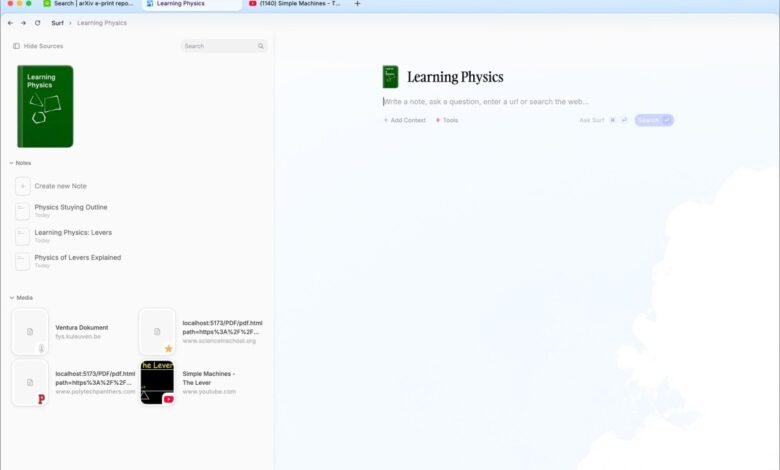
The AI application space is rapidly evolving with hybrid tools that combine distinct functionalities into single platforms. A new entrant, Deta Surf, exemplifies this trend by integrating an AI-powered web browser with advanced research and knowledge management capabilities reminiscent of Google’s NotebookLM. Developed by the Berlin and New York startup Deta, this beta application serves as both a standard browser and a dynamic research environment where users can compile topic-specific notebooks.
Within Surf, you can prompt the AI to generate concise overviews on subjects of interest. The system produces summary reports formatted in a clean, Notion-like document that remains fully editable. Because it functions as a core browser, you have the freedom to navigate to any URL. While exploring the web, the tool can distill essential information from articles, PDF documents, and even YouTube video content.
A particularly useful feature allows you to reference multiple open browser tabs when conversing with the built-in AI chatbot. By using these tabs as contextual background, you can ask detailed, multi-faceted questions. The platform also generates functional code, enabling the creation of mini applications, interactive charts, and custom graphs directly within your notebooks. Any output produced by the AI can be seamlessly added to a dedicated notebook for future reference.
This approach is not entirely unique; other contemporary AI browsers such as Perplexity’s Comet, The Browser Company’s Dia, and Opera Neon also let users employ tabs as context. Some competing tools similarly offer limited code generation.
Deta, established in 2019, initially aimed to construct a novel operating system based on an infinite digital canvas. The company discontinued that project in 2023 to pivot toward developing an AI browser. Co-founder Max Eusterbrock explained that the team experimented with various browser interfaces before concluding their initial direction was flawed.
He noted, “We spent a year in Alpha testing. Throughout that period, it became clear that AI browsers are evolving into tools primarily for machines to interact with human-centric hypertext, which wasn’t our intended goal.” Eusterbrock further emphasized that an interface lacking editing capabilities presents a poor design for effective human-computer collaboration.
Although Surf operates much like a conventional web browser, the startup identifies NotebookLM as its main competitor. Eusterbrock argues that Surf’s combination of tab-based context and local data storage, allowing for offline notebook work, makes it especially valuable for students and academic researchers.
Deta is currently offering the tool free of charge and is actively developing an integrated image generation function. Future plans may include a premium subscription tier, which would provide access to cloud backup services, collaborative features, and synchronized multi-device support.
In 2023, the company secured $3.6 million in a seed funding round led by Crane Venture Partners. Other participants included System.One, Tomahawk.VC, Tiny.VC, Acequia Capital, Angel Invest, and NPHard. An additional $500,000 has since been raised from a mix of previous and new investors.
(Source: TechCrunch)