Tech Giants Unite on Open Source Database to Cut Costs and Lock-In
▼ Summary
– Document databases are important for AI applications, handling semi-structured data like chats and context, with no open-source standard until now.
– Microsoft developed DocumentDB as an open-source document database and moved it to the Linux Foundation in 2025, gaining support from AWS and Google for vendor neutrality.
– DocumentDB is built on PostgreSQL, offering enterprise benefits like ACID compliance, a mature ecosystem, and compatibility with MongoDB drivers.
– It provides a vendor-neutral alternative to proprietary options like MongoDB, helping enterprises avoid vendor lock-in and reduce costs.
– The database includes AI capabilities, such as vector indexing algorithms, making it competitive for data-intensive AI workloads.
In the rapidly evolving world of artificial intelligence, document databases have become essential infrastructure for powering next-generation applications. These databases, which store data in flexible JSON-like formats rather than rigid tables, are particularly well-suited for handling the semi-structured information that fuels AI systems. A significant development is now underway as major cloud providers unite behind an open source initiative aimed at reducing costs and eliminating vendor lock-in.
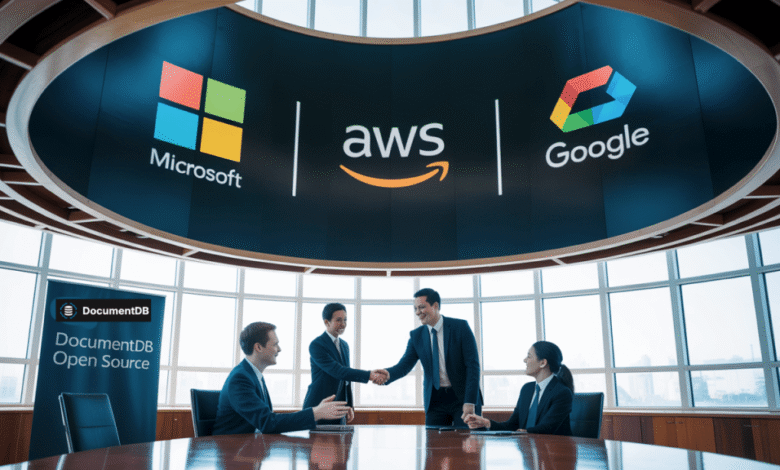
Microsoft originally developed DocumentDB and released it as open source earlier this year. The project has now transitioned to the Linux Foundation, gaining support from industry heavyweights including AWS and Google. This collaboration marks the first vendor-neutral open source alternative to proprietary solutions like MongoDB, offering enterprises both financial savings and greater flexibility.
According to Kirill Gavrylyuk, a vice president at Microsoft and the chief architect behind DocumentDB, the lack of an open standard for document databases has been a notable gap in the market. He emphasized that AI applications rely heavily on semi-structured data, making document databases a natural fit. By placing the project under the Linux Foundation’s governance, the initiative aims to foster broader community involvement and ensure long-term sustainability.
Rather than building an entirely new system from scratch, DocumentDB is engineered as an extension of the widely trusted PostgreSQL database. This approach allows organizations to leverage PostgreSQL’s mature ecosystem, including tools for monitoring, backup, and compliance with ACID standards. The integration also brings native support for BSON data types and document-style queries, combining familiarity with innovation.
A key feature is the built-in gateway that ensures compatibility with MongoDB drivers across programming languages. While full parity with MongoDB’s feature set is still a work in progress, the project’s charter explicitly prioritizes driver compatibility. This effort is expected to benefit the entire ecosystem, including MongoDB itself, by encouraging healthy competition and innovation.
It’s important to distinguish this initiative from Amazon’s existing DocumentDB service, which uses a different underlying engine. AWS has clarified that it will continue investing in both its proprietary offering and the open source project, contributing innovations and adopting features between them over time.
The timing of this collaboration is no accident. Enterprises are increasingly turning to document databases to support AI workloads such as chatbots, contextual understanding, and memory management. DocumentDB incorporates advanced vector indexing and semantic search capabilities developed by Microsoft Research, providing immediate advantages for AI applications without the licensing overhead of proprietary alternatives.
For data teams, this development represents a strategic opportunity to reduce dependency on single vendors. Organizations can begin testing DocumentDB in development environments to assess migration requirements, or architect new AI applications from the ground up using this open standard. The combination of PostgreSQL’s reliability and open source flexibility offers a compelling path forward for enterprises aiming to balance innovation with operational stability.
This movement toward open, vendor-neutral solutions empowers businesses to adopt cutting-edge database technologies without the traditional constraints of vendor lock-in. As AI continues to reshape the technological landscape, initiatives like DocumentDB provide the foundation for scalable, cost-effective, and future-proof data management.
(Source: VentureBeat)