Optical Metamaterials: A Boost for AI Data Centers
▼ Summary
– The science of optical metamaterials, originally developed for theoretical invisibility cloaks, is now being applied by startups to improve data center and AI hardware.
– These metamaterials manipulate light at a sub-wavelength scale, enabling new functions like programmable beam steering for optical switches without moving parts.
– Startup Lumotive has created a microchip using metamaterials and liquid crystals to reliably perform multiple optical switching functions, targeting data center deployment by late 2026.
– Another startup, Neurophos, uses metamaterials to build extremely small optical modulators for AI, claiming vastly greater compute density and energy efficiency than current electronic processors like Nvidia’s GPUs.
– Both companies aim to overcome the limitations of current optical and electronic systems, with their technologies undergoing evaluation and targeting commercial availability in the 2026-2028 timeframe.
The science of bending light, once a futuristic concept for cloaking devices, is now finding a powerful and practical application in the heart of modern technology: artificial intelligence data centers. Two pioneering startups are leveraging the principles of optical metamaterials to tackle the critical bottlenecks of bandwidth and energy consumption that threaten to slow the rapid advance of AI. By manipulating light at a microscopic scale, they aim to revolutionize how data is switched and processed, offering a path to more efficient and powerful computing infrastructure.
Roughly two decades ago, researchers created the first structures that could curve light around objects, making them effectively invisible. These were built from optical metamaterials, which are engineered with features smaller than the wavelengths of light they control. This allows them to bend and direct light in ways natural materials cannot. While the idea of an invisibility cloak captured the public imagination, its commercial viability was limited. “There’s no market for them,” notes Patrick Bowen, cofounder and CEO of the photonic computing company Neurophos. A significant hurdle was that early cloaks typically worked for only a single color of light, not the full spectrum needed for practical stealth.
Today, the focus has shifted from science fiction to solving pressing industrial challenges. Companies are now applying metamaterial science to enhance the optical switches that connect servers in massive data centers supporting AI and cloud services. As data demands explode, these facilities are moving toward optical circuit switches to overcome the bandwidth limits and high power draw of traditional electronic networks, which waste energy converting data repeatedly between light and electrical signals.
Current optical switching technologies, however, come with their own set of problems. Sam Heidari, CEO of the optical metasurface startup Lumotive, points out that silicon photonics-based switches struggle with energy efficiency, while those using microelectromechanical systems (MEMS) can suffer from reliability issues due to their moving parts.
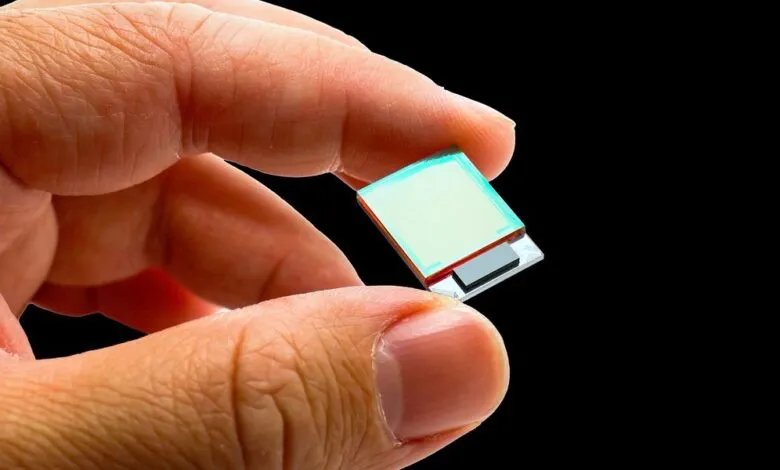
Lumotive’s solution is a new class of programmable metamaterials. The company recently unveiled a microchip covered in tiny copper structures fabricated with standard semiconductor manufacturing techniques. Between these copper features are liquid crystal elements. By electrically programming these liquid crystals, much like in an LCD screen, the chip can dynamically alter its optical properties in real time. This allows the device to precisely steer, focus, shape, and split beams of light reflected from its surface, performing the functions of multiple optical components without any physical movement. “Having no moving parts significantly improves reliability,” Heidari emphasizes.
Developing a commercially viable product required extensive research and development at semiconductor foundries. “We had to go through a lot of R&D… to not only make our devices functional, but also commercially viable in terms of the right cost and right reliability,” Heidari explains. The company asserts its chips can handle the industry standard of 256 by 256 ports and have a roadmap to scale up to an unprecedented 10,000 by 10,000. “We think this is game-changing for data centers,” Heidari states. Lumotive plans to launch its first optical switches by the end of 2026.
In a parallel development, Neurophos is targeting the computational core of AI itself. Running complex AI models on conventional electronic hardware is notoriously energy-intensive, prompting a search for alternatives. Optical computing, which processes data using light instead of electrons, promises dramatically lower power consumption. A major obstacle has been size; optical processors are typically too large to match the computing density of today’s best electronic chips.
Neurophos claims its metamaterial approach solves this problem. The company uses the technology to build optical modulators, the fundamental light-based equivalent of a transistor. These components are a staggering 1/10,000th the size of current designs and are manufactured using standard CMOS processes, with no exotic materials. “It’s entirely CMOS,” Bowen confirms.
In their system, a laser beam encoded with data shines onto a Neurophos chip. Each configurable metamaterial element on the chip modifies the reflected beam to perform complex mathematical calculations for AI workloads. “We basically fit a 1,000- by-1,000 array of optical modulators on a tiny 5-by-5-millimeter area on a chip,” Bowen says. He contrasts this with conventional silicon photonics, noting that achieving the same density would require a chip roughly a square meter in size.
Bowen makes a bold claim about the performance potential: the Neurophos microchip could deliver 50 times greater compute density and 50 times greater energy efficiency compared to Nvidia’s current Blackwell-generation GPUs. The company reports that major hyperscale cloud providers will evaluate two proof-of-concept chips later this year. Neurophos is targeting its first systems for early 2028, with production scaling up by the middle of that year.
(Source: Ieee.org)