Google Maps Adds AI-Powered Conversational Search
▼ Summary
– Google Maps is launching Ask Maps, a conversational AI feature that lets users ask complex location-based questions and receive personalized suggestions on a map.
– Ask Maps is now rolling out in the U.S. and India on mobile devices, generating answers by analyzing Google’s vast database of places and user reviews.
– The feature personalizes results using your Maps activity and allows you to take actions like booking reservations or starting navigation directly from the suggestions.
– Google has not announced ads for Ask Maps, leaving unanswered whether businesses could eventually pay to influence their appearance in the AI recommendations.
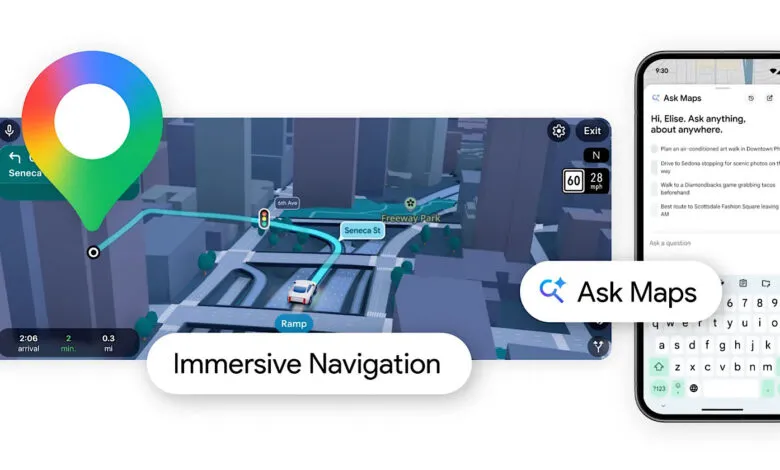
– Alongside Ask Maps, Google is launching Immersive Navigation, which adds a 3D view and features like natural voice guidance and parking recommendations.
Google Maps is introducing a new way to search for places with a feature called Ask Maps. This tool uses conversational AI, powered by Gemini, to answer complex, real-world questions directly within the app. Instead of just showing a list of results, it provides personalized suggestions plotted on a visual map, transforming how users discover local businesses and plan their activities.
The feature is now becoming available to users in the United States and India on both Android and iOS devices. A desktop version is expected to follow in the near future. With Ask Maps, you can type questions in plain language, such as “Where’s a good spot to work on my laptop with strong Wi-Fi?” or “Find me a family-friendly Italian restaurant open late.” The system then generates a tailored answer by drawing from Google’s massive database, which includes information on over 300 million places and reviews from more than 500 million contributors.
Instead of presenting traditional blue links or simple map pins, Ask Maps synthesizes review content and business details into a single, coherent answer accompanied by a customized map. This approach aims to solve more nuanced problems that a standard map search couldn’t address previously. As Miriam Daniel, VP and GM of Google Maps, noted, this new experience is designed to answer the complex, real-world questions a map could never answer before.
Results are personalized based on signals from your own Google Maps activity, like past searches and saved places. For instance, if you ask for lunch ideas, it might already factor in your preference for vegetarian cuisine. Once you receive a recommendation, you can take immediate action directly from the results. You can book a table, save the location to a list, share it with friends, or begin navigation with just a few taps.
A significant unanswered question revolves around monetization. Google has not announced any advertising within the Ask Maps feature, and company executives have declined to comment on whether businesses might eventually pay to improve their visibility in these AI-generated recommendations. Google already runs various ad formats in Maps, including promoted pins and search ads. How or if paid placements are integrated into Ask Maps in the future could substantially influence which local businesses get recommended to users.
Alongside this conversational search, Google is also launching an update called Immersive Navigation. This enhancement provides a detailed 3D view during turn-by-turn guidance, displaying nearby buildings and landscape features. Other improvements include more natural voice directions and the ability to compare alternate routes by showing trade-offs like toll costs versus potential traffic delays. New arrival features offer Street View previews of your destination, parking suggestions, and highlights showing building entrances.
Immersive Navigation is starting its rollout in the U.S. on iOS and Android. Support for in-car systems like CarPlay, Android Auto, and vehicles with Google built-in will expand over the next several months.
This launch is part of a broader pattern of deeper Gemini AI integration across Google’s services. The technology first arrived in Maps for driving navigation last November, offering hands-free conversational assistance and landmark-based guidance, before expanding to walking and cycling directions in January. Ask Marks represents a significant evolution, moving Gemini’s role from pure navigation aid into the realms of local discovery and comprehensive trip planning.
For business owners, a key consideration is the algorithm behind the recommendations. While Google states the feature uses its places database and community reviews, the specific signals used to rank and select which businesses appear in a response have not been detailed. The advertising question remains equally critical. The absence of announced ads does not preclude their future introduction, and how Google chooses to monetize Ask Maps over time could dramatically alter the competitive landscape for local visibility.
Looking forward, users in the U.S. and India can expect to see Ask Maps on their mobile devices soon, with desktop access on the way. Immersive Navigation begins its U.S. rollout now, with broader availability across compatible mobile devices and car platforms planned for the coming months.
(Source: Search Engine Journal)