This Digital Frame Brings Holograms to Your Home
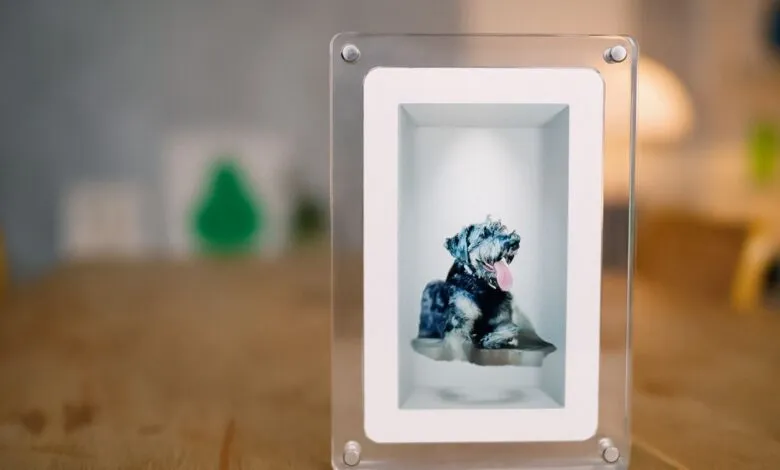
▼ Summary
– Holograms are common in science fiction but have been difficult to realize in real life, despite ongoing efforts by tech companies.
– The company Looking Glass has launched the Musubi, a consumer-focused digital picture frame designed to display 3D holographic images.
– The device uses AI to extract the main subject from a photo or video and displays it as a viewable 3D hologram within the frame.
– Unlike some other hologram-adjacent products, the Musubi is a simple frame requiring no Wi-Fi, app, subscription, or onboard cameras for operation.
– Users process images on a computer with included software and transfer them via USB-C, with the device storing up to 1,000 images and running on battery or wall power.
The dream of interactive holograms, long a staple of futuristic cinema, is taking a tangible step into everyday life with a new consumer device. Looking Glass, a company with years of experience in holographic displays, has unveiled the Musubi, a digital picture frame designed to transform ordinary photos and videos into three-dimensional holographic images. This device aims to make the science fiction vision of floating 3D pictures a practical reality for the home, moving beyond complex prototypes to a simple, user-friendly product.
At its core, the Musubi is a seven-inch frame that operates with remarkable simplicity. Users upload a standard photo or video to a free desktop application on a PC or Mac. Artificial intelligence within the software then analyzes the media, isolating the primary subject and converting it into a format that appears to hover in three-dimensional space inside the frame. The resulting hologram can be viewed from nearly every angle across a wide field of view, bringing a sense of depth and life to memories like a child’s first steps or a family celebration.
This approach stands in stark contrast to other recent entries in the spatial computing arena. For instance, gaming peripheral maker Razer recently detailed its Ava AI project, an interactive chatbot character rendered inside a 3D tube for your desk. That device is marketed as a companion for gaming and task management, representing a move toward interactive AI personas. The Musubi, however, is firmly focused on passive visual display, prioritizing accessibility and ease of use over interactivity.
A key part of its consumer-friendly design is its independence from constant connectivity. The Musubi requires no Wi-Fi, no smartphone app, no integrated cameras, and no ongoing subscription fees. All processing is handled on the user’s computer before the final holographic file is transferred to the frame via a USB-C cable. The device itself can store approximately a thousand images, though video clips are limited to thirty seconds each. It can be powered continuously by a wall outlet or run on its internal rechargeable battery for up to three hours, offering flexibility in where it’s placed.
The company’s ambition is to democratize a technology that has felt out of reach. By packaging advanced holographic display into a familiar form factor, the digital picture frame, Looking Glass hopes to bridge the gap between cinematic fantasy and living room reality, making 3D imagery an accessible part of how people preserve and view their personal memories.
(Source: Wired)