BMW Deploys Humanoid Robots in German Factories
▼ Summary
– BMW has deployed the AEON humanoid robot, built by Hexagon Robotics, at its Leipzig plant, marking the first such robot used in production in Germany.
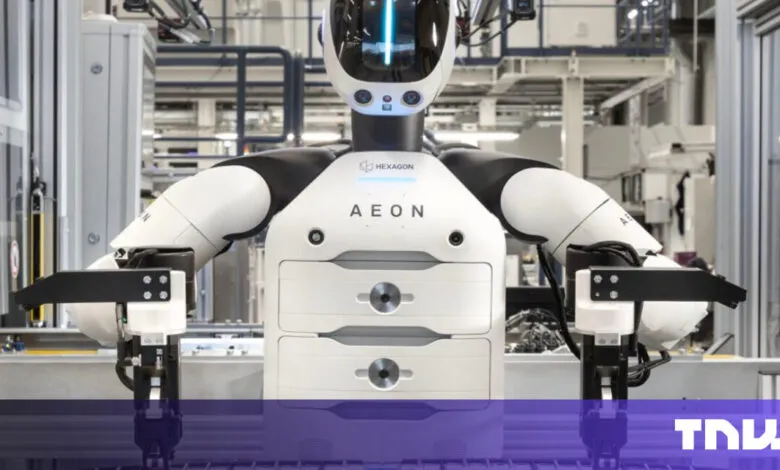
– The AEON robot features wheels for legs for mobility, a human-like torso for interchangeable tools, and advanced sensors for 360-degree awareness, initially supporting battery assembly.
– This pilot follows BMW’s successful 11-month US trial with Figure AI’s robots at its Spartanburg plant, which demonstrated significant operational scale and practical lessons.
– The initiative is led by incoming CEO Milan Nedeljković and is part of BMW’s broader ‘physical AI’ and digital production strategy to enhance competitiveness.
– BMW positions these robots as complements to human workers, taking on repetitive or demanding tasks to free employees for higher-value roles like quality control.
A new era of manufacturing is taking shape at BMW’s Leipzig plant, where a pioneering humanoid robot named AEON has begun its operational pilot. This initiative marks the first deployment of a humanoid robot in a German production facility, representing a significant step in the automaker’s broader strategy to integrate artificial intelligence with physical robotics on the factory floor. The 1.65-meter-tall, 60-kilogram robot, developed by Hexagon Robotics, is designed to support complex assembly tasks, signaling a major shift in how automotive manufacturing leverages advanced automation.
The arrival of AEON coincides with a leadership transition at BMW. The executive championing this robotics initiative, Milan Nedeljković, is poised to become the company’s new CEO in May 2026. His promotion underscores the strategic importance of this technology, with the Leipzig pilot serving as a final major project under his current role as Board Member for Production and a clear indicator of his future priorities.
Unlike traditional humanoids, AEON features a unique design where its legs end in wheels, enabling it to move swiftly at speeds up to 2.5 meters per second on flat surfaces while retaining the ability to step over obstacles. Its human-like torso is engineered for versatility, accepting various gripping tools and scanning devices without structural changes. This multifunctional capability allows it to perform a wider range of tasks compared to fixed-arm industrial robots. Equipped with 22 integrated sensors for full spatial awareness and powered by NVIDIA’s computing platforms, AEON was trained largely through simulation, a process that accelerated its development timeline dramatically.
At the Leipzig facility, AEON’s initial responsibilities focus on high-voltage battery assembly and component production, areas defined by repetitive, precise, and physically demanding work. Following theoretical assessments and lab tests, its operational debut occurred in December 2025, with further testing planned for April ahead of a full pilot integration this summer. Company executives emphasize that such pilots are crucial for evolving the use of adaptive, AI-enabled robots in real industrial environments, aligning with BMW’s goal of being a technology leader.
Hexagon Robotics, a division of the Swedish measurement technology giant Hexagon, represents an unconventional entrant into the humanoid robotics field. The AEON project was developed in collaboration with technology partners including NVIDIA, Microsoft, and actuator specialist Maxon. Hexagon’s leadership stresses an explicitly industrial design philosophy, focused on utility over spectacle. The Leipzig pilot is the robot’s first automotive deployment globally, building on a longstanding partnership between BMW and Hexagon in sensor technologies and software.
This European pilot follows a successful precedent set in the United States. At BMW’s Spartanburg plant in South Carolina, an 11-month deployment with Figure AI’s humanoid robots concluded in late 2025. The Figure 02 robot handled the removal and positioning of sheet metal parts for welding, moving over 90,000 components and contributing to the production of more than 30,000 vehicles. The project provided invaluable practical lessons, leading to revised safety protocols and improved connectivity, which are now informing next-generation systems. Both the Spartanburg and Leipzig programs reflect BMW’s strategic conviction that humanoid robots are nearing a threshold of genuine industrial usefulness.
These efforts are core to BMW’s iFACTORY production vision, which is built on the pillars of being lean, green, and digital. The digital transformation involves creating a unified data model across production systems, breaking down old silos to create a shared platform for AI agents, digital twins, and autonomous systems. Humanoid robots like AEON act as the physical layer of this increasingly virtual and connected ecosystem. To support this shift, BMW has established a dedicated Centre of Competence for Physical AI in Production, tasked with evaluating technology and guiding pilot projects from concept to global rollout.
The company is careful to position these robots as collaborators rather than replacements for human workers. The intent is to automate repetitive, ergonomically challenging, or safety-critical tasks, thereby freeing employees to focus on higher-value responsibilities like quality control, process management, and technological integration. This approach aims to create a symbiosis between human expertise and artificial intelligence, opening new avenues for innovation and competitiveness in modern manufacturing.
(Source: The Next Web)