Social Discovery’s Impact on AI Beauty Search
▼ Summary
– AI search visibility for brands is largely determined by social media discussions and validation that occur before a user ever enters a prompt.
– Social platforms like TikTok, YouTube, and Reddit are now primary search and discovery tools, forming the upstream signals that AI models reflect in their answers.
– While growing, AI search currently drives far less referral traffic and transactions compared to the massive, habitual scale of social platform and traditional search behavior.
– AI systems prioritize third-party, authentic content and expert validation (like “dermatologist recommended”) over brand-owned marketing, making social sentiment crucial for visibility.
– Brands can effectively compete by creating authentic, often low-budget video content and by integrating SEO and social strategies, rather than waiting to optimize for AI search alone.
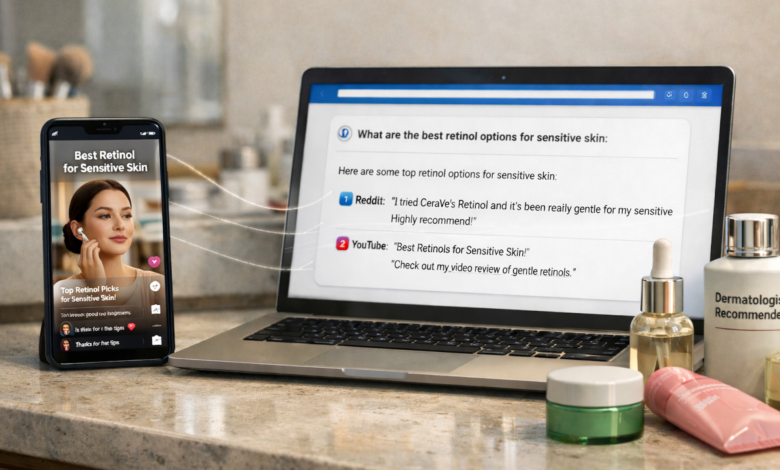
In the beauty industry, a brand’s visibility within AI search results is often determined long before a user types a query. The groundwork for appearing in generative answers is laid through ongoing social conversations, user validation, and reinforcement across digital platforms. When consumers finally turn to an AI tool, their perceptions and preferences are frequently already shaped by the signals gathered from social discovery. This dynamic makes understanding the interplay between social media and artificial intelligence not just interesting, but essential for modern marketing strategy.
The journey of discovering a new brand or product has fragmented. While AI tools are powerful for mid-funnel research and consideration, the initial spark of discovery overwhelmingly happens elsewhere. By the time someone uses a generative search, the key signals that influence AI visibility have already been formed upstream. If a brand focuses its efforts solely on optimizing for AI search interfaces, it may have missed the critical window to shape consumer consideration. This upstream influence is now dominantly social. Research indicates that roughly two-thirds of U.S. consumers regularly use social platforms as search engines, a behavior that spans generations and reflects a fundamental shift in how people find and validate information. It’s no surprise, then, that these same social platforms consistently rank among the top sources cited in AI-generated responses.
A recent study within the beauty category found that Reddit, YouTube, and Facebook were among the most frequently cited domains in both AI Overviews and ChatGPT outputs. While Reddit is often seen as an organic, community-driven space, YouTube’s strong showing highlights it as a potent yet underutilized channel for brands seeking to improve their citation footprint in AI results. This underscores a broader principle: social content and user-generated material are becoming the foundational trust engines that power all forms of search.
It’s tempting to focus on the explosive growth metrics of AI, but volume tells only part of the story. When measured against concrete business outcomes like website traffic and sales, the current scale of social and traditional search remains vastly larger. Social platforms are deeply embedded in daily search behavior; for instance, nearly 40% of TikTok users search the platform multiple times daily. Referral data paints a similar picture. One analysis of nearly a thousand ecommerce sites found that ChatGPT accounted for only about 0.2% of total sessions over a year, while Google’s organic search traffic was approximately two hundred times greater. AI search is undoubtedly important and growing, but for repeat engagement and measurable transactions, social and traditional search engines still operate at a different magnitude.
A crucial insight for forward-looking strategy is that optimizing for social media is simultaneously an investment in AI search visibility. Large language models are not primary sources of information; they are sophisticated mirrors that reflect the consensus and conversations found in their training data. These AI systems exhibit a clear preference for third-party validation, often viewing brand-owned websites with skepticism. Studies show that a significant portion of citations in AI answers come from platforms like Reddit, which can outpace traditional publishers. Furthermore, a positive correlation exists between favorable brand sentiment on social media and increased visibility in AI search results, creating a powerful validation loop.
Video content and expert authority are particularly influential in shaping AI visibility, especially in visually-driven categories like beauty. Treating platforms like YouTube and TikTok merely as brand channels, rather than as critical search surfaces, is a missed opportunity. AI crawlers analyze spoken language, on-screen text, and captions to assess content relevance and trustworthiness. For “how-to” queries, consumers often prefer the detailed, personalized guidance found in social video over a standard search result. The beauty market illustrates a divide: science-backed brands like Paula’s Choice, which produce deep educational content, dominate AI results. In contrast, traditional marketing-led brands are less visible. Phrases like “dermatologist recommended” carry significant weight because AI models treat such expert social proof as a key ranking signal.
A common barrier for brands is the perceived cost and complexity of video production. However, the current digital landscape rewards authenticity over high-gloss polish. Consumers seek relatable people with genuine concerns, not perfectly filtered advertisements. Optimizing for video discovery does not require a Hollywood budget. Effective strategies include partnering with creator platforms for affordable, targeted content and leveraging internal team members who are naturally adept on social media. A focused strategy is more important than a large existing following; there are documented cases of new TikTok profiles achieving hundreds of thousands of views within months by concentrating on meaningful, transaction-oriented content rather than chasing viral trends.
The emerging playbook is clear: a brand cannot succeed in generative AI search if it is absent from the social conversation. AI models reflect the consensus of the web; if real users aren’t discussing a product on Reddit, YouTube, or TikTok, the AI has little material to surface. To translate this understanding into action, brands must break down internal silos between SEO and social teams, prioritizing how social sentiment and expert validation drive market share. Embracing agile, authentic content creation—whether through modest creator partnerships or internal talent—is key. We are moving from an era of purely algorithm-driven discovery to one powered by community-driven validation, a shift that requires multidisciplinary agility but offers a tangible impact on business performance.
(Source: Search Engine Land)