OpenAI’s GPT-5.3-Codex: Beyond Just Writing Code
▼ Summary
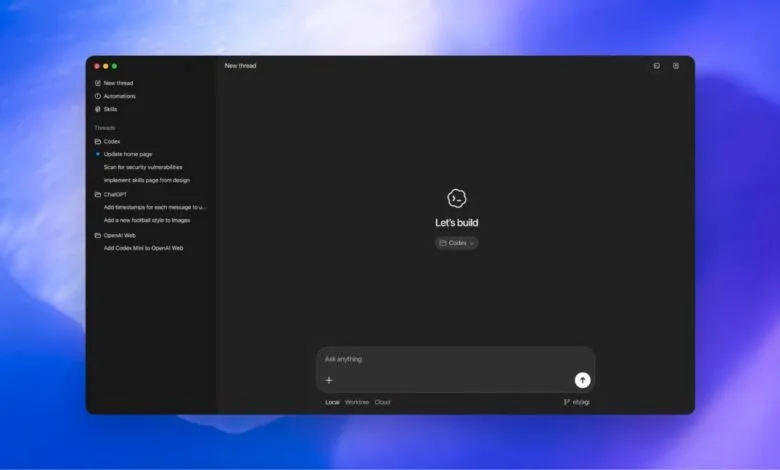
– OpenAI has released GPT-5.3-Codex, a new coding model accessible via command line, IDE, web, and a macOS desktop app, with API access planned for the future.
– The company states the new model outperforms its predecessors, GPT-5.2-Codex and GPT-5.2, on several coding and terminal benchmarks.
– OpenAI clarifies that claims the model “built itself” are an overstatement, noting its development role was similar to tools used at other firms for deployment and debugging.
– Instead, OpenAI describes GPT-5.3-Codex as having been “instrumental in creating itself,” a concept detailed further in its official blog post.
– The update positions Codex as a comprehensive tool for the entire software lifecycle, from debugging to user research, with an emphasis on user steering and status updates.
OpenAI has unveiled GPT-5.3-Codex, a significant upgrade to its advanced coding model, now accessible through multiple platforms including a command line tool, IDE extensions, a web interface, and a new macOS desktop application. While API access is anticipated in the future, this release focuses on expanding direct user interaction. The company reports that GPT-5.3-Codex demonstrates superior performance compared to its predecessors, GPT-5.2-Codex and GPT-5.2, across key industry benchmarks like SWE-Bench Pro and Terminal-Bench 2.0.
Some initial reports have sensationalized the launch with claims that “Codex built itself,” but this characterization oversimplifies the reality. The actual applications OpenAI describes align with trends seen in other enterprise software development environments. These include practical tasks such as managing system deployments, debugging complex code, and processing test results and evaluations. There is no assertion from OpenAI that the model autonomously constructed its own architecture from scratch.
A more accurate description from the company states that GPT-5.3-Codex was “instrumental in creating itself.” This nuanced phrasing, elaborated in their official blog, suggests the model played a key supporting role in its own development and refinement process, likely through automated testing and optimization loops, rather than acting as an independent engineer.
This distinction is central to the updated model’s positioning. OpenAI is actively promoting Codex as a comprehensive assistant that extends far beyond simple code generation. The broader vision is to integrate it into the entire software development lifecycle. This encompasses a wide range of activities from the initial planning stages, like writing product requirement documents (PRDs) and editing copy, to mid-cycle tasks such as user research, and through to post-deployment phases including monitoring, metrics analysis, and maintenance.
A notable feature emphasized in this update is the model’s enhanced interactivity. Developers are encouraged to steer the model during ongoing tasks and receive frequent status updates, fostering a more collaborative and iterative workflow. The goal is to transform GPT-5.3-Codex from a code-completion tool into a versatile partner capable of handling debugging, deployment coordination, test management, and various ancillary project duties.
(Source: Ars Technica)