Master AI Video SEO: Boost Your Search Visibility
▼ Summary
– Video is a complex, information-dense asset that AI models can now “watch” by deconstructing it into visual, auditory, and textual data streams for accurate indexing.
– To optimize for AI, video content should be clear, high-quality, and specific, with deliberate pacing and visual elements that remain on-screen for at least one second to be properly sampled.
– High-quality, authoritative video provides crucial ground truth to prevent AI from making incorrect assumptions or “brand drift” by filling information gaps with competitor data.
– Optimization involves ensuring clear audio, high-resolution visuals with strong contrast and readable fonts, and consistent alignment between what is said and shown.
– Providing structured text like accurate transcripts and VideoObject schema metadata is essential for AI comprehension, speed, and accuracy, serving as a reliable foundation for models.
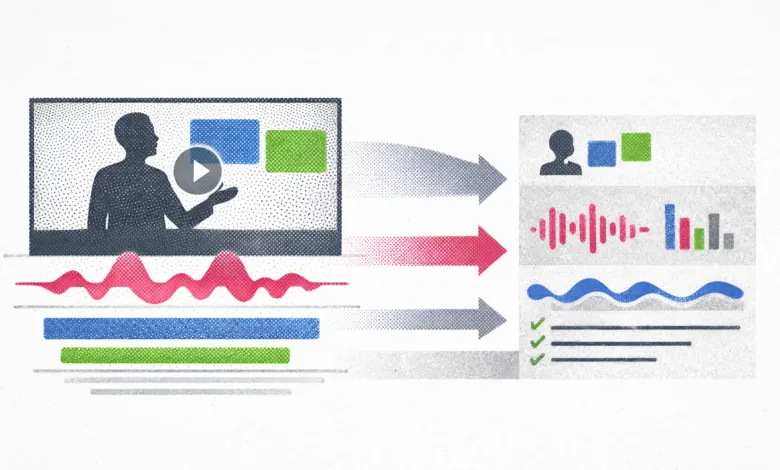
Video content represents one of the most information-rich marketing assets available today. For people, it conveys emotional depth and situational context far better than text alone. For artificial intelligence systems, it delivers a dense stream of data that enables more precise indexing and analysis. Search crawlers once struggled with video, but modern AI can now effectively “watch” it, deconstructing the content into separate visual, auditory, and textual data streams. Understanding how to optimize for this new reality is crucial for search visibility.
The importance of video for AI lies in its contextual density. Previously, search engines relied on surrounding text like titles, descriptions, and transcripts to grasp a video’s subject. In today’s AI-driven web, the video file itself serves as primary training data. When a multimodal model processes a video, it uses a method called discrete tokenization to translate the entire experience into a language it comprehends. This involves three simultaneous tasks: analyzing visual snapshots at regular intervals, interpreting audio for words, tone, and ambient sound, and connecting what is seen with what is heard. Videos that are specific and packed with clear, high-quality information, referred to as having strong content granularity, prove more impactful than longer, vaguer ones. AI can even interpret “silent” information such as on-screen text, product labels, and a presenter’s expressions. However, poor production quality can lead to errors; a blurry video or muffled audio might cause the AI to misinterpret content or favor a competitor’s clearer source.
A significant risk in this environment is brand drift. When an AI lacks specific facts about your business, it may fill informational gaps by looking at competitors, potentially attributing their features to you. High-quality, authoritative video acts as a corrective ground truth, providing the nuance, updated corrections, and trust signals that stop AI from guessing. Feeding accurate video transcripts and audio into Retrieval-Augmented Generation (RAG) systems further ensures AI narrates your brand story correctly.
Understanding how AI consumes video is key to optimization. Native multimodal models process text, images, and audio together in real time. Others use separate systems for each element. Regardless of the method, guiding the AI with structured text, like optimized titles, accurate closed captions, and verified transcripts, consistently improves performance. It’s important to note that sampling rates affect readability. Many AI models sample video at roughly one frame per second. Consequently, the rapid jump cuts popular on short-form platforms can cause AI to miss visual information. For technical content, a slower, more deliberate editing style, with pans, text overlays, and scene changes that linger for two to three seconds, ensures the AI captures clear, representative frames.
Optimizing the visual layers of your video is essential. While advanced models sample naturally, others depend on tools like object detection and optical character recognition (OCR). To aid this process, prioritize resolution and readability; crisp 1080p video typically offers the best balance for AI models. Use bold, simple fonts and high-contrast color combinations, like white text on a black background, to maximize OCR reliability. Incorporate clear visual anchors, such as an unobstructed software interface or a slowly rotating product, to help the AI build a spatial understanding. Consistent branding with specific colors and logo placement also aids in brand recognition.
The audio layer carries equal weight. AI analyzes speech patterns, tone, and cadence to determine emphasis and expertise. Employing “audio bolding”, using deliberate pauses before and after key points, helps the AI identify your most important information. Crucially, ensure your audio and visual elements are synchronized; conflicting signals, like mentioning one product while showing another, can lead the AI to disregard the information entirely.
Despite AI’s growing visual capabilities, text layers remain a critical safety net. A human-verified transcript acts as a Rosetta Stone, translating your video into the plain text format that large language models process most efficiently. Transcripts enhance speed, improve accuracy for technical terms, and ensure compatibility with AI systems that cannot yet parse video. For a comprehensive approach, implement VideoObject schema markup. This structured data standard communicates rich metadata to search engines. Key advanced properties include defining video chapters for “seek-to-action” functionality, providing a verified transcript for absolute accuracy, and using interaction statistics to signal content authority and engagement.
Investing in video optimization is a powerful strategy to secure your brand’s accuracy and authority in AI-mediated search. Expert-led video content provides the definitive ground truth that compels AI to be precise, preventing it from making assumptions based on your competitors. It stands as one of the most effective methods for demonstrating expertise to both human audiences and artificial intelligence, solidifying your position within search engine results.
(Source: Search Engine Land)