You’re Probably Using Your Hue Lights Wrong
▼ Summary
– Philips Hue’s new SpatialAware technology solves a common smart lighting problem by understanding a room’s layout and the physical placement of lights.
– The system creates a 3D map of the room using a smartphone’s AR capabilities within the Hue app to scan the space.
– It intelligently distributes colors and effects from remastered scenes based on each light’s location, such as mimicking a sunset with specific tones on opposite walls.
– The technology ensures lighting scenes are applied as intended by designers, resulting in more polished, integrated, and evenly distributed effects.
– SpatialAware is scheduled for release in Spring 2026 and will require compatible Hue lighting connected to the Hue Bridge Pro.
Many smart lighting enthusiasts enjoy the vibrant possibilities of color-changing bulbs, but achieving a truly cohesive look throughout a room can be surprisingly tricky. Standard pre-set scenes often fall flat because the lights themselves have no understanding of their physical placement. Philips Hue has introduced a clever solution to this common problem with its new SpatialAware technology. This system intelligently maps your room’s layout to distribute lighting effects in a way that feels intentional and polished.
The magic happens when you use your smartphone within the Hue app. By scanning your room, the app leverages augmented reality to build a detailed 3D model. This map records the precise location of every Hue bulb and fixture. Once stored, this spatial data allows the newly remastered lighting scenes to activate with remarkable intelligence. The system analyzes the scene’s design and strategically assigns colors and intensities based on each light’s position in the room.
Imagine selecting a “sunset” scene. With SpatialAware, the lamps on your western wall might glow with a warm, golden hue to mimic the dying light, while ceiling fixtures on the opposite side of the space could dim to a deeper, cooler tone. This creates a dynamic and realistic atmosphere that standard scenes cannot match. Philips Hue has already reconfigured approximately half of its existing scene library to be compatible, programming each one to adapt dynamically to the unique map of your home.
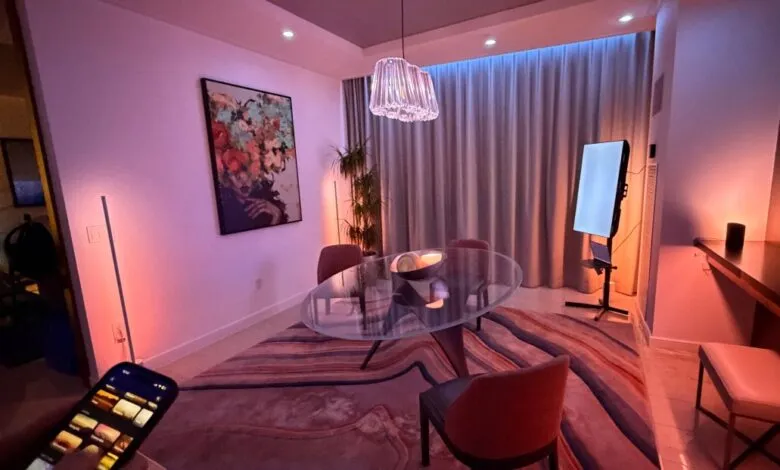
A recent demonstration in a hotel dining room, outfitted with various Hue ambient lights and recessed ceiling bulbs, highlighted the transformative difference. The comparison between an original scene and its SpatialAware-remastered version was striking. The updated lighting appeared far more integrated and professionally designed. “That’s because it’s actually being done the way the lighting designer intended,” explained George Yianni, CTO and founder of Philips Hue. The colors were distributed more evenly and logically.
For instance, in a “Savannah Sunset” scene, the original version had a mix of orange and soft white ceiling lights, resulting in a disjointed appearance. The remastered scene bathed all overhead lights in a consistent, soft orange glow. Similarly, in a “Nightlight” scene, the original kept ceiling lights on, while the intelligent version correctly turned them off, a subtle but significant improvement that aligns with the scene’s purpose of providing gentle, low-level illumination.
This innovative feature is scheduled for release in Spring 2026. It will require lights to be connected through the Hue Bridge Pro, ensuring the system has the necessary processing power to manage the spatial data and deliver seamless, room-aware lighting experiences that finally live up to their full potential.
(Source: The Verge)