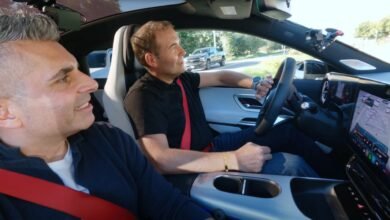
Hands-Free: Testing Mercedes’ New Driver Assist on the Road

▼ Summary
– Adaptive cruise control debuted in 1999 with the Mercedes-Benz S-Class, using radar to react to vehicles ahead and creating the first partially automated car.
– The technology has evolved to include lane-keeping and GPS geofencing, allowing vehicles to handle most highway driving when the driver is attentive.
– The current development goal is to extend this automation to lower-speed surface streets, not just highways, to further reduce the human driving burden.
– Mercedes’ latest system, Drive Assist Pro, is designed for this purpose and demonstrated credibly on San Francisco’s city streets.
– The new entry-level CLA EV, not the S-Class, is the first Mercedes to feature an improved version of this Drive Assist technology with better braking control.
The evolution of driver assistance technology has moved far beyond simple cruise control, with modern systems aiming to handle complex urban environments. Mercedes-Benz, a pioneer in this field since introducing radar-based adaptive cruise in 1999, is pushing these boundaries further with its latest Drive Assist Pro system. This technology is engineered to operate not just on highways but also on surface streets, significantly reducing the driver’s workload in varied conditions. A recent demonstration in downtown San Francisco showcased its capabilities, presenting a compelling vision for more relaxed urban commuting.
Traditionally, Mercedes reserves its most advanced features for flagship models like the S-Class. However, the company is taking a different approach with this new generation of assistance tech. The first vehicle to receive the upgraded Drive Assist Pro will be the upcoming production version of the new CLA, an entry-level electric vehicle. This sleek sedan, positioned below $50,000, is already equipped with the current Drive Assist suite, which offers refined control over braking and deceleration.
A notable improvement in the existing system, which enhances everyday usability, is how it interacts with driver input. When adaptive cruise control is active, you can now apply the brake without immediately canceling the entire system. This allows for smoother, more intuitive interventions when traffic suddenly slows, letting the driver momentarily assume control before seamlessly handing it back to the vehicle’s automation. This subtle refinement points to a more integrated and natural relationship between human and machine, a philosophy that underpins the more ambitious Drive Assist Pro. The goal is clear: to create a system that feels less like a set of discrete functions and more like a competent co-pilot, capable of navigating the stop-and-go unpredictability of city driving.
(Source: Ars Technica)