Runway launches AI model router amid crowded generative media market
▼ Summary
– Runway launched the Media Router via its Runway Dev platform, which automatically selects the best generative media model based on a developer’s priority for quality, speed, or cost.
– The Media Router is the first model router built specifically for generative media, aiming to be a one-stop shop for developers integrating media generation into their products.
– Developers can set preferences for model routing, such as prioritizing American providers over Chinese ones or controlling token pricing, which has become a key concern in 2026.
– The router’s intelligence layer is based on Runway’s in-house creative team’s expertise in evaluating media outputs, like motion handling in video or composition in images.
– Runway’s strategy shifts from focusing on leading AI video models to becoming an orchestration layer, as its models no longer top rankings and the best model continues to change.
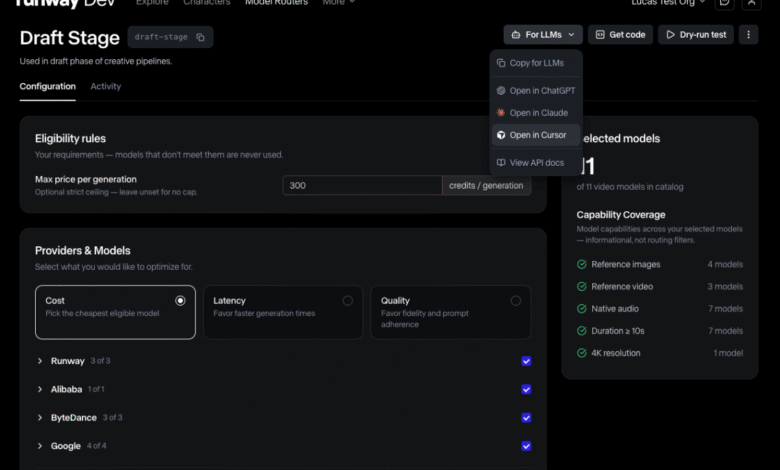
Runway is repositioning itself , no longer content to be just another player in the generative media space, the company is building the infrastructure that powers it all. On Thursday, the startup unveiled the Runway Media Router through its developer platform, Runway Dev, which launched earlier this month. This platform offers API access to a growing library of third-party image, video, and audio models, alongside Runway’s own proprietary technology.
The Media Router is an automated tool that selects the most suitable image, video, or audio generation model for a given request, based on whether a developer prioritizes quality, speed, or cost. While model routers have become standard in the large language model (LLM) space, Runway claims this is the first purpose-built for generative media. “The routing really fits into that overall promise of being the easiest one-stop shop for developers to integrate with any type of generative media model,” said Anthony Maggio, Runway’s chief product officer.
This launch, shared exclusively with TechCrunch, marks a significant evolution for Runway. What began as an AI video startup is now positioning itself as the infrastructure layer for companies building with generative media. Through Runway Dev, clients like Adobe, Cloudflare, ElevenLabs, Expedia, Shutterstock, and Quora can embed media generation directly into their own products via Runway’s API, rather than directing users to Runway’s standalone app or website.
The timing of the router’s release is critical. The generative media model landscape has exploded, making it increasingly difficult and time-consuming for developers to evaluate new releases. Runway Dev solves this by giving developers access to the latest models as soon as they hit the market. “Most developers are not spending the time to really understand the capabilities of each of these models and where they excel or differ based on various types of outputs across video, image, and audio,” Maggio explained. “The unique proposition we’re bringing to the table is all of that intelligence around what the best model is for each different use case, and meshing that with preference you apply around the context of your business.”
Maggio also noted a growing trend: Chinese generative media models are gaining popularity, but many businesses are wary of working with models originating from China. As the Trump administration explores bans and sanctions against Chinese open AI models, some developers may set preferences for American model providers. That is just one example of the customizable preferences available. Maggio says customers are primarily focused on routing based on token pricing and quality. Token pricing has become a hot-button issue in 2026, as enterprises that went all-in on agentic AI faced steep token bills. While model routing for token pricing is common in the LLM world, its application to generative media is a natural progression. The Media Router launch comes just weeks after Runway replaced its unlimited subscription plans with token-based pricing, a move that drew criticism from some users.
On the quality front, determining which model delivers the best output for a specific task is far more complex for generative media than for language models. That is where the router’s intelligence layer comes into play. It leverages Runway’s in-house creative team’s expertise in evaluating outputs across every media type , from how video models handle motion to how image models manage composition or how voice models handle lip syncing. Runway had already built much of this intelligence layer for its agent product, a conversational AI creative partner launched in May that transforms text prompts into fully edited multi-shot videos and marketing campaigns. The Runway Media Router, Maggio says, packages the same routing technology for external developers.
Runway’s strategy reflects the fragmented and hyper-competitive nature of the current generative media market. The startup’s last major AI video model release, Gen 4.5, debuted in December, topping leaderboards and outperforming models from incumbents like Google. That same month, Runway released its first world model. However, aside from an upgrade to its video editing model, Aleph 2.0, in May, Runway has not dropped a new dedicated frontier video model in months. (TechCrunch has asked when Gen-5 is expected.) While Aleph 2.0 remains a top video editing model according to Artificial Analysis, Runway’s text-to-video and image-to-video models no longer lead the rankings. The top 20 spots are now dominated by heavyweights like Google, China’s ByteDance, and Alibaba.
Rather than asking developers to bet on a single model staying ahead, the Media Router assumes the best model will continue to shift. This keeps Runway in the game, not necessarily as the best new AI model, but as the best orchestration layer. Anastasis Germanidis, Runway’s co-founder and co-CEO, acknowledged that the startup has long been known for “that end user piece,” but building that required a full stack , a developer platform, a creative tool suite, and an inference layer beneath it all. He says the company has seen rising demand from businesses for Runway to operate across every part of that stack.
“You need great models underneath, but the orchestration increasingly matters a lot because people are building entire campaigns with those models, or they’re building entire finished multi-scene generations out of those models,” Germanidis said. “It’s something that we increasingly had to build , that intelligence layer that comes on top of the pure pixel models. The router is one way in which the benefits of that come to users.” Or as Maggio put it more broadly: “If you zoom out at the one thing Runway has been doing since 2018, it’s that we’re deeply focused on research, while building for where we think the space is going at the same time.”
(Source: TechCrunch)
