SaaSpocalypse Over, Says Thoma Bravo
▼ Summary
– Thoma Bravo founder Orlando Bravo declared the “SaaSpocalypse” over, stating AI is now an “enormous tailwind” for software companies, with half of new portfolio revenue coming from AI.
– The panic began in February after Anthropic’s AI agent tools triggered a selloff, wiping $285bn off software stocks due to fears that AI agents would reduce human software subscriptions.
– Software stocks have rebounded, with the iShares Expanded Tech-Software ETF rallying 21% in May, but the recovery is uneven, favoring AI infrastructure firms over seat-based application software.
– Snowflake CEO Sridhar Ramaswamy refused to declare the crisis over, citing risks from rival improvements and the high cost of running AI agents, which has already exceeded budgets at Uber and Microsoft.
– The deeper market shift is a repricing away from software premiums toward usage, proprietary data, and genuine AI leverage, with both Bravo’s optimism and Ramaswamy’s caution potentially valid.
Four months ago, artificial intelligence appeared poised to dismantle the software industry. This week, one of its largest backers declared the crisis over. The reality, however, lies somewhere between panic and relief.
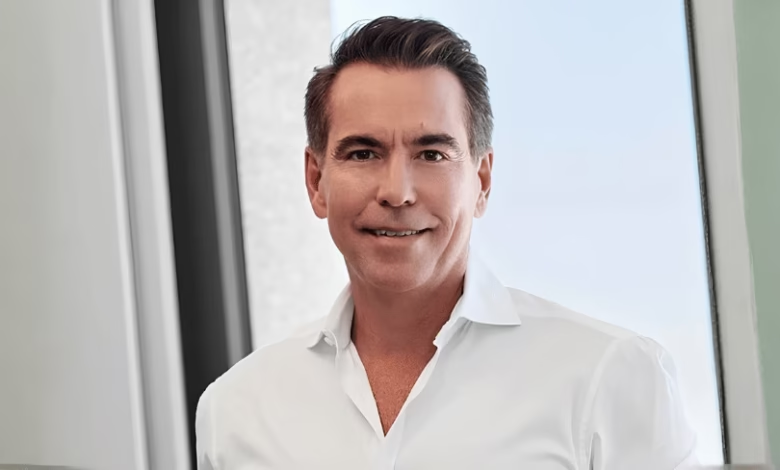
Orlando Bravo, founder of Thoma Bravo , a top software-focused private equity firm managing nearly $200 billion , told CNBC at the SuperReturn International conference in Berlin that the industry’s fear has subsided. “The SaaSpocalypse is over. It’s finished, no more,” he stated, describing AI as “an enormous tailwind for software companies.” Roughly half of the new revenue across his portfolio now comes from “AI revenue, agentic revenue,” and he anticipates software and AI will merge into “a new agentic solution” for enterprise clients.
The term Bravo sought to bury emerged in February, when Anthropic’s Claude Cowork agent tools triggered a sharp selloff. Investors grew alarmed that AI agents could slash the number of human “seats” on which subscription software pricing depends, wiping out roughly $285 billion from software, financial, and asset-management stocks in just 48 hours. Per-seat software valuations plummeted as AI-native spending surged. Salesforce fell about 30 percent on the year, while SAP lost roughly a third of its market value.
Bravo’s confidence is backed by a rebound. The iShares Expanded Tech-Software ETF surged 21 percent in May , its best month since October 2001 , and software has transformed from a market pariah into a leader, with stocks left for dead in March staging a sharp recovery.
But “over” is too tidy a label for what is unfolding. The recovery is a bifurcation, not a rising tide. Companies owning the picks-and-shovels of AI infrastructure and consumption-priced businesses have soared: DigitalOcean is up over 220 percent this year, Datadog about 76 percent, and CrowdStrike more than 50 percent. In contrast, seat-based application software remains stuck in a hole. HubSpot is down roughly 46 percent on the year despite revenue growth above 20 percent, and Monday.com has fallen about 45 percent. The market now rewards AI-defensibility and penalizes anything an agent could plausibly replace, even when underlying fundamentals are solid.
Not everyone is ready to sound the all-clear. Snowflake CEO Sridhar Ramaswamy declined to declare the SaaSpocalypse over, arguing it is “better to be paranoid” in a market where a rival’s improvement can erase an overnight lead. His caution highlights the next challenge: the cost of running AI agents. Uber capped its engineers’ agentic-AI coding spend at $1,500 per month each after blowing through its 2026 budget. Even Microsoft reportedly scaled back Claude-powered agents once expenses exceeded what human staff cost. The economics that were supposed to doom software may yet bite the AI tools meant to replace it.
Bravo himself acknowledged unresolved questions around governance, cybersecurity, and returns on agentic tools. “It is a period of discovery now, which creates pressure on the whole system,” he said. And as one of the world’s largest software investors, he has every incentive to call a bottom.
So is the SaaSpocalypse over? The share-price panic clearly is. But the deeper repricing , moving away from software earning a premium simply for being software and toward usage, proprietary data, and genuine AI leverage , is only beginning. Many still argue the funeral was oversold from the start. Bravo calls the bottom; Ramaswamy calls for humility. On the evidence so far, both can be right at once.
(Source: The Next Web)