Google Discover publisher profiles: How they work and why they matter
▼ Summary
– Google’s Discover publisher profiles, introduced in September 2025, aggregate content from websites and social platforms, giving users more control over which publishers appear in their feeds.
– Most publishers cannot control their profile layout, but a limited beta group can edit features like banner images, pinned posts, and custom links.
– Profile photos and “About” descriptions typically come from the Knowledge Graph or a YouTube account, while total follower counts aggregate across social media, not Google Discover.
– There are two profile types: one for web publishers (generally eligible if they have a Knowledge Graph) and one for social media publishers (often requiring roughly 50,000 followers and primarily built around X accounts).
– Editable profiles are likely to remain limited to established publishers and creators, with Google expected to continue iterating on the layout and customization options.
Google Discover’s publisher profile feature has been live for over a year, yet it remains one of the platform’s most underdocumented and misunderstood offerings. While the initial rollout in late 2025 introduced publisher follows and dedicated profile pages, the full scope of how these profiles function is still coming into focus.
Now, these Discover publisher profiles are appearing more frequently for a wide range of entities, from traditional media outlets and niche publishers to social-first creators. Understanding how they work, how they connect to the Knowledge Graph and social platforms, and why some publishers are already being offered more customizable experiences is critical for anyone relying on Google for content distribution.
Why These Profiles Matter Right Now
As a technical SEO, I’ve learned to accept that Google’s documentation often leaves gaps. But with Discover publisher profiles, the silence is especially deafening. The official Discover documentation barely scratches the surface, despite these pages playing an increasingly central role in how content surfaces.
The timing of this feature’s growth is significant. As publishers grapple with shifting visibility in an AI-dominated search landscape, Discover profiles offer users a direct way to curate their feeds. They give audiences more control over which publishers appear while simultaneously aggregating content from websites and social media into a single, branded hub.
Because Google has shared so little, I’ve spent considerable time analyzing these profiles across different publisher types. Several clear patterns have emerged, particularly around how Google builds these pages, their connection to the Knowledge Graph, eligibility criteria, and the emerging beta for editable profiles.
What a Discover Publisher Profile Actually Looks Like
The September 2025 Discover update was a major shift. It introduced dedicated landing pages for publishers, gave users a more direct method to influence their feeds, and deepened the integration of social content.
For the most part, publishers have no control over the layout of their profile pages. However, in March, a select group of publishers began showing a more polished, premium layout with extra features. This has since been confirmed as a limited beta where publishers can edit and manage their profiles directly.
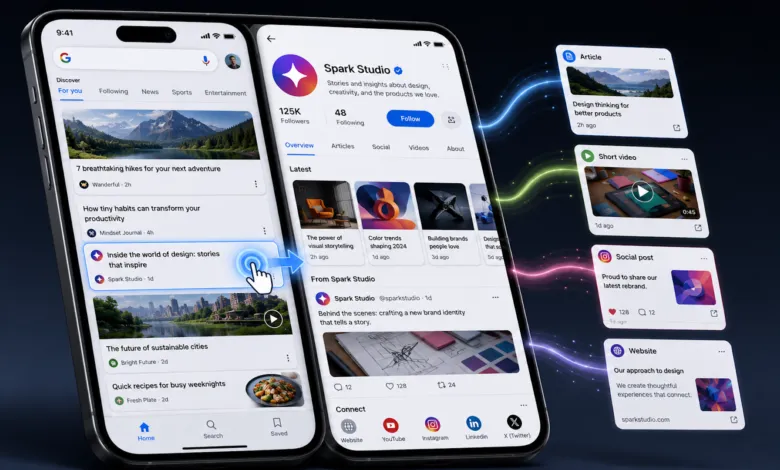
A standard Discover publisher profile typically includes:
- A profile photo, pulled first from the Knowledge Graph, then falling back to a linked YouTube account’s image.
- A total follower count, which aggregates followers across social media platforms (not Google Discover followers).
- Links to supported social profiles: YouTube, TikTok, Instagram, Facebook, X, and LinkedIn.
- An About section, usually sourced from Wikipedia or the Knowledge Graph.
- A feed of latest posts, combining articles and social media content.
What Editable Profiles Offer
Publishers in the beta group gain access to several customization options:
- A customized banner image at the top of the profile.
- The ability to pin posts (both articles and social content) to the top of the page.
- General links that can point to any page, not just articles or social posts. For example, Fox Weather uses this to link to an app and a livestream.
The Two Types of Publisher Profiles
Functionally, there are two distinct categories of publisher profiles in Discover.
Profiles for web publishers cover any brand that publishes on a website: legacy news, local outlets, trade publications, and even company blogs. If an organization has a Knowledge Graph entry and publishes regularly, it likely already has a profile. Because Google doesn’t provide a direct way to find these, tools like Damián Taubaso’s Profile Page Finder or 1492’s Vision can help locate yours. These profiles are generally more enriched, often including a logo, an About section, and social links.
The most common problem with web publisher profiles is missing social media links. To fix this, you should:
- Add the social account as a `sameAs` entry in your organization schema.
- Link to your homepage from the website section in your social media bios.
- Use the “Send feedback” option on your profile page to request the addition of specific social links.
Profiles for social media publishers are for brands or individuals who don’t primarily publish on a website. This includes journalists, notable figures, and accounts that publish only on social platforms. A rough rule of thumb for eligibility is around 50,000 followers on a safe-for-work account. These profiles are often less complete, as they lack a connection to a website and the Knowledge Graph. They are most commonly built around X accounts, which can result in a profile with no picture or description. Connecting the account to YouTube is the best way to get a profile photo added.
Where Discover Publisher Profiles Are Headed
Given the ongoing beta testing, it seems likely that Google will eventually announce editable profiles as a broader feature. However, the current templates are unlikely to remain static. The existing layouts aren’t particularly user-friendly, and Google will probably continue refining how these pages are structured and customized.
Access to editable profiles will likely remain somewhat restricted. While hundreds or even thousands of publishers may eventually gain entry, universal access seems improbable. For now, this capability appears destined to remain a perk for established publishers and well-known creators.
(Source: Search Engine Land)